
U.S. September PPI Far Exceeds Expectations: Renewed Inflation Pressure Triggers Repricing in Tech and Crypto Markets
The U.S. Producer Price Index (PPI) for September came in significantly above market expectations, indicating that corporate cost pressures have not subsided and that inflationary momentum is gradually spreading from energy into the services sector. For markets, this not only increases uncertainty around the Federal Reserve’s monetary policy outlook, but also places clear pressure on richly valued technology, semiconductor, and AI-related stocks. High-volatility assets such as Bitcoin have also come under pressure as risk-off sentiment intensifies.
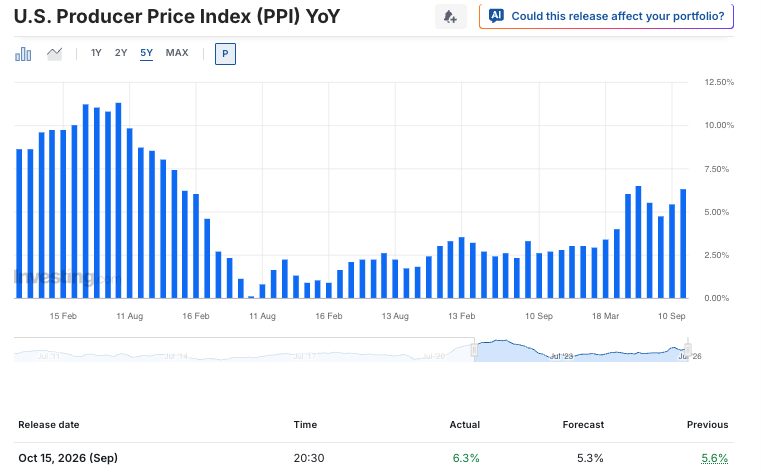
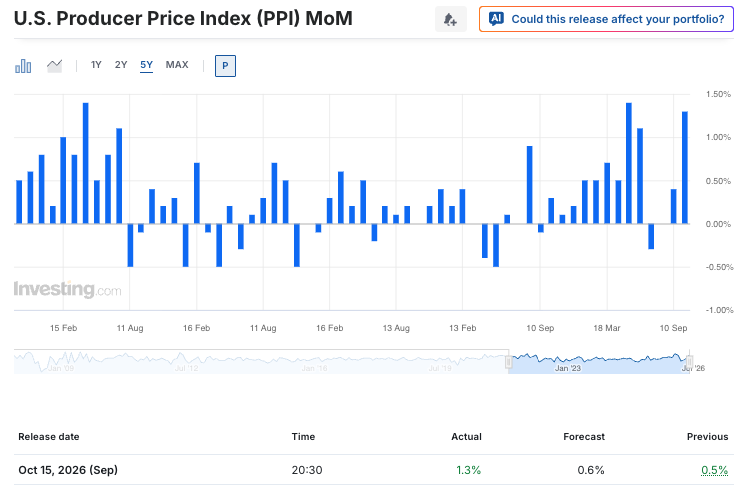
According to data released by the U.S. Bureau of Labor Statistics (BLS), U.S. PPI rose 1.3% month over month in September, sharply higher than the 0.4% increase in August and well above market expectations of roughly 0.5% to 0.6%. On an annual basis, PPI inflation accelerated from 5.4% in August to 6.3%.
 |
 |
More importantly, core PPI, which excludes food and energy prices, increased 0.7% month over month, above both the previous month’s 0.2% increase and the market forecast of 0.3%. The annual core PPI rate rose to 5%. This suggests that inflationary pressure is not merely the result of short-term energy price fluctuations, but is becoming evident across a broader range of goods and services.
Surging Energy Prices Push Up Goods-Side Costs
The primary driver behind the rise in PPI was energy. Data showed that energy prices climbed 10.8% in September, pushing final-demand goods prices up by 2.6%, marking a substantial increase by historical standards.
Gasoline prices surged 20.3%, making a significant contribution to the rise in goods prices. Diesel, jet fuel, and residential electricity prices also moved higher. Food prices rose 1.2% month over month. While some categories, such as eggs, saw sharp price declines, these declines were not enough to offset the broader impact of rising energy costs.
If elevated energy prices persist, businesses will generally face two choices: absorb the higher costs and accept lower profit margins, or pass those costs on to consumers through higher prices. If the latter becomes more widespread, producer-side inflation may increasingly feed through into consumer prices.
Inflation Pressure Extends From Goods to Services
In addition to rising goods prices, services prices also showed signs of acceleration. Services prices increased 0.8% in September, with transportation and warehousing costs rising 3.4%, while wholesale and retail trade service margins rose 1.4%.
Services inflation is typically more persistent because wages, rents, logistics expenses, and operating costs do not decline quickly. When services prices and core PPI rise at the same time, markets become more focused on whether companies have begun passing higher costs on to end consumers.
Meanwhile, certain PPI components linked to the Fed’s preferred Personal Consumption Expenditures (PCE) price index showed mixed performance. For example, airfares increased, while some healthcare-related prices remained relatively moderate. This means that while PPI provides important inflation signals, markets will still need to assess upcoming PCE, CPI, and labor market data for a more complete view of the policy outlook.
Federal Reserve Expectations Become More Uncertain
With both headline and core PPI coming in above expectations, the market’s assessment of the Fed’s future policy path has become more complicated.
On one hand, stronger producer-side inflation makes it difficult for the Fed to fully dismiss the risk of renewed inflation. On the other hand, the bond market’s response suggests that some investors are more concerned about downside risks to economic growth, corporate earnings, and highly valued assets.
Market data showed that the 10-year U.S. Treasury yield declined at one point, while Treasury prices rebounded. This combination of stronger inflation data and rising bond prices suggests that traders may be positioning for slower economic growth and a correction in risk assets, rather than interpreting the data solely through the lens of higher interest rates.
Interest-rate probabilities reflected in the CME FedWatch Tool have also continued to shift, indicating that no clear consensus has emerged regarding the next policy meeting. For traders, this implies that short-term market volatility could increase further.
Technology and AI Stocks Become the Focus of Selling Pressure
Following the PPI release, selling pressure in U.S. equities was concentrated in semiconductors and the AI supply chain. The Nasdaq Composite fell by as much as around 1.4% intraday, while the S&P 500 also weakened.
At the individual stock level, semiconductor companies including Micron, Intel, and AMD fell by more than 4%. AI infrastructure and data center-related companies such as Dell, Arista Networks, and SanDisk also posted notable declines.
This reflects a market reassessment of two key risks:
1. Interest-rate and discount-rate risk: If inflation remains elevated, expectations for rapid monetary easing may be constrained, which could weigh on the valuations of high-price-to-earnings technology stocks.
2. Corporate capital expenditure risk: If the economic outlook weakens, investment in AI, cloud infrastructure, and data center construction may slow, potentially affecting revenue expectations across the supply chain.
However, there are also signs that some data center-related costs are easing. Prices for electronic components and accessories have declined, computer equipment prices have risen only modestly, and construction costs have remained broadly stable. This suggests that while the AI investment theme may face a near-term valuation correction, cost pressures across the supply chain may not deteriorate across the board.
Key Factors to Watch Going Forward
Markets will likely focus on the following indicators:
-
Upcoming U.S. CPI and core CPI data: To determine whether inflation is continuing to spread from energy into core services.
-
The PCE Price Index: As the Fed’s preferred inflation gauge, it will directly influence expectations for policy rates.
-
U.S. Treasury yields and the U.S. dollar: These reflect the market’s overall pricing of growth, inflation, and monetary policy.
-
Technology earnings and corporate capital expenditure guidance: Whether the AI theme can maintain high-growth expectations will be critical for semiconductor and related supply-chain valuations.
Conclusion
September’s sharply stronger-than-expected PPI data has once again sounded an inflation warning for markets. Rising energy costs, stronger services prices, and accelerating core PPI all suggest that the Fed cannot yet confidently declare inflation risks fully resolved.
In the near term, markets are likely to swing between two competing narratives: “renewed inflation” and “slowing economic growth.” Technology stocks, semiconductors, the U.S. dollar, Treasuries, and crypto assets could all experience heightened volatility as a result. For traders, rather than taking one-directional bets, it may be more prudent to closely monitor incoming data, maintain clear risk controls, and remain alert to liquidity risks around major economic data releases.
Looking to trade U.S. equity index moves driven by macroeconomic data, interest-rate expectations, and technology earnings? Explore U.S. stock index CFD trading on Bitget and respond flexibly to market volatility in indices such as the Nasdaq 100 and S&P 500.
All trading education provided by Bitget is for educational purposes only and should not be considered financial advice. The strategies and examples shared are for reference only and may not reflect actual market conditions. CFD trading involves significant risk, including the potential loss of capital. Past performance does not guarantee future results. Please conduct thorough research and ensure that you understand the risks involved. Bitget is not responsible for any trading decisions made by users.


- Surging Energy Prices Push Up Goods-Side Costs
- Inflation Pressure Extends From Goods to Services
- Federal Reserve Expectations Become More Uncertain
- Technology and AI Stocks Become the Focus of Selling Pressure
- Key Factors to Watch Going Forward
- Conclusion