
Introduction to Bitget Institutional Loans (Unified Trading Account)
Questo articolo non è presente nella lingua che hai selezionato e ti è stata automaticamente raccomandata la versione Inglese.
Introduction to Bitget Institutional Loans (Unified Trading Account)
2025-09-30 14:00
426059Condividi
Institutional Loans is a leveraged financing service provided by Bitget specifically for market makers, quantitative funds, and institutional users. Funds are disbursed directly to your designated financing account, while collateral assets remain unfrozen. As long as the LTV remains within the required range, these assets can be traded as usual, providing additional funding while maintaining operational flexibility.
Product advantages
-
Risk models tailored to strategy types: The Hedge and HFT products are designed for hedging and high-frequency trading scenarios, respectively. Their LTV calculations reflect the actual available capital for your strategy rather than applying a uniform standard.
-
Unified multi-account management: A single Risk Unit can support up to 300 sub-accounts that share the same set of LTV metrics. Funds can be freely transferred and allocated among accounts within the unit, allowing flexible allocation of strategy positions.
-
Flexible use of funds: Collateral assets remain unfrozen. As long as the LTV remains within the required range during the loan term, positions and trading strategies can operate normally without interrupting market-making or arbitrage activities.
Product types
Institutional Loans offers two product types based on the trading strategy. Different types are subject to different risk control rules:
|
Product type
|
Applicable strategies
|
Risk control constraints
|
|
Stable arbitrage (Hedge)
|
Hedging arbitrage, cash-and-carry arbitrage, and long-short pairs
|
Subject to LTV (Hedge), Delta limits, and position leverage limits
|
|
High-frequency trading (HFT)
|
High-frequency market making, ultra-short-term trading, and frequent position opening and closing
|
Subject to LTV (HFT)
|
Note: To change your product type, contact your account manager. You can confirm your current product type through the Get Risk Unit API.
Product rules
|
Item
|
Description
|
|
Eligibility
|
Users at Pro1 or above who have completed KYB verification
|
|
Loan currencies
|
USDT, USDC, BTC, and ETH
|
|
Loan leverage
|
5x
|
|
Supported accounts
|
Unified trading accounts (UTA);
only OSL custody accounts are supported.
Custodial trading sub-accounts are not supported.
|
|
Collateral assets
|
The converted net asset value of unified trading accounts within the Risk Unit. Conversion rates are calculated according to the loan product configuration. For details, see Institutional Loan collateral conversion rates. Collateral can be traded normally and is not frozen.
Important: If you convert margin assets for an Institutional Loan into non-margin assets or margin assets with lower conversion rates when placing a spot trading order, causing the risk ratio to reach or exceed the liquidation threshold, the order may trigger immediate liquidation. Please manage your risk carefully to avoid asset losses caused by liquidation.
|
|
Loan term
|
1–12 months
|
|
Interest calculation
|
Interest accrues daily and is settled monthly
Daily accrued interest = Outstanding principal × Daily interest rate
|
|
Disbursement account
|
The financing account within the Risk Unit under the unified trading account structure, which is a dedicated sub-account for Institutional Loans
|
|
Repayment rules
|
Loan repayment date:
Repayment scenarios:
|
|
Interest payment rules
|
The system automatically collects interest on the first day of each month. Before the first day of each month, deposit the corresponding interest into the dedicated sub-account for the Risk Unit to prevent the LTV from increasing after automatic interest deduction.
|
|
Interest-free option
|
Institutional Loans may qualify for 0% interest if the monthly trading volume requirement is met. Otherwise, interest will accrue at Bitget's standard Institutional Loan interest rate. For details, see: Institutional Loan interest-free program
|
Risk control
1. About Risk Units
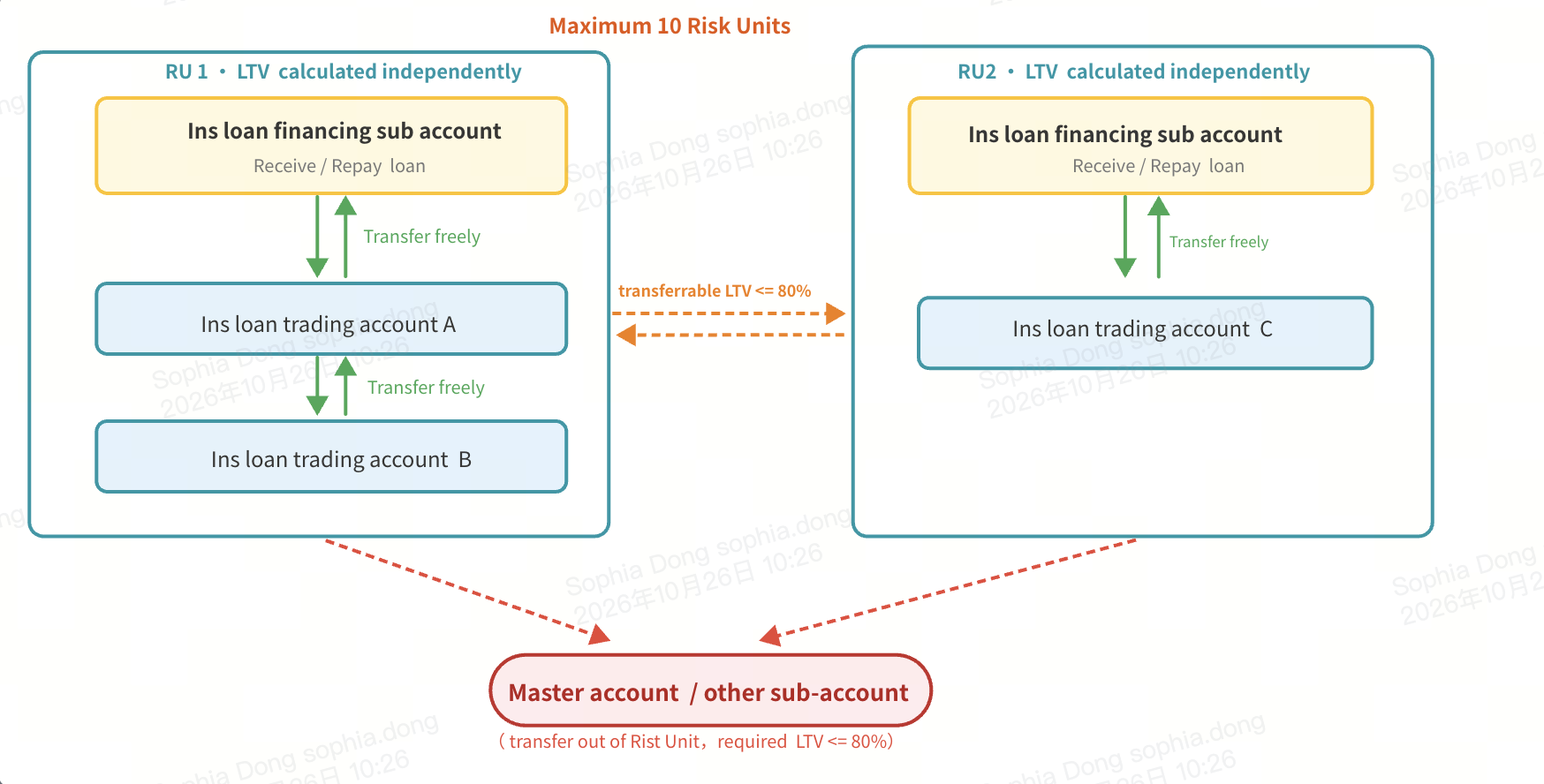
A Risk Unit is the basis for Institutional Loan risk calculations. Each Risk Unit consists of one financing sub-account, which is a dedicated settlement sub-account used to receive and repay loans, and multiple financed trading accounts, which are sub-accounts used for daily trading. All LTV, Delta, and position leverage calculations are performed at the entire Risk Unit level, and all accounts within the unit share the same set of risk metrics.
An institution may create multiple Risk Units to isolate the risks of different strategies or fund pools. Each Risk Unit calculates its LTV independently and does not affect other units.
|
Configuration
|
Rule
|
|
Maximum number of Risk Units
|
Each institution may create up to 10 Risk Units
|
|
Maximum number of sub-accounts
|
Each Risk Unit may have up to 300 linked sub-accounts
|
|
Account type restrictions
|
Standard sub-accounts and virtual sub-accounts may join a Risk Unit. Main accounts and demo accounts may not join. The account mode must be Advanced Mode, and the collateral mode is fixed as All Coins.
|
|
UID ownership
|
The same UID may belong to only one Risk Unit and must be part of the same main account and sub-account structure
|
|
Fund transfer rules
|
Funds may be freely transferred between sub-accounts within the unit. Transfers out of the Risk Unit are allowed only if the LTV after the transfer does not exceed the transfer restriction threshold.
|
|
Unlinking conditions
|
Sub-accounts may be unlinked only after all loans for the entire Risk Unit have been fully repaid. Alternatively, an individual sub-account may be unlinked after its assets have been reduced to zero.
|
|
API support
|
OpenAPI supports dynamically linking and unlinking sub-accounts. Risk Unit members can be managed through the Link/Unlink UID and Get Risk Unit endpoints.
|
2. LTV calculation
LTV, or loan-to-value ratio, reflects the proportion of the current outstanding loan to the net value of collateral assets. It is the core risk control metric for Institutional Loans. The LTV denominator varies by product type:
LTV formula for stable arbitrage (Hedge) = Outstanding loan ÷ Total Risk Unit asset value
LTV formula for high-frequency trading (HFT) = Outstanding loan ÷ (Total Risk Unit asset value − Total maintenance margin)
Definitions:
-
Outstanding loan — Outstanding loan principal disbursed to the financing account + Outstanding loan interest
-
Total Risk Unit asset value — The sum of the converted net value of collateral assets across all sub-accounts with unified trading accounts in the Risk Unit:
-
Total Risk Unit asset value = Sum(Positive equity in each sub-account's unified trading account margin coins × USD index price × tiered conversion rate) − Sum(Negative equity in each sub-account's unified trading account margin coins × USD index price);
-
Coin equity = Balance + Amount in use + Unrealized PnL;
-
The conversion rate is the dedicated tiered conversion rate for Institutional Loans. It is tiered by position size and differs from the standard conversion rate for unified trading accounts. For details, see Institutional Loan margin coins and conversion rates or query it through the API. For coins without a configured conversion rate, positive equity is converted at 0%, while negative equity is still deducted at 100%.
-
-
Total maintenance margin (HFT only) — The sum of the maintenance margin across all sub-accounts with unified trading accounts in the Risk Unit, denominated in USD.
-
Maintenance margin can be viewed on the trading page or queried through the API.
-
Calculation example:
Assumptions: Outstanding loan = 500,000 USDT, total Risk Unit asset value = 1,000,000 USDT, and total maintenance margin = 100,000 USDT
-
LTV (Hedge) = 500,000 ÷ 1,000,000 = 50%
-
LTV (HFT) = 500,000 ÷ (1,000,000 − 100,000) = 500,000 ÷ 900,000 ≈ 55.6%
3. LTV risk limits
When the following thresholds are reached, the corresponding operations will be restricted. The Hedge product uses LTV (Hedge) as the determining metric, while the HFT product uses LTV (HFT).
|
LTV threshold
|
Restrictions
|
|
≥ 80%
|
Transfer restrictions: The maximum amount available for transfer is determined by the current LTV. A transfer out is allowed only if the LTV after the transfer does not exceed the transfer restriction threshold. Once the LTV reaches the transfer restriction threshold, assets cannot be transferred to accounts outside the Risk Unit's sub-account unified trading accounts, including other accounts under the same sub-account. Transfers are also subject to the unified trading account's own transfer restrictions. Use the API (Get transferable amount) to query the actual transferable amount.
|
|
≥ 85%
|
Position-opening restrictions: Buying non-stablecoin assets through spot or margin trading is prohibited. Opening new futures positions, including USDT-M, Coin-M, and USDC futures, is also prohibited. Only position closing and reduce-only operations are allowed.
|
|
≥ 90%
|
Liquidation triggered: In addition to the position-opening restrictions, all spot trading and futures operations, including position closing, are prohibited. The system automatically executes liquidation repayment until the LTV falls to the liquidation stop threshold of 85%.
|
The thresholds above can be obtained through the Get Product Info API. The current real-time LTV can be viewed through the Get Risk Ratio API.
4. Delta risk control (Hedge product only)
Delta measures a Risk Unit's exposure to directional market movements. A fully hedged account has a Delta close to 0. The greater the one-sided directional position, the higher the Delta and market risk.
Delta calculation, performed across the entire Risk Unit by aggregating unified trading account assets from all sub-accounts within the unit:
Delta = Total net exposure of the Risk Unit ÷ Total net asset equity of the Risk Unit
-
Net exposure per coin = ABS(Long exposure + Short exposure). Long exposure includes positive spot equity, while short exposure includes short futures positions.
-
Total net exposure = Σ(Net exposure per coin × Coin Ratio)
-
Coin Ratio = Rating factor × Concentration weight, with rTokens additionally multiplied by the × Market-closure weight. The rating factor reflects the coin's liquidity and risk rating. The concentration weight increases as the proportion of a single coin's exposure to net equity rises. The market-closure weight applies only to rTokens. It is 1 during regular trading hours and increases during overnight sessions or market closures.
-
Total Risk Unit asset value: The sum of the converted net value of collateral assets across all sub-accounts with unified trading accounts in the Risk Unit, calculated using the same logic as LTV
-
Stablecoins such as USDT, USDC, USDE, and DAI are excluded from the Delta calculation
Delta trading restrictions
When Delta reaches or exceeds the threshold of Delta ≥ 2.0, new orders that increase exposure in the over-limit direction are prohibited. Delta can be reduced by closing positions or opening positions in the opposite direction, after which the restriction is automatically lifted.
Direction determination rules, assessed independently for each coin:
|
Current net direction
|
Product
|
Restricted orders that increase exposure
|
Permitted orders that reduce exposure
|
|
Net long
|
Futures
|
Open long
|
Open short or reduce-only
|
|
Spot
|
Buy
|
Sell
|
|
|
Margin
|
Buy
|
Sell
|
|
|
Net short
|
Futures
|
Open short
|
Open long or reduce-only
|
|
Spot
|
Sell
|
Buy
|
|
|
Margin
|
Sell
|
Buy
|
Calculation example for the Hedge product, assuming total net asset equity of the Risk Unit = 1,000,000 USDT:
|
Coin
|
Spot
|
Futures long
|
Futures short
|
Net exposure (USD)
|
Coin Ratio
|
Weighted net exposure
|
|
BTC
|
5 BTC
|
+1 BTCUSDT
|
−4 BTCUSDT
|
5×$60,000 + 1×$60,000 − 4×$60,000 = 120,000 (net long, 12% concentration)
|
1.0
|
120,000
|
|
ETH
|
0
|
0
|
−30 ETHUSDC
|
0 − 30×$3000 = −90,000, with net exposure of 90,000 (net short, 9% concentration)
|
1.0
|
90,000
|
|
rAAPL
|
200 rAAPL
|
—
|
—
|
200×$250 = 50,000 (net long, 5% concentration, market currently closed)
|
2.0
|
100,000
|
|
Total
|
—
|
—
|
—
|
—
|
—
|
310,000
|
Delta = 310,000 ÷ 1,000,000 = 0.31 (below 2.0, so no trading restrictions apply)
Note: Because the rAAPL market is closed, its market-closure weight is increased and its Coin Ratio = 2.0. As a result, its net exposure of 50,000 USD is counted as 100,000 USD. During regular trading hours, the Coin Ratio would be 1.0 and Delta = 260,000 ÷ 1,000,000 = 0.26.
If another 30 BTC in long BTC futures positions is opened:
-
New BTC net exposure = 120,000 + 30×60,000 = 1,920,000 USD (net long, with concentration increasing to 192%)
-
As BTC concentration increases, the Coin Ratio rises to 2.0, and weighted net exposure = 1,920,000 × 2.0 = 3,840,000 USD
-
Total weighted net exposure = 3,840,000 + 90,000 + 100,000 = 4,030,000 USD
-
Delta = 4,030,000 ÷ 1,000,000 = 4.03 > 2.0, triggering Delta risk controls. The system independently determines the restricted trading direction for each coin in the Risk Unit:
|
Coin
|
Net direction
|
Restricted orders
|
Permitted orders
|
|
BTC
|
Net long
|
Open long BTC futures / Buy BTC spot
|
Open short futures, place reduce-only orders, or sell spot
|
|
ETH
|
Net short
|
Open short ETH futures / Sell ETH spot
|
Open long futures, place reduce-only orders, or buy spot
|
|
rAAPL
|
Net long
|
Buy rAAPL spot
|
Sell spot
|
API queries: The Delta threshold can be confirmed through the Get Product Info API. The current real-time Delta value for Hedge accounts can be queried through the API .
5. Position leverage risk control (Hedge product only)
Position leverage is calculated at the entire Risk Unit level by aggregating unified trading account positions across all sub-accounts in the unit. It reflects the leverage of the overall position size relative to net equity, including both long and short positions:
Position leverage = (Futures position value + Spot holdings value) ÷ Total net asset equity of the Risk Unit
-
Futures position value = Σ(Long position size × Mark price) + Σ(Short position size × Mark price). Long and short positions are both included, excluding isolated margin positions.
-
Spot holdings value = ABS(Σ Non-stablecoin equity × Index price)
-
Stablecoins are excluded from the numerator
Calculation example for the Hedge product, assuming total net asset equity of the Risk Unit = 1,000,000 USDT:
|
Coin
|
Spot
|
Futures long
|
Futures short
|
|
BTC
|
+5 BTC
|
+1 BTCUSDT
|
4 BTCUSDT
|
|
ETH
|
0
|
0
|
30 ETHUSDC
|
Futures position value = (1+4)×mark price of $60,000 + 30×mark price of $3,000 = 300,000 + 90,000 = 390,000 USD
Spot holdings value = 5×index price of $60,000 = 300,000 USD (ETH is excluded because there are no spot holdings)
Position leverage = (390,000 + 300,000) ÷ 1,000,000 = 0.69x (below 10x, so no trading restrictions apply)
Position leverage trading restrictions
When position leverage reaches or exceeds the threshold of position leverage ≥ 10x, spot buying, margin buying and selling, and opening new futures positions are prohibited. Only reduce-only or position-closing orders may be placed.
API queries: The position leverage threshold can be confirmed through the Get Product Info API. The current position leverage of a Hedge Risk Unit can be queried in real time through the API .
6.Trading restrictions reference table
|
Trigger condition
|
Spot buy
|
Spot sell
|
Margin trading
|
Open futures positions
|
Close futures positions
|
Transfer out
|
|
Normal
|
✓
|
✓
|
✓
|
✓
|
✓
|
✓
|
|
LTV ≥ 80% (transfer restrictions)
|
✓
|
✓
|
✓
|
✓
|
✓
|
✗
|
|
LTV ≥ 85% (position-opening restrictions)
|
✗
|
✓
|
✗
|
✗
|
✓
|
✗
|
|
LTV ≥ 90% (liquidation triggered)
|
✗
|
✗
|
✗
|
✗
|
✗
|
✗
|
|
Delta exceeds the limit (Hedge only)
|
✗ Over-limit direction
|
✗ Over-limit direction
|
✗ Over-limit direction
|
✗ Over-limit direction
|
✓
|
✓
|
|
Leverage exceeds the limit (Hedge only)
|
✗
|
✓
|
✗
|
✗
|
✓
|
✓
|
Note:
-
When multiple restriction conditions are triggered simultaneously, the restrictions apply cumulatively.
-
Over-limit direction refers to the trading direction that would further increase Delta exposure. Opposite-direction operations that balance or reduce exposure are not affected.
-
Each trading pair has an independent maximum position-opening leverage limit that applies to every position-opening order in all states, including spot margin, USDT-M, Coin-M, and USDC futures. Use the “ Get Supported Trading Pair Info” API to query this information.
Liquidation repayment mechanism
When the LTV reaches the liquidation threshold, the system triggers liquidation repayment with the goal of reducing the LTV to the liquidation stop threshold.
Execution process:
-
Cancel open orders: Cancel all unfilled open orders across unified trading accounts in the Risk Unit, including spot, margin, USDT/USDC perpetual futures, and Coin-M futures orders.
-
Lossless repayment: If using directly transferable assets in the Risk Unit for repayment would reduce the LTV to the liquidation stop threshold, the system automatically transfers the assets to complete the repayment.
-
Repayment through conversion of transferable assets + Simultaneous futures position reduction: Transferable margin coins are converted for repayment while the corresponding opposing futures positions are simultaneously reduced. This reduces the loss from unhedged exposure caused by repayment. If the LTV falls to the liquidation stop threshold, the liquidation process ends.Example: Assume an institutional user must repay 50,000 USDT and the account holds 2 BTC and a short BTC futures position. The system simultaneously performs two operations: ① It converts 2 BTC into USDT at the market price, including slippage, and uses 50,000 USDT from the proceeds to complete repayment; ② It simultaneously reduces and closes the short BTC futures position to lower position exposure.
-
Full futures position closure (MMR): Fully close all futures positions in each account and transfer all remaining margin assets to the financing account.
-
Negative balance handling: If the Institutional Loan remains undercollateralized after the above process is completed, it will be handled according to the negative balance compensation process specified in the signed agreement.
Note:
-
Institutional Loan liquidation and unified trading account liquidation are two independent risk control mechanisms. If both are triggered simultaneously, Institutional Loan liquidation will skip any account currently undergoing unified trading account liquidation.
-
Liquidation fee = Repayment amount × 2%
Account trading permissions
Trading permissions vary by account type within a Risk Unit. Plan the use of funds according to your actual needs:
|
Account type
|
Spot
|
Spot margin
|
Futures
|
Strategies / Copy trading / Conditional orders
|
Description
|
|
Main account
|
✓
|
✓
|
✓
|
O
|
Excluded from Risk Unit LTV calculations and not subject to Institutional Loan risk controls
|
|
Financing account
|
✓ (spot only)
|
✗
|
✗
|
✗
|
A dedicated loan settlement account that does not support futures trading, spot margin, or strategy trading. We recommend using it only for fund deposits, withdrawals, and settlement management.
|
|
Financed trading account
|
✓
|
✓
|
✓
|
✗
|
The primary trading account, supporting spot, futures including USDT-M, Coin-M, and USDC, and spot margin trading. It is subject to LTV risk limits. Strategy trading and copy trading are unavailable for all Institutional Loan accounts.
|
-
“Strategies / Copy trading / Conditional orders” includes strategy trading such as spot and futures grid trading, Martingale, Infinity Grid, and CTA; copy trading, including leading trades; and advanced order types such as trigger orders, OCO, TP/SL, trailing orders, iceberg orders, and TWAP orders. These features are unavailable for all accounts in an Institutional Loan Risk Unit.
FAQ
-
How do I apply for an Institutional Loan?
- Contact your account manager or email institutional@bitget.com to inquire about Institutional Loan services. We will arrange for a dedicated business manager to contact you.
-
What are the prerequisites for adding a sub-account to a Risk Unit?
-
Account type: Only sub-accounts may join. Main accounts and demo accounts may not join.
-
Account mode: The sub-account must have been upgraded to a unified trading account in Advanced Mode. For upgrade instructions, see: How to upgrade to a unified trading account?/ How to switch account modes for a Bitget unified trading account?
-
Collateral settings: After joining, the collateral mode is fixed as All Coins, and custom margin is not supported. See: How to manage collateral settings in a unified trading account?
-
Futures position leverage: When joining, the leverage of futures positions and spot margin in the account must not exceed the leverage limit for the corresponding trading pair, which can be queried through the Institutional Loan API.
-
Will collateral assets be frozen?
No. Assets within a Risk Unit can be traded normally without being locked. However, converting assets with high conversion rates into assets without configured conversion rates will increase the LTV. Please manage your risk accordingly.
-
How can I query supported trading pairs and collateral coins?
-
Supported trading pairs and the leverage limit for each pair: Get Supported Trading Pair Info API
-
Supported collateral coins and conversion rates: Institutional Loan collateral conversion rates
-
Can borrowed funds be transferred outside the Risk Unit?
Funds may be transferred in, but transfers out are permitted only if the LTV after the transfer does not exceed the transfer restriction threshold. If the LTV has already reached the transfer restriction threshold, transfers out are prohibited.
-
Can funds be transferred between sub-accounts within a Risk Unit?
Yes. Transfers between sub-accounts within a Risk Unit are not subject to LTV restrictions. Restrictions apply only to transfers outside the Risk Unit.
-
Can assets in custody wallets such as Copper or Fireblocks be used as collateral?
No. Assets held in third-party custody wallets or mirrored in Bitget accounts cannot be used as collateral for Institutional Loans. Collateral must be held directly in sub-accounts within the Risk Unit.
-
Are there trading restrictions on the financing account?
Yes. The financing account, which is the dedicated settlement account within a Risk Unit, does not support futures trading, spot margin, or strategy trading. We recommend designating a sub-account exclusively for settlement as the financing account and conducting daily trading through other financed trading accounts.
-
Does exceeding the Delta limit affect only new positions? Will existing positions be forcibly closed?
Existing positions will not be forcibly closed. Exceeding the Delta limit only prevents new orders that would further increase directional exposure. Existing positions are unaffected. Once Delta is reduced below the threshold by closing positions or opening positions in the opposite direction, the restriction is automatically lifted.
-
How can I avoid liquidation?
We recommend monitoring LTV in real time through the API. When LTV approaches 85%, you can reduce it by transferring in additional collateral assets, proactively repaying part of the principal, or appropriately reducing your position size.
-
Can I still operate my account after liquidation is triggered?
During liquidation, the system suspends all trading and transfers out. The account only supports transfers in from external sources. We recommend taking proactive action when LTV approaches 85%, such as transferring in collateral or applying for repayment, to avoid entering the liquidation process.
For more information, please refer to:
If you have any questions, please contact the Bitget Institutional Team:
-
Email: institutional@bitget.com
-
Telegram: @Bitget_Institutional_Ops
*Questo annuncio è sensibile al fattore tempo. Si prega di notare la data di pubblicazione. La piattaforma non si assume alcuna responsabilità per eventuali perdite dirette o indirette derivanti dal mutare delle circostanze o da contenuti obsoleti.
*Questo contenuto è stato tradotto tramite intelligenza artificiale ed è puramente indicativo. Non garantiamo l'accuratezza della traduzione e decliniamo qualsiasi responsabilità per eventuali errori, omissioni o perdite derivanti dall'uso di questo contenuto tradotto. In caso di discrepanze, prevarrà la versione originale.
Articoli correlati
Ti è stato d'aiuto?