
BNB Chain contract "Er Dang Jia" goes live on mainnet, but is it still worth participating in perp DEXs?

For StandX, the importance of DUSD appears to surpass that of the contract platform itself.
For StandX, the importance of DUSD seems to surpass that of the contract platform itself.
Written by: Eric, Foresight News
Following Aster, another highly anticipated perp DEX on BNB Chain, StandX, announced the launch of its mainnet on the afternoon of November 24.
It must be said that the timing chosen by StandX is somewhat awkward. Not only is this a period when the hype around perp DEXs is gradually declining, but it is also a time when the overall market is just recovering from a recent sharp downturn.
Although when it comes to airdrop farming, if you are already a heavy contract user or want to use hedging trades to generate high trading volumes without loss, there is no reason not to participate. However, overall, although StandX did not state it explicitly, it seems that DUSD is considered even more important than the contract platform itself in the eyes of the team.
Early Core Members of Binance Contracts Leave to Start a Business
The founders' backgrounds can be said to be StandX's biggest selling point. Among StandX's three founders, one is one of the designers of Binance's contract products, another is the former head of growth for Binance contracts, and the last is a former senior trading systems engineer at Goldman Sachs. A product jointly created by three of the people who understand trading systems and crypto contract products best in the world naturally raises expectations.
In an interview in September, StandX co-founder and former Binance contracts growth lead Justin broke down StandX. Justin stated that, as the team that was among the first in the industry to launch linear contracts (using USDT as margin), they have always adhered to an "original" approach from Binance to StandX. StandX was developed from scratch, from the underlying architecture to the user UI.
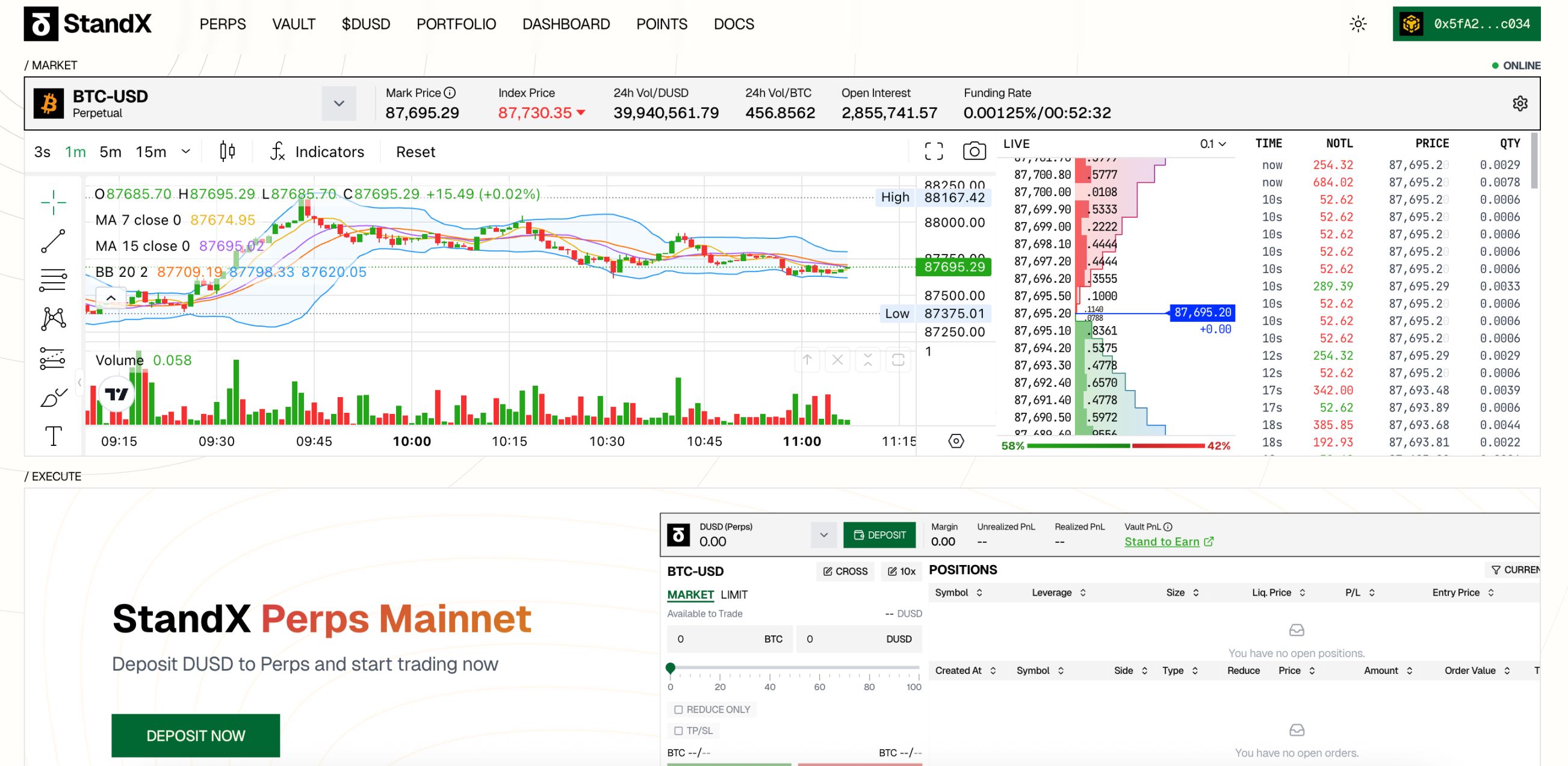
According to the StandX documentation, there are not many differentiating factors in the overall design of the contract platform. In addition to basic functions, StandX has also designed a Vault product that allows users to deposit funds and use their own strategies to provide liquidity on the platform. In the future, StandX also plans to launch Vaults similar to "copy trading." The only notable feature of StandX, apart from the differences in functionality and experience brought by independent development, is the introduction of the yield-bearing stablecoin DUSD from the very beginning.
DUSD is a stablecoin that generates yield through delta-neutral strategies, and its specific strategy is not much different from other similar stablecoins. Interestingly, DUSD is the only unit of account on StandX, meaning that users who want to trade on StandX must convert their USDT or USDC on BNB Chain or Solana into DUSD and deposit it into the "contract wallet" before they can start trading.
If it were just the introduction of a yield-bearing stablecoin, considering that HyperLiquid has also introduced its own stablecoin USDH, this might just be a necessary step in the development path of perp DEXs, which is understandable. However, combined with StandX's mainnet points program, things are not so simple.
Mainnet Points Program Centers on DUSD
Most perp DEXs, when designing points programs as a reference for future airdrops, make trading volume one of the core considerations for points, since high trading volume indicates the platform's credibility, popularity, and trading depth. However, StandX's points system is heavily skewed toward DUSD.
After the mainnet launch, users have five ways to earn points:
- For every DUSD held in the contract wallet, users can earn 1.2 points per day. When calculating the amount of DUSD, unrealized PnL is included, so even if you have open losing positions, those losses will be excluded from the DUSD calculation;
- Making two contract trades per day with a total value exceeding 100 DUSD earns 10 points;
- Providing liquidity for DUSD/USDT or USDC pairs in DeFi: each DUSD in the LP counts as 1 point, and each USDT or USDC counts as 1.2 points. For example, providing an LP with 100 DUSD and 100 USDC earns 220 points. However, users must keep the LP tokens in their wallet; further staking or collateralizing will change ownership and affect point calculation;
- Trading DUSD on DEXs will grant points equal to 5% of the DUSD trading volume. On Solana, trades must be made directly on Raydium for easy tracking;
- Referring a new user: both parties receive 5% of all points earned by the new user.
As can be seen, except for the second point, which requires two contract trades totaling 100 DUSD per day, all other ways to earn points are related to DUSD.
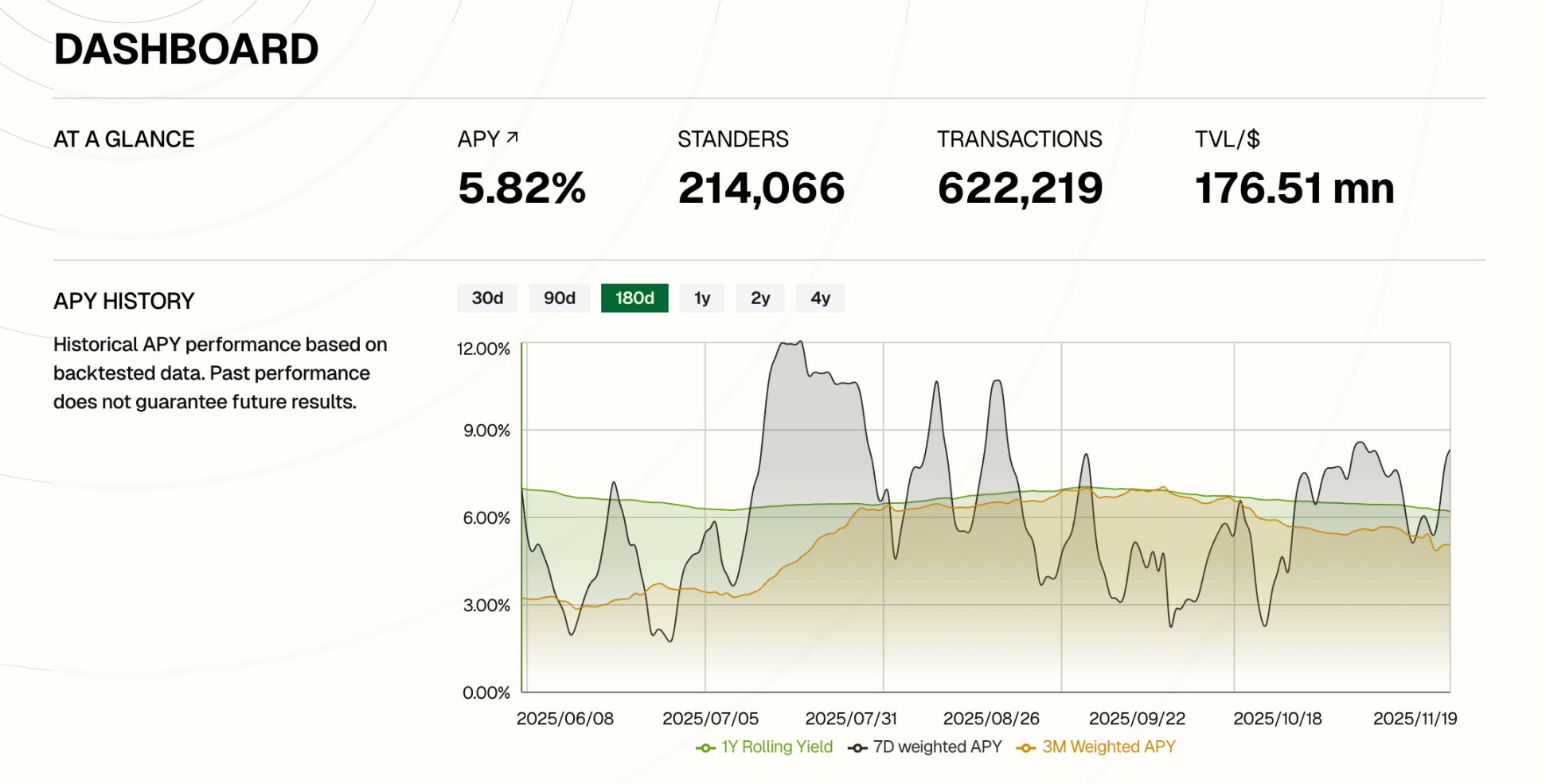
Under this incentive mechanism, StandX's contract trading volume on the first day of mainnet launch was just over $55 million. According to DefiLlama's statistics on global perp DEX trading volumes, StandX ranked outside the top 35 on its first day. However, DUSD accumulated over $176 million in TVL in a short period. According to StandX's official data, DUSD has more than 200,000 participating addresses.
StandX has not publicly explained why the importance of DUSD was prioritized over platform trading volume in the early stages of the launch. The author speculates that, on one hand, the StandX team, due to their extensive experience, is confident in the subsequent growth of trading volume and is not in a hurry to encourage wash trading early on at the expense of user experience. On the other hand, for this design that requires minting a new stablecoin using USDT or USDC, some bad actors have already caused the market to become wary. If sufficient liquidity is not established early, later efforts may yield half the results with twice the effort.
As for why perp DEXs make issuing their own stablecoins a strategic priority, the author speculates that it is mainly to lock value within their ecosystem. The StandX team was the first to launch perpetual contracts using USDT as margin, and compared to spot trading, contracts may be the core driver of USDT growth. Binance has also tried issuing its own stablecoin or supporting new stablecoins, but it has been difficult to replicate the scale of USDT.
In the aforementioned interview, Justin also analyzed why GMX and dYdX have been surpassed: full on-chain processes make the experience inferior to CEXs, while new products represented by HyperLiquid have achieved qualitative improvements in user experience by sacrificing some decentralization. At this point, there is not much room for further improvement, so for StandX to capture market share, it must take a different approach.
Given this, the stablecoin segment is likely a crucial part that the StandX team must seize early on, because in a bear market, trading fees may not provide consistent revenue, but stablecoins can. What StandX can "innovate" with DUSD is also a key reason for users to continue engaging with the platform.
Disclaimer: The content of this article solely reflects the author's opinion and does not represent the platform in any capacity. This article is not intended to serve as a reference for making investment decisions.
You may also like
AI Agents Challenge Traditional Banking Security: 5 Cryptocurrencies Worth Trying as Blockchain Identity Advances

Uber Technologies stock closes 3.43% lower; 15-minute RSI sits at 27.11
Counter-terrorism forces take to the streets, Louvre closes! France erupts in a new wave of protests over the weekend, with turmoil threatening to spread across Europe
France is engulfed in a new wave of violent protests, with 70,000 security personnel deployed urgently and curfews imposed in multiple cities. Macron admits to mishandling the response. Financial markets have sounded the alarm early — the spread between French and German government bonds has surged to its highest level since the European debt crisis, PMI has fallen below the threshold for expansion, luxury shops have boarded up windows, the Louvre Museum has closed, and Paris City Hall estimates losses of tens of millions of euros. The turmoil also threatens to spread across Europe.

Bitcoin Miners Are Fleeing to AI: So Why Is the Hash Rate Surging?

Crypto prices
More


