Bitcoin continues to function as the primary collateral asset for crypto-backed credit, even as market volatility triggers price pullbacks and increased liquidations. Data from CryptoQuant and platform-specific metrics tied to Nexo indicate that borrowers and large holders have maintained exposure to Bitcoin rather than rotating into alternative assets.
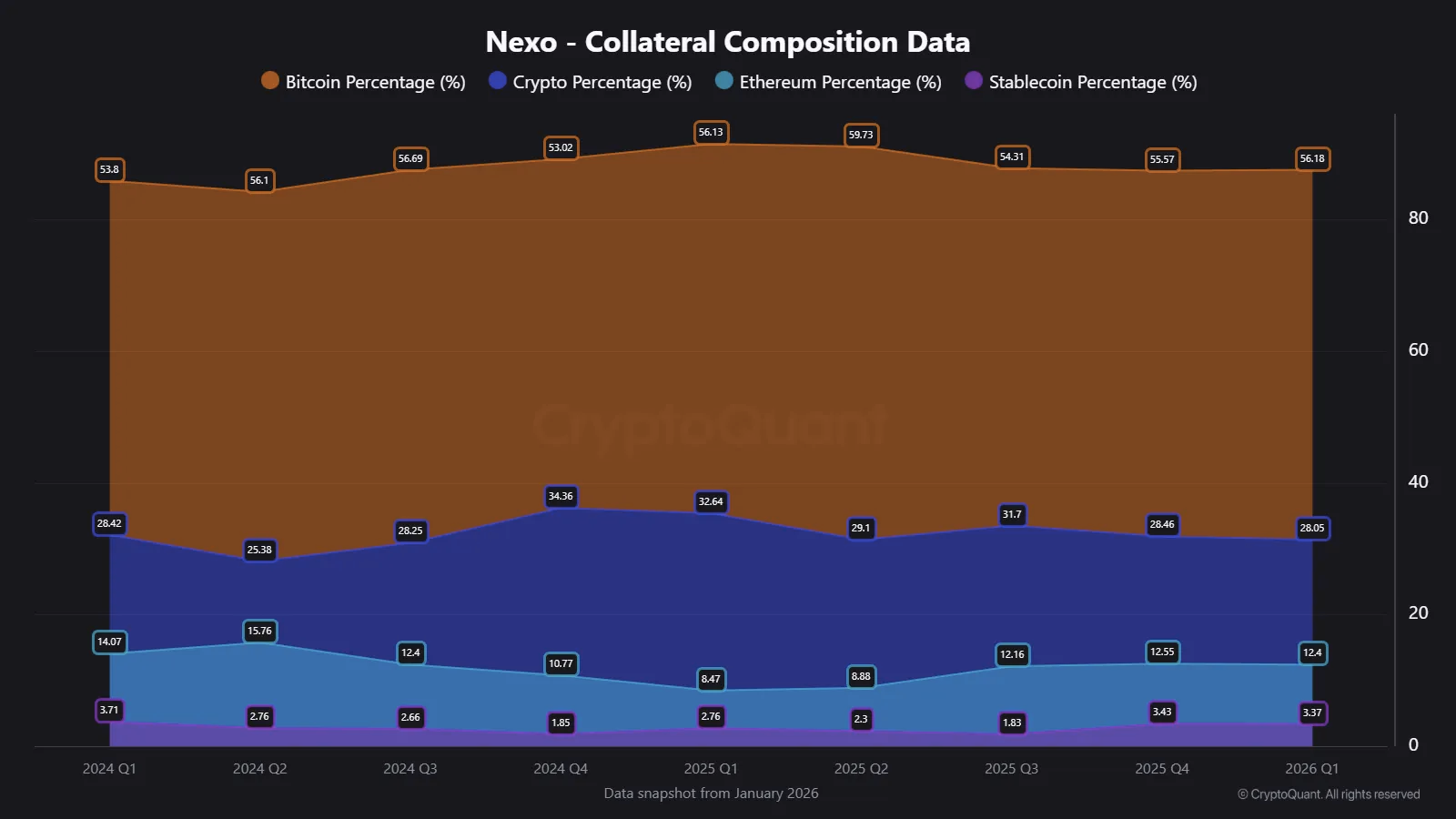
Quarterly collateral composition data for Nexo, covering the period from 2024 Q1 through 2026 Q1, shows Bitcoin consistently accounting for the largest share of loan backing. Over the period observed, Bitcoin represented roughly 54% to 60% of total collateral.
After a brief decline in early 2024, Bitcoin’s share increased through late 2024 and early 2025, reaching just under 60%. By Q1 2026, Bitcoin dominance stood at 56.2%, even as broader market conditions softened.
Other crypto assets formed the second-largest category, fluctuating mostly between the mid-20% and low-30% range. Ethereum’s share declined from mid-teens levels in early 2024 to single digits in early 2025 before recovering to just above 12% later in the period. Stablecoins remained below 4% throughout.
 Source:
CryptoQuant
Source:
CryptoQuant
On-chain data from CryptoQuant also points to renewed accumulation by large holders during recent price weakness. On February 6, accumulator addresses recorded inflows of 66,940 BTC, marking the largest single-day inflow observed during the current market cycle.
(adsbygoogle = window.adsbygoogle || []).push({});Historical data shows similar accumulation spikes during prior downturns in 2020–2021 and 2022–2023. The recent surge, supported by a rising 30-day moving average, indicates sustained inflows rather than isolated transfers.
Furthermore, on Feb 9, spot Bitcoin ETFs saw inflows of $145M, with the Grayscale (GBTC) seeing the largest inflow of about $130.54M, followed by Ark & 21Shares (ARKB) with $14.09M, VanEck (HODL) with $12M, Franklin (EZBC) seeing $6.14M, and lastly Fidelity (FBTC) getting inflows of $3.08M. BlackRock’s IBIT saw the only outflow of the day with $20.85M.
Related: Bitcoin Steadies Around $70,000 After Violent Sell-Off Shakes Market Confidence