
Locals prefer satoshis to dollars, says Africa Bitcoin chair Stafford Masie

Stafford Masie, executive chairman of Africa Bitcoin Corporation, said Tuesday that Bitcoin functions as everyday money in parts of Africa rather than primarily as a store of value.
Speaking to Natalie Brunell on the Coin Stories podcast on Tuesday, Masie said the framing of Bitcoin (BTC) differs sharply across regions.
“Where I come from, Bitcoin is money,” he told Brunell, adding that in some circular economies in Africa, merchants “won’t accept dollars — they accept satoshis.”
While investors in developed markets often emphasize its role as an inflation hedge, he described communities where satoshis circulate directly in local economies. He also pointed to the stark difference between inflation in the West and in parts of Africa.
“When you guys talk about debasement, you talk about 4% to 5% annually — we talk about 4% to 5% in an afternoon,” he said.
 Source:
Coin Stories
Source:
Coin Stories
Masie compared the shift to the continent’s rapid adoption of mobile technology, arguing that younger populations are bypassing legacy financial systems. Rather than transitioning gradually from stable fiat currencies, he described a move from what he called “broken money” and sharp currency debasement into digital assets.
He also highlighted Africa’s youthful demographics as a key factor, noting that more than a quarter of the continent’s population is under 20. He said younger generations are embracing emerging technologies such as artificial intelligence and they “love Bitcoin.”
Masie said that in this context, Bitcoin becomes more than a passive store of value. Instead, he described it as “pristine capital;” a financial substrate that individuals and businesses can build on. He said:
In Africa, we know the age before 2008 and the age after 2008. After the Bitcoin white paper and before the Bitcoin white paper. Our lives changed, because suddenly we had something that couldn’t be debased. It was immutable, decentralized, can’t be confiscated. That to an African is life or death.”
Masie is a longtime technology executive who previously led major tech operations in South Africa.
Related: Africrypt founders back in South Africa years after platform collapse: Report
Crypto adoption in Africa
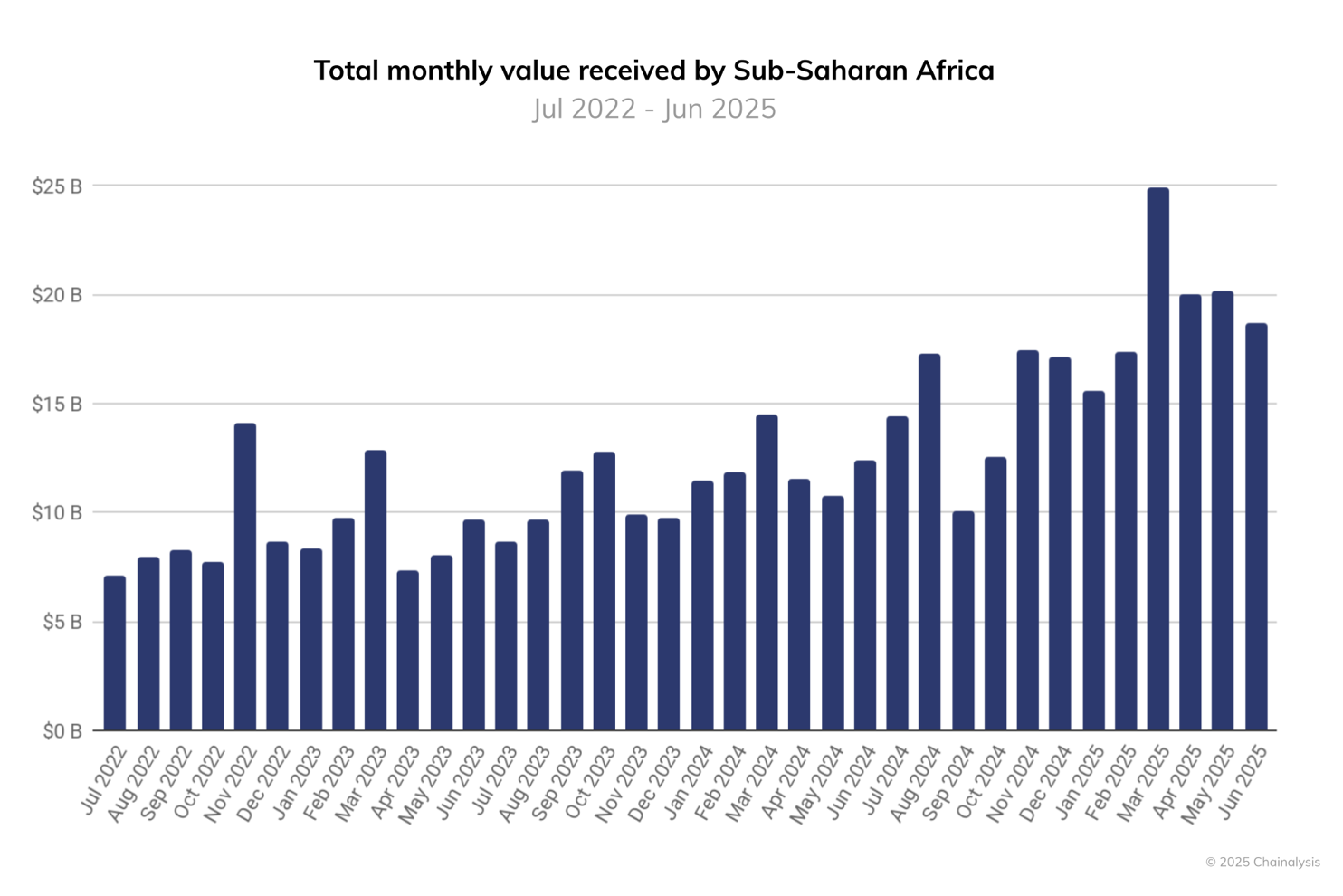
Data from blockchain analytics company Chainalysis appears to back up the shift on the continent that Masie is describing.
From July 2024 to June 2025, Sub-Saharan Africa received more than $205 billion in onchain value, up 52% year-on-year, making it the third-fastest growing crypto region globally. In March 2025 alone, monthly volume spiked to nearly $25 billion, driven largely by activity in Nigeria following a currency devaluation.
 Source:
Chainalysis
Source:
Chainalysis
Sub-Saharan Africa has also stood out as a retail-driven crypto market. Transfers under $10,000 accounted for more than 8% of total value sent in the region during the same time period, compared with about 6% globally, according to the report released in September.
At the same time, Nigeria and South Africa showed notable institutional activity, with onchain flows indicating recurring multimillion-dollar stablecoin transfers linked to cross-border trade between Africa, the Middle East and Asia.
In January, speaking at the World Economic Forum, former UN Under-Secretary-General Vera Songwe explained how stablecoins are increasingly viewed as a cheaper remittance and settlement tool in Africa.
She said remittances have become “more important than aid” in many African economies, while traditional transfers can cost about $6 per $100 sent. With inflation exceeding 20% in about a dozen countries and an estimated 650 million people unbanked, she said stablecoins offer both a payments rail and a store of value in markets facing currency pressure.
Magazine: Would Bitcoin really be at $200K if not for Jane Street? Trade Secrets
Disclaimer: The content of this article solely reflects the author's opinion and does not represent the platform in any capacity. This article is not intended to serve as a reference for making investment decisions.
You may also like
British Pound catches bid as BoE hawk warns inflation is embedded
AI Agents Ignite CPU Demand! Mizuho Estimates Market Size to Reach $209 Billion by 2030, Raises Target Prices for AMD (AMD.US), Intel (INTC.US), etc.
Mizuho stated that with the rapid increase in application scenarios for AI agents, server CPU demand is expected to grow significantly, which will further drive demand for DRAM, NAND, and server equipment.
Top Midday Stories: Google Strikes 20-Year Nuclear Power Deal With Constellation; Marvell Raises Revenue Guidance for 2026-27
11:45 AM EDT, 10/06/2026 (MT Newswires) -- All three major US stock indexes were up in late-morning trading Tuesday, as oil prices and Treasury yields were down. In company news, Alphabet's (GOOG, GOOGL) Google has entered into a 20-year deal with Constellation Energy (CEG) to add 890 megawatts of nuclear power to the PJM interconnection grid, the companies said Tuesday. The agreement will enable over $4.3 billion in investments in new equipment and technology at 11 Constellation nuclear facilities in Illinois, Pennsylvania and New Jersey, the companies said. Alphabet's Class C and Class A shares were up 0.3% and 0.6%, respectively, around midday. Constellation shares were up 13.7%. Marvell Technology (MRVL) now expects to generate revenue of $12 billion in 2026 and $18 billion in 2027, up from its previous guidance of a combined $20 billion over that period, Chairman and Chief Executive Matthew Murphy said Tuesday at a conference, according to a transcript. Marvell shares were up 7.0%. McKesson (MCK) and CD&R have entered into a definitive agreement to acquire Option Care Health (OPCH) for $32.05 per share, reflecting a total enterprise value of about $5.8 billion, the companies said Tuesday. After the deal closes, which is expected to occur in H1 2027, CD&R will hold a majority interest of 51% in Option Care Health, while McKesson will invest $1.4 billion to hold the remaining 49%, the companies said. McKesson shares were up 0.1%, while Option Care shares were up 32.7%. Uber Technologies (UBER) has agreed to acquire ezCater for $2.3 billion in cash, the ride-hailing company said Tuesday. The deal, expected to close in the coming months, will expand Uber's catering orders and give restaurants access to larger orders and more customers, the company said. Uber shares were down 0.4%. Energy Transfer (ET) said Tuesday it has entered into a definitive agreement to acquire Vaquero Midstream in a bolt-on deal valued at about $2.63 billion. The deal consideration will consist of $1.95 billion in cash and about 33.3 mill
Oil prices and the euro resonate, signaling an inflection point for major assets
Crypto prices
More


