
Yen Falls Below Historic Low Again, Ministry of Finance Sighs Powerlessly

Morning FX
As expected, the Japanese yen continued to fall below the 162 threshold, reaching a forty-year low. Since the signing of the Plaza Accord in 1985, the yen has never depreciated to such an extreme level.
Traditional exchange rate factors have lost validity, making it increasingly difficult for the Ministry of Finance to intervene. Neither nominal nor real interest rate spreads, nor even the balance of payments, can explain the current weakness of the yen. The root cause is structural selling pressure, forcing Japan to re-examine its entire exchange rate system.
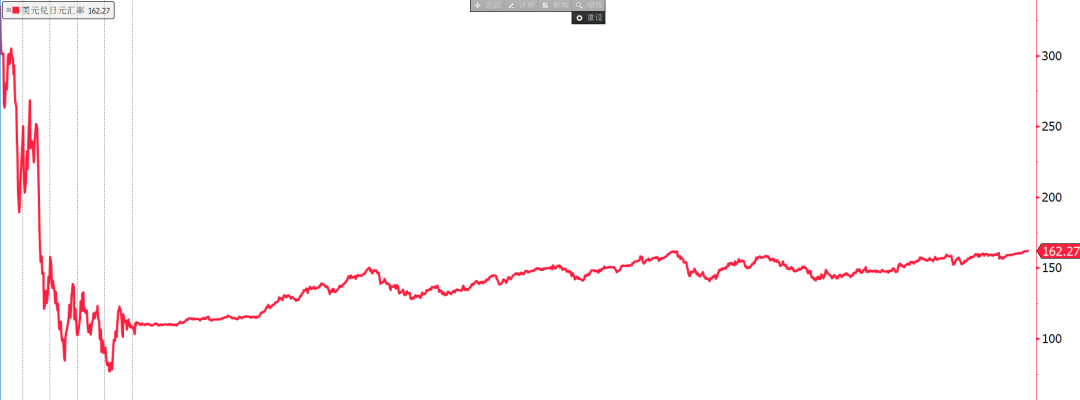
Figure: Forty-year low for the yen
1. The deterrent effect of intervention is diminishing
The last intervention by the Ministry of Finance was at the end of April, involving about 10 trillion yen (USD 63 billion), pushing the USDJPY rate down from 160 to as low as 155. However, in less than a month, the yen depreciated back again.
The last intervention changed from focusing on the speed of volatility (rapid depreciation in a short period), to defending a fixed level; the psychologically important market level is 160, and in practice, interventions began once 160 was breached, with multiple quick and small-scale entries aimed at sustaining deterrence.
As 160 was breached again this time, the market anticipated another intervention, but both the Ministry of Finance and Bank of Japan exercised great restraint, expressing concern only verbally. If a strong signal is not sent at a fixed threshold, the market will continue to test the authorities’ bottom line, which will progressively embolden short sellers and raise the future cost of intervention even further.
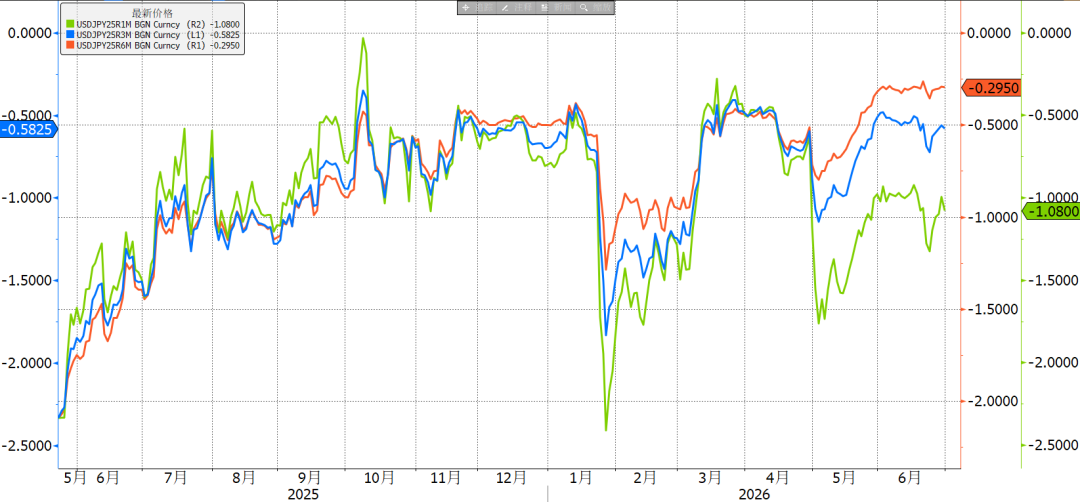
Figure: Dissipation of intervention panic
Yen risk-reversal option prices fell sharply after the two breaks above 160, with the market briefly pricing in intervention risk. However, such panic has faded, and risk-reversal prices have returned to normal.
2. The failure of macro factors is most fatal
Although the recent rise in USDJPY has been driven by the Federal Reserve’s hawkish pivot and the resurgence of the strong US dollar, traditional factors can no longer explain this scale of depreciation.
Looking at the US-Japan interest rate differentials, the spread has continued to narrow since US rates peaked in 2024. The short-end spread has dropped from a peak of 5% to 2.5% currently; the ten-year bond spread has narrowed from 4% to 1.73%. If last year's depreciation could be ascribed to real rate spreads widening, this year, with US and Japanese inflation diverging, the real rate spread has narrowed simultaneously.
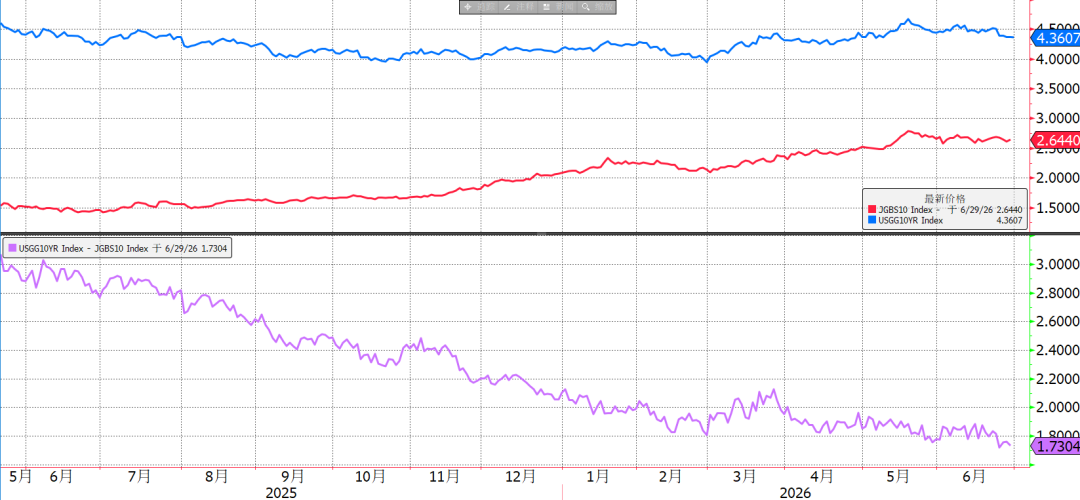
Figure: Interest rate spreads do not explain yen weakness
Japan's current account surplus was about 9.8 trillion yen in the first quarter, expanding markedly year-on-year. However, it appears only capital outflows are dominating the exchange rate. The settlement rate of current account surpluses is extremely low, while the narrowing spread does not deter carry trades; selling pressure on the yen remains strong.
With macro factors failing, intervention is like a mantis trying to stop a chariot, and there is also a lack of suitable market conditions (such as a downturn in US data) for effective actions. Only sufficient strength and resolve can curb the yen’s depreciation.
3. Summary
(1) The yen has fallen to a forty-year low, relentlessly declining after breaching 160 and now approaching the most extreme levels seen after the Plaza Accord.
(2) The yen’s current weakness can no longer be explained by macro factors; structural selling pressure is rendering the Ministry of Finance’s intervention increasingly ineffective, yet sufficient deterrence must be provided to prevent a vicious cycle.
Disclaimer: The content of this article solely reflects the author's opinion and does not represent the platform in any capacity. This article is not intended to serve as a reference for making investment decisions.
You may also like
GSK (GSK.US), Inovio (INO.US), and Agios (AGIO.US) cluster for review, US innovative drugs welcome FDA approval window
The FDA will intensively decide on several new drugs in the next two weeks: GSK's functional cure therapy for hepatitis B, Inovio's rare disease therapy, Agios's new drug for sickle cell disease, and Sun Pharma's application for expanded indications.

After the Philadelphia Semiconductor Index and Nasdaq plunged, Morgan Stanley called to "get ready to increase positions"
Michael Wilson from Morgan Stanley stated that as the significant correction trajectory in most stock markets over the past few months is about to end, investors should be prepared to increase the risk exposure in their portfolios.
Roadster is just an appetizer? Renowned investor predicts: SpaceX (SPCX.US) may announce the acquisition of Tesla (TSLA.US) within weeks at $420 per share
Gary Black, Managing Director of the Future Fund, recently tweeted a prediction that SpaceX may announce an all-stock acquisition of Tesla within weeks and view the launch of the flying edition Roadster as an opportunity to integrate Elon Musk's companies.

Crypto prices
More


