
Bitget App
Trade smarter
Buy cryptoMarketsTradeFuturesStocksEarnInstitutionAI & More
Is XRP quietly building toward $1.90 as macro pressure eases and demand holds?

Is XRP quietly building toward $1.90 as macro pressure eases and demand holds?

CryptoNewsNetCryptoNewsNet2026/09/05 15:12
By:CryptoNewsNet
Back to the list

Is XRP quietly building toward $1.90 as macro pressure eases and demand holds?

Is XRP quietly building toward $1.90 as macro pressure eases and demand holds? image 0  invezz.com 26 m
Is XRP quietly building toward $1.90 as macro pressure eases and demand holds? image 1

$XRP has recovered from its recent pullback, holding the $1.32 support over the past few days.

The altcoin is now up by more than 6% in the last 24 hours as traders assess changes in the macroeconomic environment ahead of the latest US employment report.

The recovery comes as sustained ETF inflows and record activity on the $XRP Ledger continue to support a cautiously bullish view.

$XRP trading volume remains elevated

Trading activity has moderated from its recent peak, but daily volume remains higher than it was one month ago at roughly $2.7 billion. That figure represents approximately 3.2% of $XRP’s circulating market capitalization.

Elevated volume suggests that traders remain actively engaged even as the token consolidates following its rally.

The Crypto Fear and Greed Index stands at 77 after recently reaching 80. Although the decline shows that investor optimism has cooled, the indicator remains within the “Greed” category.

Market participants therefore retain a broadly positive outlook following recent regulatory and macroeconomic developments.

Interest-rate expectations have become a significant source of uncertainty for the cryptocurrency market.

Data from the CME FedWatch tool indicates that the probability of a September rate hike has increased from approximately 39% to 50%.

Federal Reserve Chair Kevin Warsh has signaled reluctance to allow inflation to remain elevated.

US price growth over the past 12 months has reportedly been running at almost twice the central bank’s target, supporting expectations that policymakers may maintain a hawkish stance.

Higher interest rates generally strengthen the appeal of yield-bearing assets and tighten financial conditions, which can reduce demand for cryptocurrencies and other risk-sensitive investments.

Demand for US spot $XRP exchange-traded funds has remained positive despite the token’s recent pullback.

The products recorded net inflows for 11 consecutive trading sessions. August inflows totaled approximately $159 million, marking their strongest monthly performance since December.

Investors added another $21 million during the first three trading days of September, even as $XRP’s price consolidated.

Sustained inflows indicate that demand through regulated investment products remains resilient, although ETF activity does not guarantee that $XRP’s price will rise.

Finally, on-chain data also reflects increased participation across the $XRP Ledger. According to Santiment, the seven-day moving average of daily active addresses reached a record 1.34 million.

That represents a 10% increase from the previous high of 1.22 million recorded in March 2025.

Rising active addresses can indicate greater network usage and investor engagement.

However, the metric does not reveal whether the activity reflects buying, selling, payments, or other transactions.

The increase suggests that participants are becoming more active as $XRP approaches an important technical level.

$XRP bulls target the $1.90 resistance level

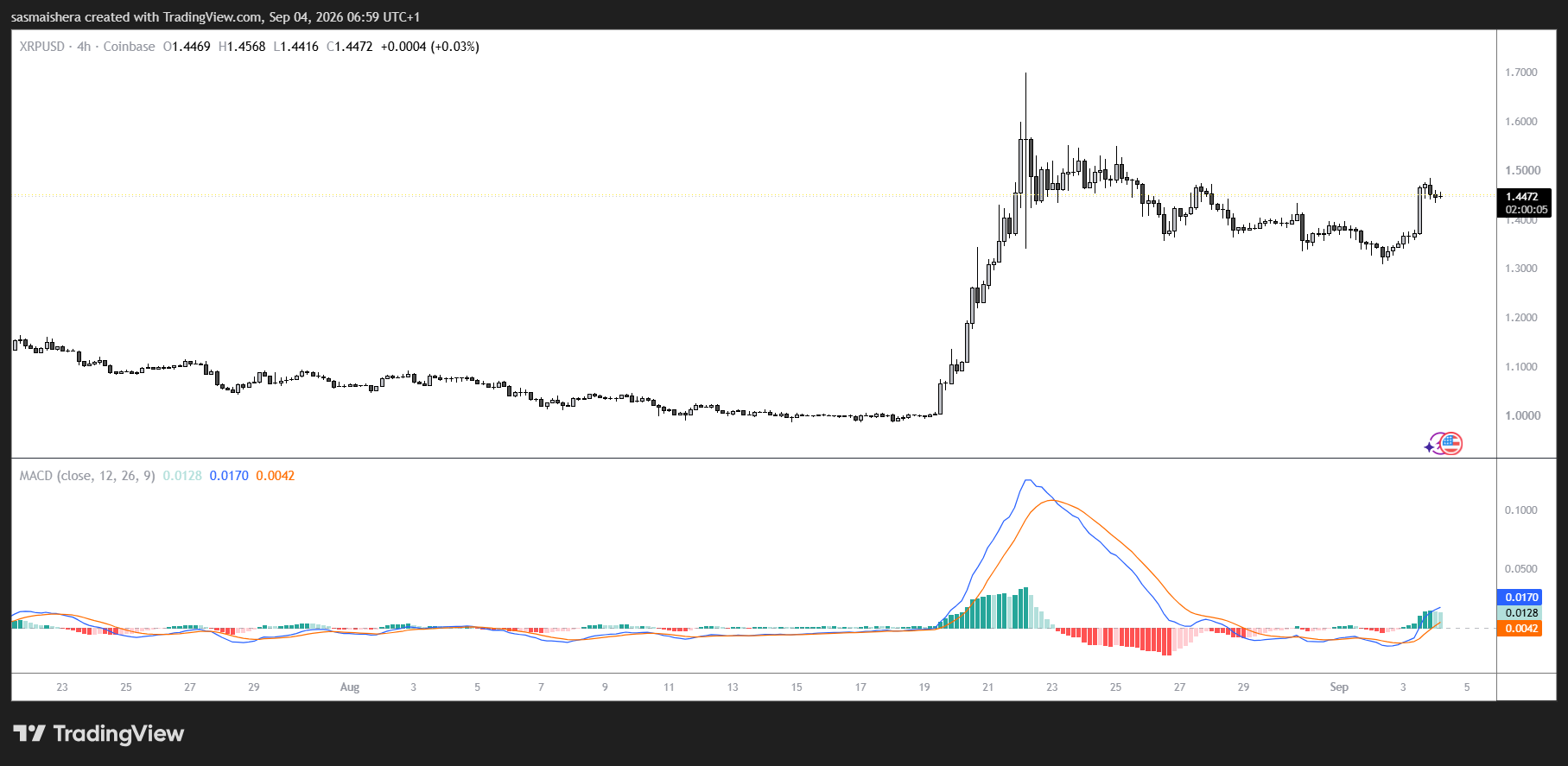
$XRP is trading around $1.44 on Friday, maintaining its bullish near-term structure after extending above all three major exponential moving averages.

The 50-day, 100-day, and 200-day EMAs are positioned between approximately $1.230 and $1.350. These moving averages now provide several layers of dynamic support if $XRP experiences another pullback.

Despite easing momentum indicators, the token’s broader technical structure continues to favor buyers.

The Relative Strength Index has retreated from overbought territory into the mid-60s. An RSI reading above 50 indicates that buying pressure remains stronger than selling pressure.

Its decline from overbought levels suggests momentum is cooling following $XRP’s steep rally rather than signaling an immediate bearish reversal.

The Moving Average Convergence Divergence indicator remains slightly negative, pointing to a possible short-term consolidation phase.

$XRP may therefore trade sideways or experience a limited pullback before attempting another move higher.

The 200-day EMA near $1.352 represents $XRP’s first important support level.

This moving average is reinforced by horizontal support around $1.300, creating a broader demand zone between the two levels.

If sellers push $XRP below this area, the next support sits near the convergence of the 50-day and 100-day EMAs slightly above $1.230.
Is XRP quietly building toward $1.90 as macro pressure eases and demand holds? image 2

A deeper correction could expose the psychological $1.000 level, although such a move would require a significant deterioration in the current bullish structure.

The next major resistance sits near the horizontal barrier at $1.900. A sustained daily close above this level would confirm renewed bullish momentum and could reopen the path toward fresh highs.

However, failure to maintain support above the moving averages could delay the breakout and extend the current consolidation.

$XRP’s near-term direction will depend on whether buyers can defend the $1.300–$1.352 support zone while building enough momentum to challenge $1.900.

0
0

Disclaimer: The content of this article solely reflects the author's opinion and does not represent the platform in any capacity. This article is not intended to serve as a reference for making investment decisions.

Understand the market, then trade.
Bitget offers one-stop trading for cryptocurrencies, stocks, and gold.
Trade now!

You may also like

Updated: Delta Air Lines warns that as fuel prices hit profits, airline capacity will tighten further

Delta Airlines lowers its annual profit forecast due to an expected increase in fuel costs to $6 billion. The CEO stated that ticket prices have risen by about 20% this year, with limited passenger resistance. Analysts warn that maintaining high ticket prices in 2027 is critical for improving profitability. The article includes comments from the earnings call and analyst remarks. Rajesh Kumar Singh/Shivansh Tiwary, Reuters Chicago, October 9 - Delta Airlines (DAL.N) said on Friday that, despite strong travel demand and rising ticket prices, soaring fuel costs have forced it to cut its 2026 profit expectations by nearly a quarter. So, the airline industry may need to further limit flight growth next year to protect profitability. This warning highlights the increasingly tough challenges faced by U.S. airlines. While strong demand and restricted seat growth have allowed airlines to significantly raise ticket prices and offset higher fuel costs, aggressively increasing flights to capture more demand may intensify competition, making it harder to maintain high fares and protect profits. Based in Atlanta, Delta now expects its annual fuel expenditure to increase by about $6 billion compared to last year—about $2 billion higher than its July forecast—due to the Iran war (link) causing global jet fuel prices to spike. Airlines worldwide are preparing for a prolonged fuel shock. Michael O’Leary, CEO of Ryanair Group RYA.I, said Thursday that high jet fuel prices could persist for another 12-18 months (link), adding more pressure on airlines to raise fares and control costs. https://www.reuters.com/graphics/AUTOMATED-20261008/A4A-JET-FUEL-DAILY-1Y/xmpjwjnmbvr/chart.png “In a high-cost environment, you can’t simply grow your way out,” Delta CEO Ed Bastian said on the earnings call. He noted that the industry has already taken steps to restrict capacity, but more measures will be needed next year to improve profitability. Bastian said Delta raised ticket prices about 20% this year, and passenger resistance has been limited. He is confident that even if fuel costs eventually drop, the high fares can still be maintained. Delta lowered its adjusted annual earnings per share forecast from the July prediction of $6.50-$7.50 to $5.10-$5.60. According to LSEG data, the midpoint of the new range is below analysts’ average expectation of $5.46. Third-quarter adjusted earnings per share were $1.72, four cents below analysts’ average forecast. In midday trading, shares of Delta dropped 1.7%, United Airlines UAL.O fell 1.4%, and both American Airlines AAL.O and Southwest Airlines LUV.N were down about 1%. Delta partly shields itself from rising fuel costs by owning a refinery outside Philadelphia (link), which is expected to generate over $700 million in profits this year. Even with this buffer, the airline expects its fourth-quarter fuel price to rise from $3.61 per gallon in Q3 to $4.25 per gallon. Delta forecasts adjusted fourth-quarter earnings per share to be between $1.15-$1.65, with the $1.40 midpoint roughly matching analysts’ average expectation of $1.39. Fare increases Government data shows that in the first eight months of 2026, U.S. airlines spent $42.9 billion on fuel, an increase of $13.2 billion compared to the same period last year despite slightly reduced consumption. According to the U.S. Bureau of Labor Statistics, strong demand and limited seat growth pushed average U.S. airline ticket prices up by about 25% year-on-year between April and August. https://www.reuters.com/graphics/USA-AIRLINES/FUEL/lbpgdnbzwvq/chart.png Analysts at Melius Research said that despite surging fuel costs, Delta’s ability to raise fares helps keep second-half profits roughly stable. Still, they warn that the company’s profit margin has struggled to improve over the years. “It is critical for margin improvement to maintain or raise fares in 2027,” they wrote in their research report. With industry capacity growth expected to accelerate in Q4, this challenge will likely become even tougher. Deutsche Bank analysts expect the proportion of fuel costs recouped through revenue measures to fall in Q4 and predict full recovery won’t happen until early 2027. Bastian noted that low industry returns are another reason for limiting capacity growth. He said Delta will be cautious with its 2027 capacity plan until the fuel price outlook becomes clearer. He added that international routes may account for a larger share of Delta’s capacity expansion compared to domestic routes. Currently, Delta says its premium cabins and corporate travel business remain strong, and its economy cabin business is gradually improving. With Q4 ticket bookings already exceeding 60%, Delta expects revenue to increase about 20% year-on-year, despite limited capacity growth. Executives said early booking trends for Q1 2027 are also encouraging. (For the convenience of non-native English speakers, Reuters automatically translates its reports into several

路透社•2026/10/09 17:36