
Liderando el alza de las acciones bancarias en el extranjero, ¿Goldman Sachs es realmente el gran ganador de las operaciones relacionadas con Trump?

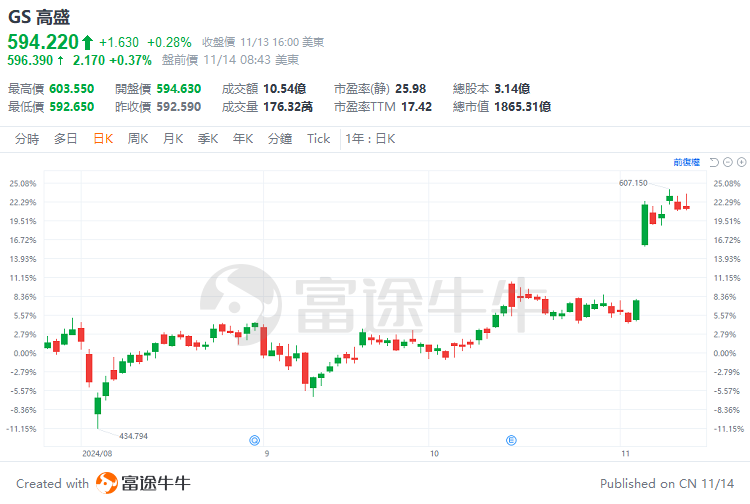
 Según “The Wall Street Journal”, el desempeño de Goldman Sachs probablemente no sea casualidad. Al igual que otros bancos de Wall Street, Goldman Sachs se beneficiará del aumento en las actividades de fusiones y adquisiciones (M&A) y las IPO, además de la relajación regulatoria. Además, normalmente durante los períodos de bonanza en Wall Street, Goldman Sachs presenta resultados sobresalientes: en 2021, cuando se disparó la actividad de negociación, su rentabilidad anual sobre el capital llegó al 23%, mientras que el retorno del índice bancario S&P 500 fue apenas del 12%.
 Analysis suggests that due to the significant growth of private crediting and alternative assets, goldman sachs may become a potential big winner among banks. On one hand, there will be no restrictions on private crediting during Trump's presidency, allowing it to continue growing for the next four years; on the other hand, the rise in government bond yields may also benefit private crediting.
Since Trump's election, the market's expectations for trade activities, regulatory relaxation, and private crediting have risen, with bullish factors continuing to accumulate, driving. $Goldman Sachs (GS.US)$ the arrival of the "harvest season."
In November, Goldman Sachs topped the global banks in the S&P 500 index, with a nearly 15% increase, far exceeding the approximately 9% increase in the S&P 500 bank index, and on par with the increase of private equity giant Apollo this month.
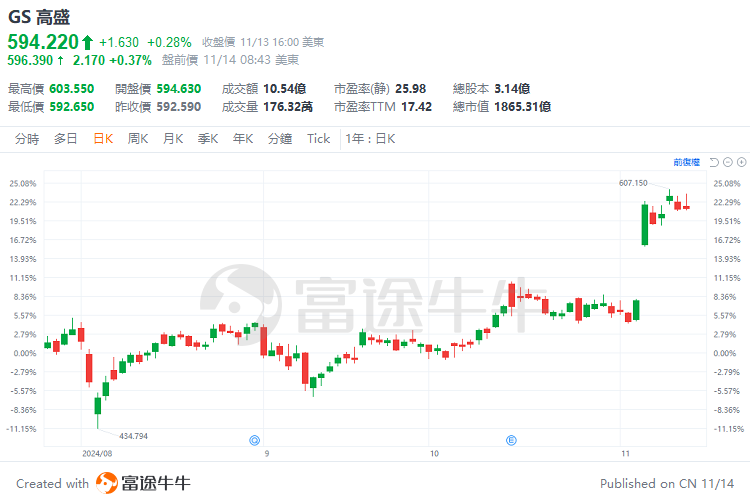
 According to The Wall Street Journal, Goldman Sachs' performance is likely not accidental. Like other Wall Street banks, Goldman Sachs will benefit from increased M&A and IPO activities, as well as relaxed regulations. Moreover, during prosperous times on Wall Street, Goldman Sachs tends to perform exceptionally well: in 2021, during the surge in trading activities, its annual return on equity reached 23%, while the overall return on equity of the S&P 500 bank index was only 12%.
However, due to the significant growth in private crediting and alternative assets, Goldman Sachs may become a potential big winner among these banks.
Analysts believe that under the Trump administration, new securities regulatory agencies or systemic risk regulatory agencies may be less inclined to restrict the availability of private crediting investments with relatively poor liquidity to everyday investors, or see them as a source of financial risk. TD Cowen Washington Research Group analyst Jaret Seiberg said:
"We expect no restrictions on private crediting during the Trump administration, which is why we believe private crediting will continue to grow over the next four years."
Another reason is that the rise in government bond yields may benefit private credit, especially in rapidly growing areas such as Asset Backed Financing (ABF). Moody's Executive Vice President of Private Credit Mark Wasden said, "The increase in government bond yields will impact long-term asset rates (follow the increase)."
Although other major Wall Street banks are also involved in private credit business, analysts believe that Goldman Sachs' ongoing strategic shift may allow it to gain more significant benefits.
In its recent strategy, Goldman Sachs has shifted its asset management department from betting on the company's own funds to investing more through funds for clients. The latter has lower capital intensity and can generate stable management fee income. As of the third quarter, Goldman Sachs manages approximately $140 billion of private credit assets and continues to enter rapidly growing markets such as Asset Backed Securities (ABS).
This also means that Goldman Sachs can further expand the pre-tax profits of its asset and wealth management division by charging higher fees.
However, analysts also warn that if the tariffs implemented by Trump put pressure on large multinational companies, it may widen credit spreads or slow down client activities. Policy uncertainties or excessive market volatility caused by unexpected presidential statements, combined with rapidly rising rates, may make financing more challenging. In addition, regulatory changes sometimes do not necessarily meet people's expectations.
Editor/ping
Disclaimer: The content of this article solely reflects the author's opinion and does not represent the platform in any capacity. This article is not intended to serve as a reference for making investment decisions.
You may also like
SKYAI fluctúa un 42,4% en 24 horas: la narrativa de IA impulsa una alta volatilidad, sin un evento único claro

Trending news
MoreCrypto prices
More





