
News
Stay up to date on the latest crypto trends with our expert, in-depth coverage.

1Bitget UEX Daily | Hormuz Reopening Becomes Negotiation Focus; Nvidia Market Cap Breaks $5.2 Trillion; Storage Stocks All Hit New Highs (April 28, 2026)2Alphabet (GOOGL) Q1 2026 Earnings Preview: Cloud Growth Above 50% and AI Monetization in Focus3IOSG In-Depth Analysis of MSTR STRC: The BTC Financing Flywheel Behind 11.5% Yield

Australian Dollar trades mixed in countdown to the Aussie CPI, Fed policy
FXStreet·2026/04/28 06:06
USD/CAD Price Forecast: Gains ground above 1.3600, while bearish technical bias persists
FXStreet·2026/04/28 05:57
NZD/USD slips to 0.5900 as US-Iran tensions support USD; focus remains on FOMC meeting
FXStreet·2026/04/28 05:15
Amazon (AMZN) Q1 2026 Earnings Preview: AWS and Advertising as Dual Growth Engines
Bitget·2026/04/28 04:22
Gold struggles below $4,700 as US-Iran tensions support USD ahead of FOMC meeting
FXStreet·2026/04/28 04:00
BTW (Bitway) fluctuates 42.3% in 24 hours: Trading volume surge triggers sharp price volatility
Bitget Pulse·2026/04/28 03:13
Flash
06:42
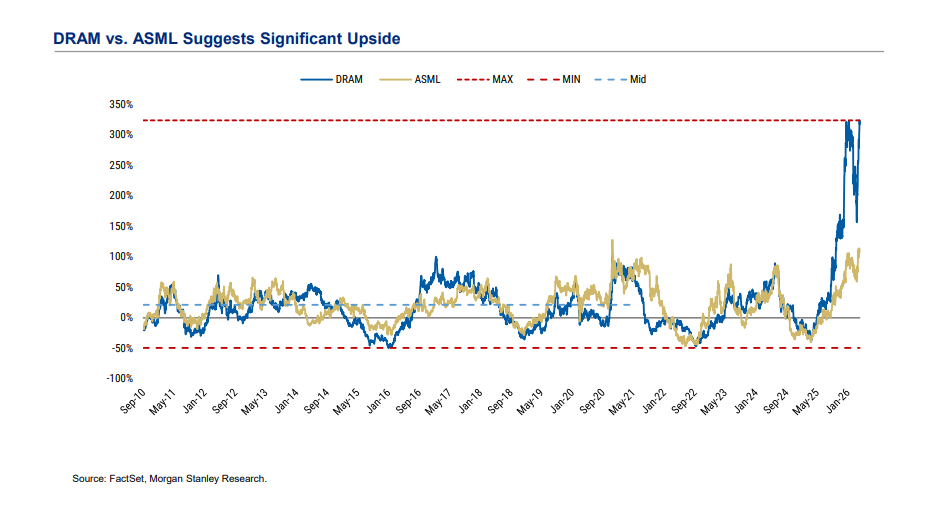
AI Computing Power Demand Drives Memory Industry Boom, Micron and SanDisk Enter "Valuation Reassessment Cycle"BlockBeats News, April 28th. As AI infrastructure continues to expand, global memory manufacturers are emerging as one of the biggest beneficiaries of this AI boom. Melius Research analyst Ben Reitzes initiated coverage on Micron Technology and SanDisk with a "Buy" rating for the first time, assigning price targets of $700 and $1350 respectively over a two-year horizon.
The analysis suggests that AI data centers are driving a surge in demand for HBM (High Bandwidth Memory) and NAND flash, reshaping the semiconductor industry's profit landscape. Unlike traditional SaaS software companies facing pricing pressure based on usage, memory manufacturers are locking in revenue and gross margins through 3- to 5-year long-term procurement agreements, establishing a new business model akin to "reverse SaaS."
Currently, NVIDIA and Advanced Micro Devices heavily utilize the HBM solution in GPUs, driving a continued shift of global DRAM resources towards AI. Samsung Electronics, SK Hynix, and Micron have all redirected a significant portion of their DRAM production capacity to HBM, leading to a tightening of general memory supply and rapid price increases.
Currently, Micron's market capitalization is approaching $600 billion, while SanDisk has seen a cumulative increase of over 300% in the past year, surpassing a market cap of $157 billion. Analysts believe that if demand for Agent AI and Entity AI continues to grow, there may still be room for further upside in the memory industry's valuation.
06:39
Tempo launches subscription payments, automatic deduction, and virtual address features to support stablecoin payments for businessesForesight News reported that payment public chain Tempo has announced on Twitter that it has launched subscription payments, automatic deductions, and virtual address features. Enterprises can now achieve regular automatic deductions through a one-time authorization, while generating an independent virtual address for each customer or each invoice. Funds will be automatically consolidated into the main wallet without additional initialization or token sweeping operations, greatly reducing operational costs. According to the official statement, Tempo's stablecoin consulting team can assist enterprises in evaluating use cases and bringing them into production.
06:39
Large-scale Detention of Iranian Oil Tankers at Chabahar Port, US Naval Blockade Approaching Critical "Export Cutoff" PointBlockBeats news, April 28 — According to shipping monitoring agencies and satellite data, Iranian crude oil exports are rapidly coming to a halt due to the blockade imposed by the US Navy. A large number of fully loaded supertankers are gathering near the waters of Chabahar port, just a step away from the US military control line. Data shows that currently, there are 6 to 8 VLCC supertankers and several medium and small-sized oil tankers anchored in the Oman Gulf region. In the past week, the US military intercepted and redirected two large oil tankers in this area. With the transport function of the Strait of Hormuz nearing paralysis, the size of Iran's offshore floating storage has risen to about 155 million barrels of crude oil. To maintain exports, Iran has even recommissioned an old tanker with a 30-year vessel age that had been out of operation for three years. According to Kpler data, Iran's remaining oil storage capacity can only last for approximately 12 to 22 more days. If the blockade continues, the market expects Iran to begin reducing output as soon as mid-May, with a scale that could reach 1.5 million barrels per day. Export data is also clearly deteriorating. Iran's average daily crude oil exports in March were still around 1.85 million barrels, but have recently dropped to about 567,000 barrels — a decrease of roughly 70%. Analysts point out that, since Iranian crude oil is mainly sold to Asia through indirect channels, the impact on revenues typically appears with a lag of 3 to 4 months, so the current blockade's shock to fiscal income has not yet been fully reflected.
Trending news
MoreNews