
News
Stay up to date on the latest crypto trends with our expert, in-depth coverage.

1Bitget UEX Daily | Ceasefire Expectations Rise, US Stocks Hit New Highs; Dell Earnings Beat Triggers After-Hours Surge; Anthropic Valuation Surpasses OpenAI (May 29, 2026)2 Marvell Technology’s Q1 fiscal 2027 earnings highlights include record revenue growth of 28% year over year, surging AI orders that drove an upward revision to full-year expectations, and strong Q2 guidance.3Strategy Stock (MSTR) Takes a Hit as Saylor’s $14 Billion Bitcoin Pledge Spooks Market

Dash says crypto forgot its original killer app: digital cash
Crypto.News·2026/05/31 09:12

Traders Share Bullish Sentiments Over Near Protocol Altcoin NEAR, a Beautiful Asset to Daytrade
Cryptonewsland·2026/05/31 09:03
Billionaire says crypto seizure risk weakens Bitcoin’s gold case
Crypto.News·2026/05/31 08:57
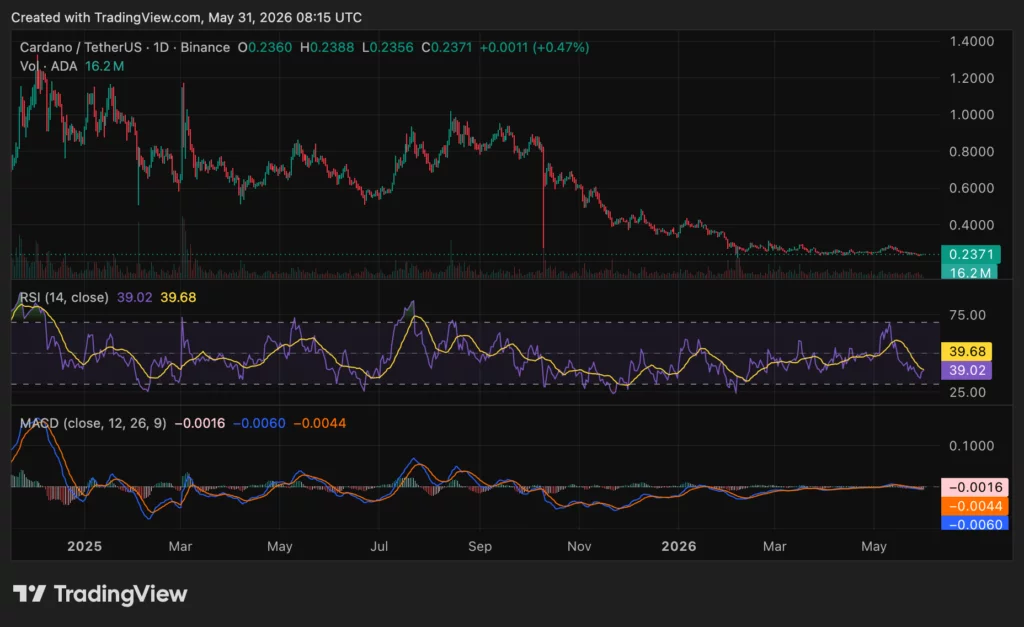
Cardano price risks $0.113 as Summit 2026 cancellation hits ADA
Crypto.News·2026/05/31 08:36

ONDO nears $0.34 support after $2.13mln whale transfer – Can bulls defend it?
CryptoNewsNet·2026/05/31 08:27

Sui faces outages, KEY support test, and 23.78mln unlock – Trouble ahead?
CryptoNewsNet·2026/05/31 08:15

Crypto rally: Why Humanity, Worldcoin, FET, and Venice Token are soaring
CryptoNewsNet·2026/05/31 08:15

Shiba Inu Price Analysis: What Would It Take for SHIB to Reach $0.0001?
Cryptonewsland·2026/05/31 08:00
XDC rebounds from a key support – Will THIS help price reach $0.037?
CryptoNewsNet·2026/05/31 07:51

The US debt machine is getting harder to stabilize – So where does Bitcoin fit in?
CryptoNewsNet·2026/05/31 07:39
Flash
09:32
A certain exchange highlights trending coins: LAB rises in popularity, up 27.51% in 24HThe popularity ranking shows HYPE at the top of the HYPE Hot List, with LAB having the largest increase. The rankings are as follows: ① HYPE ($68.44, 2.93%) ② ZEC ($547.58, 6.00%) ③ WLD ($0.3385, 13.36%) ④ ETH ($2026.41, 0.53%) ⑤ LAB ($8.76, 27.51%). The main capital outflow for LAB is average, with a net outflow of $4.1032 million in 24 hours, and a 24-hour trading volume of $42.9711 million, among which the main capital net inflow is $0.00.
09:06
Nasdaq 100 ETF Dacheng: Warns of premium risk in secondary market trading pricesThe Nasdaq 100 ETF Dacheng announcement stated that recently, the fund's secondary market trading price has been significantly higher than the fund share's indicative net asset value, resulting in a substantial premium. On May 29, 2026, the closing price was 1.857 yuan, while the indicative net asset value per share at the close was 1.7226 yuan. If the premium does not effectively decrease by June 1st, the fund has the right to take temporary suspension or other measures. Currently, the fund is operating normally, and there is no undisclosed major information that should be disclosed. Investors should pay attention to premium risks and invest prudently.
08:53
Fuel costs have surged by nearly 70%, freight rates continue to soar, and the strait crisis is consuming $500 million from Maersk every month.Due to factors such as impeded passage through the Strait of Hormuz, marine fuel costs have surged by nearly 70%, and global container shipping prices continue to rise sharply. The price of very low sulfur fuel oil at the world’s top 20 bunkering hubs has increased by 68% since mid-February, while high sulfur fuel oil is up by 66%.The CEO of the Danish shipping giant Maersk Group revealed that the Strait of Hormuz crisis is bringing the company an additional $500 million in monthly fuel expenses. The CEO of the German company Hapag-Lloyd stated that their additional weekly fuel costs reach 50 to 60 million euros, with freight rate increases basically matching cost increases.British shipping consultancy Drewry pointed out that ongoing geopolitical tensions in the Middle East, along with high fuel costs and surcharges, are putting significant pressure on freight rates across all shipping lanes. If the strait cannot be reopened soon, market disruptions will intensify further.An ExxonMobil senior vice president warned that if passage through the Strait of Hormuz cannot be restored in the coming weeks, Brent crude oil prices could soar to $150 to $160 per barrel, further driving up marine fuel costs and surcharges.From a trading logic perspective, the cost transmission from fuel to freight rates is largely complete. The main focus ahead is on the time window for restoring passage through the strait. If the stalemate continues, inflationary pressures will further transmit through the shipping chain to global consumer goods prices.
News