
Iran’s "Covert Oil Route" Surfaces as a Risky, Yuan-Tied Means of Survival

The Emergence of Iran's Controlled Strait Corridor
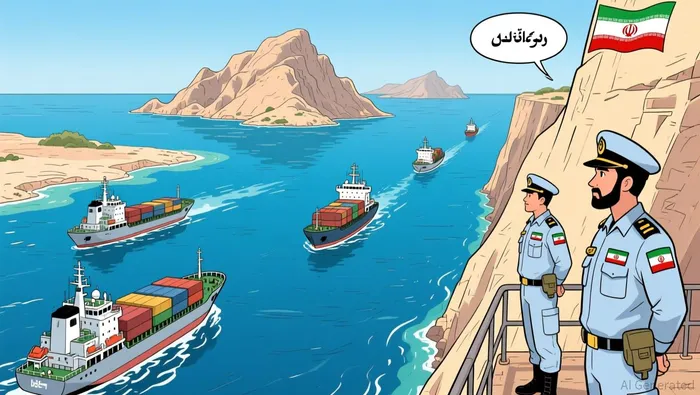
The so-called "Iranian corridor" through the Strait of Hormuz has developed as a tightly regulated, unofficial passage under significant pressure. Far from being an open trade route, this narrow channel is subject to strict Iranian oversight and presents considerable risks. On a typical day, only four ships have been recorded leaving the Persian Gulf via this northern path, which closely follows the Iranian coastline between Larak and Qeshm islands. This minimal traffic is just a shadow of the volume seen before the conflict.
Functioning much like an unofficial checkpoint, the corridor's access is unpredictable. A recent event where three Chinese vessels were denied passage for lacking proper authorization highlights the arbitrary nature of entry. The Iranian Revolutionary Guard Corps has openly declared the strait "closed," contradicting previous statements and cautioning ships against using the corridor without explicit approval. Even those with prior clearance remain at the mercy of Tehran's decisions, always facing the possibility of being turned back.
Iran is now working to formalize its control over this route. Lawmakers are drafting legislation to impose fees on ships seeking safe transit, signaling a move to institutionalize and profit from its authority over the strait. For now, the corridor remains a restricted and evolving passage, characterized by limited daily crossings, the power to refuse entry, and the looming introduction of official tolls.
Impact on Iranian Exports and the Rise of Petro-Yuan Trade
Despite the corridor's limitations, Iran's main export operations remain largely unaffected. Oil production and shipments from Kharg Island, the country's primary export terminal, continue uninterrupted. Iran has made it clear that any attack on this crucial hub would provoke a severe response, warning of consequences even greater than a full closure of the Strait of Hormuz. This situation—steady exports from Kharg alongside a blocked main strait—necessitates alternative routes and financial mechanisms.
Meanwhile, US actions have paradoxically accelerated the development of parallel systems. While targeting Kharg Island, Washington has also temporarily eased sanctions on Iranian oil, allowing tankers to deliver crude to China. Over recent years, Iran has established a covert "shadow fleet" to circumvent US restrictions and prioritize China as its main customer. This has fostered a growing trade network that operates outside the reach of the US dollar and financial oversight.
This alternative network is becoming more formalized. Reports suggest Iran may soon require that broader access to the strait be contingent on settling transactions in yuan, effectively codifying current practices. Every barrel shipped to China through the restricted strait bypasses the dollar system, while tankers from other Gulf nations remain idle. The infrastructure supporting this petro-yuan trade—including China's Cross-Border Interbank Payment System and barter deals—has proven resilient even during conflict and is unlikely to disappear once hostilities end.
For Iran, this corridor and yuan-based trade provide a crucial means to sustain export levels despite the main route's closure. For China, it ensures a steady, discounted oil supply and advances efforts to reduce dependence on the dollar. This arrangement represents a risky but practical workaround, bypassing traditional bottlenecks and financial controls, and illustrates how geopolitical pressure can spur the creation of alternative economic systems.
Risks and Constraints: The Corridor's Fragility
The corridor's potential as a dependable supply route is severely limited by both its operational weaknesses and political instability. Its throughput is negligible compared to the vast volumes it aims to replace. Before the conflict, approximately 20 million barrels of oil flowed through Hormuz each day. Now, with only four ships making the journey daily, the corridor offers little relief from the supply shortfall, which the IEA describes as having slowed to a mere "trickle."
Political unpredictability is the corridor's greatest weakness. Iranian control is inconsistent and subject to abrupt changes. The recent refusal of passage to three Chinese ships for lacking clearance is a clear example. The Revolutionary Guard's announcement of the strait's closure, which contradicted earlier reassurances, shows that even authorized vessels are not guaranteed safe passage. Iran has also threatened to block ships associated with the US and Israel, using the corridor as a political lever rather than a neutral trade route.
Operational transparency is further undermined by electronic disruptions and the intentional disabling of Automatic Identification System (AIS) transponders. Many ships, especially those carrying Iranian crude, cross with their transponders switched off, making it difficult to verify actual movements and assess the corridor's real capacity. This lack of visibility increases uncertainty for buyers and traders, diminishing the corridor's reliability as an alternative route.
In summary, the corridor remains a risky and limited experiment. It is highly susceptible to sudden political shifts, its capacity is insignificant compared to the scale of disruption, and deliberate obfuscation clouds its true operation. At present, it does not offer a dependable alternative for global oil supply.
Key Developments to Monitor
The future of the corridor depends on several critical factors that will determine whether it becomes a more established feature of the global oil landscape or fades as an unreliable option. The most immediate issue to watch is whether Iran enacts its proposed legislation to charge ships for using the strait. This move would mark a significant step toward formalizing Tehran's control and transforming a wartime measure into a potential source of revenue, though details on rates and enforcement remain unclear.
Tracking the number of vessels using the corridor is also essential for gauging its real-world significance. Currently, only four ships are observed leaving the Gulf daily, a minuscule figure compared to the pre-war flow of 20 million barrels per day. Any sustained rise in these numbers, especially if confirmed by multiple tracking sources, would suggest the corridor is gaining traction. Conversely, continued low volumes or erratic usage would reinforce its status as a fragile, politically sensitive route. Ongoing electronic interference and ships operating without AIS make this data unreliable, so updates as more information becomes available will be important.
Wider market dynamics also play a role. The blockade has already forced major producers to cut output by at least 10 million barrels a day. If the conflict endures, further reductions are likely, increasing the urgency for alternative routes. Watch for the development of new, stable shipping lanes or significant changes in the behavior of other Gulf exporters. The corridor's value as a backup option grows as the main disruption persists.
Ultimately, the corridor remains a low-capacity, politically unstable route. Its throughput is negligible compared to the disruption, and its operation is subject to abrupt political decisions. This leaves global oil markets vulnerable to further shocks. For now, the corridor is a high-risk, provisional experiment rather than a reliable alternative supply channel.
Disclaimer: The content of this article solely reflects the author's opinion and does not represent the platform in any capacity. This article is not intended to serve as a reference for making investment decisions.
You may also like
SOL Faces Influx of Exchange Deposits and Security Incident, Market Prospects Remain Unclear

Smart investors increase holdings in Japan ETFs as global tensions challenge ongoing reform efforts

General Motors Sees 9.7% Decline in Q1 Sales Due to Tariff Surge and Severe Winter Weather

uniQure Approaches April 13 Court Deadline Amid Stricter FDA Position on Gene Therapy Study

Trending news
MoreCrypto prices
More





