

Stock market investing can be stressful. After all, it's no fun to see your net worth fluctuate up and down like a roller coaster. That said, investors who want to sleep a little easier should consider betting on stable blue chip companies with large dividends. These businesses tend to experience less volatility, and the combination of capital appreciation and compounding payouts could lead to substantial long-term returns.
Let's explore why Procter & Gamble (PG 0.19%) and Philip Morris International (PM +0.36%) fit the bill and could make great picks to buy and hold for the long haul.
Procter & Gamble
Since its founding in 1837, the business has grown to become one of the world's largest consumer goods companies, known for market-dominating products like Tide laundry detergent and Gillette razors. Its safe business model, consistent profitability, and market-crushing dividend make it ideal for investors who prioritize stable returns.
Key Data Points
It's difficult to conclusively measure a company's safety. But it can arguably be boiled down to two key factors: diversification and recession resistance. Over the last few decades, Procter & Gamble has established a presence in multiple relatively unrelated parts of the economy. And this characteristic prevents weakness in one specific category from having a large impact on the company's overall performance.
For example, in the unlikely event that the toothpaste market declines, the detergent or personal grooming businesses could make up for it. The company has the added benefit of focusing on staple goods -- items that people tend to continue buying even in a bad economy.
With a market cap of $335 billion, Procter & Gamble is mature and established, so investors shouldn't expect explosive stock price growth. Much of its long-term returns will come from its dividend, currently yielding 2.94%. Management has increased its payout for 69 years in a row. The company has what it takes to maintain its track record for more decades.
Image source: Getty Images.
Philip Morris International
U.S. tobacco company Altria (previously known as Philip Morris) has been one of the top-performing American stocks over the last century; if someone were lucky enough to have a great-grandparent who invested $1 in the company in December 1925, and subsequent generations reinvested all the dividends without selling, all the branches of the family tree could divvy up a jackpot of $2.65 million by 2023.
And speaking of descendants, the company's successor still has what it takes to deliver substantial returns. In 2008, Philip Morris split into two companies: Altria Group, which assumed its U.S. operations, and Philip Morris International, which took over the global business. Over the last five years, the two companies' performance has started to diverge, with Philip Morris International gaining 83% compared to Altria's gain of just 29% over the same period.
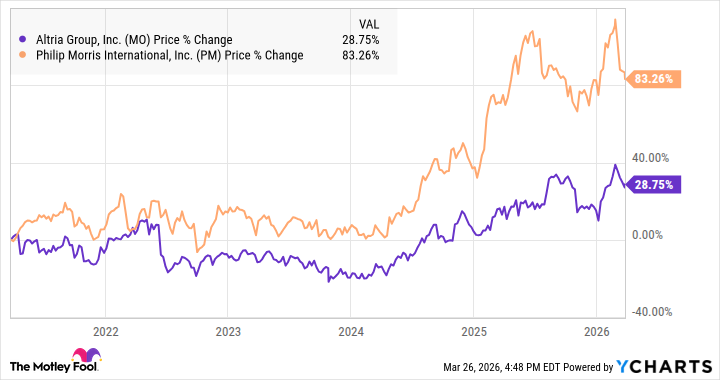
The success of the international business may have a lot to do with its diversification. With major operations across Europe, Latin America, and Asia, no one region can have an outsize impact on its sales. This is very important in an industry like tobacco, where regulatory changes can dramatically impact the business in a particular country.
Philip Morris International has also made the decision to pivot away from traditional cigarettes to products that expose users to lower levels of some harmful chemicals. It patented a system called Iqos, which heats tobacco instead of burning it. The company also acquired oral tobacco giant Swedish Match in a $16 billion deal that has given it access to the category-leading oral tobacco product Zyn while dramatically expanding its distribution channels in the U.S. market.
Key Data Points
Like Procter & Gamble, Philip Morris International is serious about its dividend. The yield now totals 3.55%, and it has increased its payout for 17 years in a row. While both companies are long-term winners, Philip Morris looks like the better buy because of its larger dividend and innovation-driven growth strategy.





