
Lockheed’s War Premium May Already Be Maxed Out—Execution Now Determines Upside

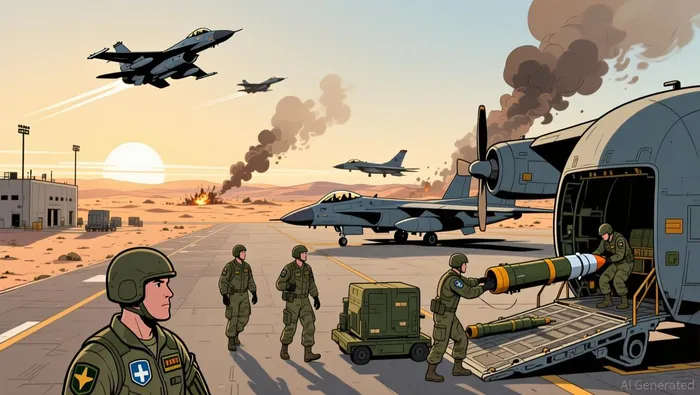
The market's reaction to the Iran conflict has been a textbook case of a "FOMO trade" in motion. When the war erupted on February 28, 2026, it triggered explosive demand for defense products, from precision munitions to aerospace components. The result was a sharp sector rotation, with defense stocks like Lockheed Martin, RTX, and Northrop Grumman surging dramatically while the traditional safe-haven tech sector has struggled. This shift has been so pronounced that tech and other megacap tech-related stocks have led U.S. equity indexes lower, contributing to the S&P 500's worst quarterly performance in about four years.
The core expectation gap here is clear. The market has aggressively priced in a prolonged, high-intensity conflict, driving defense shares higher on the promise of war-driven revenue. Yet, the sector's recent surge may have already captured the maximum expected war-driven revenue upside. The setup now is one of high sensitivity: with the markets poised to be "extremely sensitive to headlines", the next move for defense stocks hinges on whether the conflict's duration and intensity can exceed current, already-optimistic pricing. Without a fundamental earnings beat that signals even greater profit expansion, the room for further gains appears limited. The rotation has happened; the question is whether the trade has gone too far, too fast.
The War Premium vs. The Backlog: Separating the Signal from the Noise
The market's 40% rally in Lockheed MartinLMT-- is a story of two parts: a powerful war premium layered on top of an exceptionally strong fundamental base. The key to the trade's sustainability is separating the signal-the real, contracted revenue-from the noise of geopolitical speculation.
The war premium hinges on one variable: the duration of the Strait of Hormuz disruption. This energy shock is the catalyst that could force Congress to rapidly approve the Pentagon's $200 billion supplemental request, directly funding the conflict and creating a massive, additive demand for munitions and fighters. The premium is already priced in to some degree, but it remains conditional. The real valuation floor, however, is Lockheed's record $194 billion backlog, which represents roughly 2.5x its annual revenue. This is not speculative demand; it is contracted, government-obligated revenue under a new, long-term framework that enables rapid scaling of production. The structural driver here is the shift away from annual awards to multi-year contracts, which provides the company with a reliable growth trajectory.


Yet, this cycle faces a persistent headwind that has plagued the sector for a decade: the struggle to convert top-line growth into bottom-line expansion. Despite soaring backlogs and revenue, defense companies have historically struggled to grow profits above a low-single-digit annual rate. This is due to structural margin pressures, including increasing technological complexity and mounting negotiating power from the U.S. government, especially on fixed-price contracts. The question for investors is whether the current conflict is different. The war is adding demand, but if profit growth remains capped, the market may be betting on new conflicts to keep revenue expectations elevated. In other words, the trade is now a bet on the war's duration, but the underlying business model has not fundamentally changed.
The bottom line is that the war premium is a volatile, headline-driven variable, while the backlog provides a stable, but not necessarily high-margin, floor. The expectation gap now is whether LockheedLMT-- can execute on its massive production ramps fast enough to beat the earnings growth already priced into its current valuation. If the Hormuz disruption is prolonged, the premium could extend. If supply chain constraints limit execution, the stock's ability to rise further may be capped by the same margin pressures that have held profits back for years.
The Expectation Gap: Execution vs. Priced-In Optimism
The market's aggressive pricing of a prolonged conflict has created a high-stakes expectation gap. Defense stocks have rallied hard, but the real test is whether companies can convert soaring demand into near-term earnings growth fast enough to justify those elevated prices. The risk of disappointment is rising.
Analyst sentiment reflects this caution. While the sector's fundamentals are strong, the consensus view is one of hesitation. Median price targets for major defense names suggest limited upside from recent levels, implying that much of the war-driven optimism is already baked in. The trade is no longer a simple bet on geopolitical headlines; it is a bet on flawless execution. The constraint is conversion speed. Turning a record $194 billion backlog into revenue takes time, and companies must now beat an EPS growth trajectory that the market has already priced into its current valuation. Any stumble in ramping production or meeting guidance could trigger a sharp reset.
This dynamic is further complicated by the broader market's rotation. The tech sector's weakness, which has led the S&P 500 to its worst quarterly performance in years, has reduced the opportunity cost of holding defense stocks. With the sector's forward P/E ratio now falling close to the S&P 500's, defense shares are becoming a more attractive alternative if tech underperformance persists. This provides a floor, but it also means the sector's valuation is no longer commanding a significant premium for its growth story. The expectation gap is now a race between the pace of operational execution and the durability of the geopolitical catalyst. If the Hormuz disruption is prolonged, the premium could extend. If supply chain constraints or margin pressures limit execution, the stock's ability to rise further may be capped by the same structural headwinds that have held profits back for years.
Catalysts and Risks: What to Watch for the Next Move
The current thesis for defense stocks rests on a fragile equilibrium: a war premium layered on a strong fundamental base. The next move will be dictated by concrete signals that either confirm this setup or trigger a sharp reset. Investors must watch three key catalysts.
First, the near-term test is earnings execution. The war premium is a top-line story, but the market has already priced in a significant revenue boost. The critical question is whether this translates into accelerated earnings per share growth. Quarterly reports will be the first real data point on this conversion. If companies can show that soaring demand is flowing through to the bottom line faster than expected, it could validate the premium. Any miss on EPS growth, however, would signal that the operational execution is lagging the priced-in optimism, likely triggering a sell-off.
Second, the conflict's trajectory is the ultimate variable. The market is now "extremely sensitive to headlines," and a de-escalation or ceasefire would directly challenge the core catalyst. The recent rally in March was sparked by hopes for an end to the war, a classic "sell the news" dynamic. Any positive development on the diplomatic front would likely prompt a sharp reversal, as the war-driven revenue premium evaporates. Conversely, if the conflict intensifies or spreads, it could extend the premium. The duration of the Strait of Hormuz disruption is a key metric to monitor, as it directly influences the likelihood of a massive supplemental funding request.
Third, the opportunity cost of holding defense stocks is shifting. The tech sector's weakness, which has led the S&P 500 to its worst quarterly performance in years, has reduced the appeal of safe-haven alternatives. If war-related economic headwinds-like rising yields-continue to pressure tech valuations, the forward P/E ratio of the sector could fall further. This would make defense stocks look relatively more attractive, providing a floor for the sector. However, if tech stabilizes or rebounds, the relative advantage of defense diminishes, increasing the pressure on defense stocks to deliver standalone growth.
The bottom line is that the expectation gap is now a race against time. The trade has been made; the next move depends on whether the conflict's duration can exceed the market's already-optimistic pricing, and whether companies can execute fast enough to beat the earnings growth already baked into their valuations.
Disclaimer: The content of this article solely reflects the author's opinion and does not represent the platform in any capacity. This article is not intended to serve as a reference for making investment decisions.
You may also like
SOL Faces Influx of Exchange Deposits and Security Incident, Market Prospects Remain Unclear

Smart investors increase holdings in Japan ETFs as global tensions challenge ongoing reform efforts

General Motors Sees 9.7% Decline in Q1 Sales Due to Tariff Surge and Severe Winter Weather

uniQure Approaches April 13 Court Deadline Amid Stricter FDA Position on Gene Therapy Study
Trending news
MoreCrypto prices
More





