
"Lehman moment" shadow reappears? Blue Owl hit by $5.4 billion in redemptions, private credit funds accelerating withdrawals

The private credit industry, once seen as a key growth engine on Wall Street, is now facing the challenge of intensified capital outflows. Blue Owl Capital’s two core private credit funds experienced investor redemption requests totaling approximately $5.4 billion in the first quarter of this year, accounting for 22% of the size of its largest fund and 41% of its technology fund. This rare and large-scale wave of redemptions has not only impacted the company’s assets under management but has also triggered a market-wide re-examination of liquidity, valuation, and the long-term growth model of the private credit industry.
$5.4 Billion in Redemptions—Blue Owl in the Spotlight
Data shows that Blue Owl Capital saw redemption requests amounting to about $5.4 billion this time, affecting two key private credit funds. Their flagship fund, with an approximate size of $36 billion, faced redemption requests of about 22%, while another fund focused on the technology sector saw a redemption ratio as high as 41%.
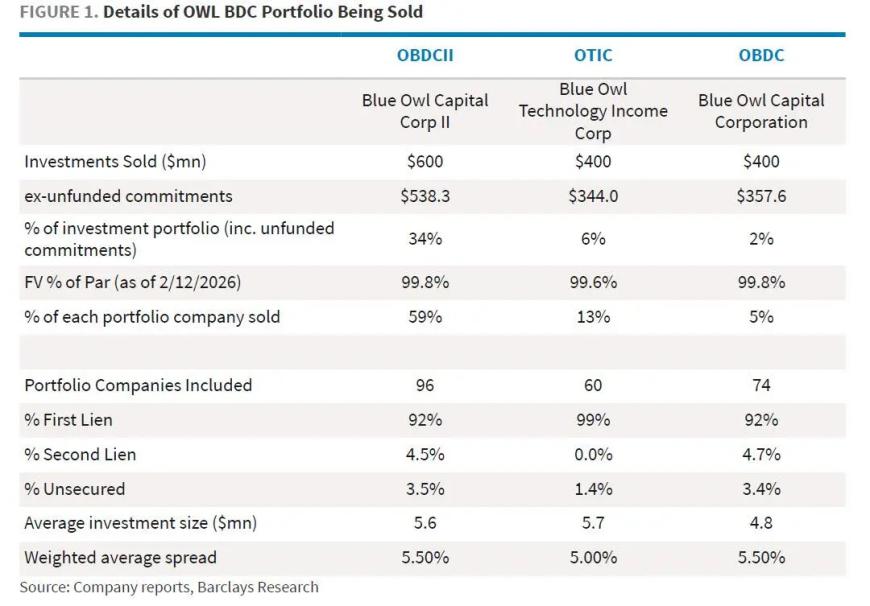
(Source: Company report, Barclays Research)
Such large-scale capital withdrawals are uncommon in the private credit sector and indicate a clear shift in investor sentiment. Private credit, which rapidly expanded in recent years, once attracted massive inflows due to stable returns and relatively high yields, but under current conditions, this model is undergoing a stress test.
After the announcement, Blue Owl’s share price fell sharply, with a year-to-date decline of over 40%, reflecting market concerns about its future growth potential.
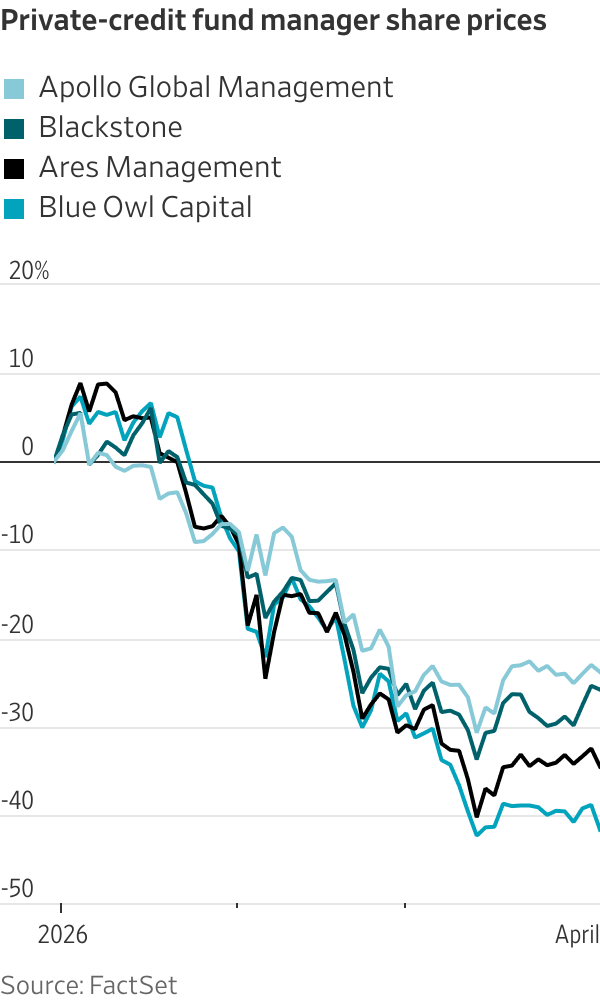
(Image source:FactSet)
From “High-Yield Safe Haven” to Capital Exodus
In recent years, private credit has swiftly risen to become a crucial financing channel outside of traditional banks, especially for providing loans to companies with lower credit ratings. However, this model relies heavily on continuous capital inflows and stable default rates.
Over the past year, several high-profile defaults have begun to erode investor confidence. At the same time, investors have become increasingly aware that private credit assets are less liquid; once market conditions deteriorate, the difficulty of redemption rises significantly. This shift in perception is a key trigger for capital outflows.
Data shows that in the last two quarters, investors have already withdrawn more than $11 billion from private credit funds, indicating this trend is not isolated but represents an industry-wide structural change.
Private credit funds generally impose redemption restrictions, usually allowing redemptions of no more than 5% of the total fund shares per quarter. This mechanism is designed to manage liquidity risk, but when redemption demands surge, it may also heighten investor anxiety.
Blue Owl has also implemented a 5% redemption cap this time. According to data, its flagship fund will pay out about $988 million for redemptions while attracting approximately $872 million in new capital inflows, resulting in a net outflow of around $116 million.
Although the company claims its funds hold more than $11.3 billion in cash, credit lines, and highly liquid assets—enough to meet at least two years of redemption demands—market concerns persist that if redemption pressure remains, the fund may have to sell loan assets at a discount, further eroding returns.
Institutional Divergence: Clear Strategy Divides Emerge Within the Industry
Facing redemption pressures, private credit firms are adopting distinct strategies.
Some firms are choosing to raise their redemption caps to reassure investors—for example, Blackstone and Cliffwater have increased theirs to 7–8%; while other firms, such as Apollo, Ares, and BlackRock, are holding to the 5% restriction to protect the interests of remaining investors.
This divergence reflects an evolving competitive landscape within the industry:
“Liquidity-First” camp: Seeking to maintain investor confidence through higher redemption limits
“Asset Protection” camp: Prioritizing asset quality and long-term returns
However, whichever strategy is adopted, neither can completely avoid the pressure of capital outflows.
External Pressure: Dual Shocks from Macro and Policy Environment
The challenges facing the private credit industry are not limited to internal structural issues but are also influenced by broader macroeconomic changes.
On one hand, artificial intelligence is disrupting business models in the software industry, making the profit outlook of some borrowing firms uncertain; on the other hand, conflict in the Middle East has driven up energy prices, exacerbated inflation, and increased both financing costs and default risks for companies.
Additionally, the U.S. Treasury has stated it will discuss risks in the private credit market with regulators, indicating the industry may face stricter regulation in the future.
Meanwhile, the Trump administration is pushing to include private credit in the 401(k) pension system—a policy shift that, in the current environment of redemption pressure, is drawing increased controversy.
Market Maneuvering: Hedge Funds Move In to “Bottom Fish”
As the industry comes under stress, some hedge funds are seizing the opportunity.
Saba Capital founder Boaz Weinstein has proposed purchasing Blue Owl fund shares at 65–80% of net asset value, providing a liquidity exit for investors. Although this means investors must take a certain loss, it also highlights the “discount arbitrage” opportunities present in the market.
This scenario suggests that the private credit market is shifting from a stage of “incremental expansion” to one of “stock-based competition.”
Disclaimer: The content of this article solely reflects the author's opinion and does not represent the platform in any capacity. This article is not intended to serve as a reference for making investment decisions.
You may also like
Welcoming Super Central Bank Week
An unexpected event occurred just 15 minutes after the market opened
MaskNetwork (MASK) fluctuates 40.1% in 24 hours: Trading volume soars 1790% amid technical breakthrough
Trending news
MoreCrypto prices
More





