
April 3 Financial Morning Brief: Rate Hike Expectations Intensify, Gold Price Falls Below 4700, Trump Vows to Continue Striking Iran, Oil Prices Surge Over 13%

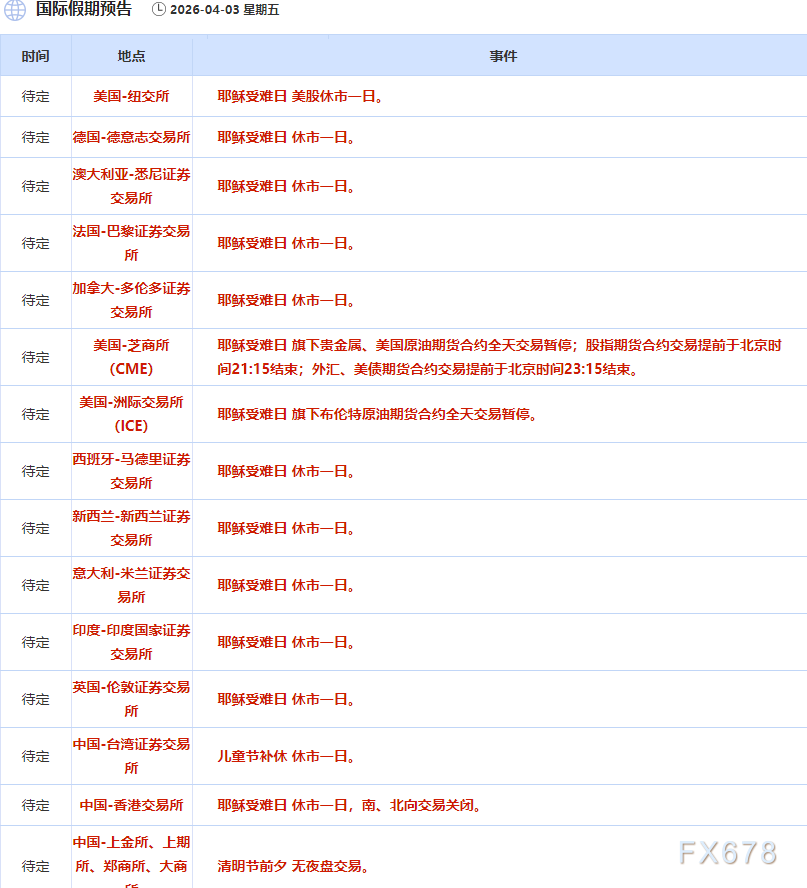
Huitong Network, April 3—— On the morning session of April 3 in the Asian market (UTC+8), trading in gold and crude oil was suspended throughout the day due to Good Friday. However, gold prices fell sharply on Thursday, finally closing below $4,700/ounce, impacted by a stronger US dollar and rising expectations of a rate hike.
On Friday (April 3, UTC+8) in the Asian early trading session, trading in gold and crude oil was suspended throughout the day due to Good Friday. However, on Thursday, gold prices tumbled, ultimately closing below $4,700/ounce, pressured by the strengthening US dollar and rising expectations of a rate hike. Oil prices surged over 13% on Thursday, with US crude climbing above $112/barrel, marking the largest single-day absolute gain since 2020, as US President Trump vowed to continue striking Iran and provided no timetable for ending hostilities or reopening the Strait of Hormuz.
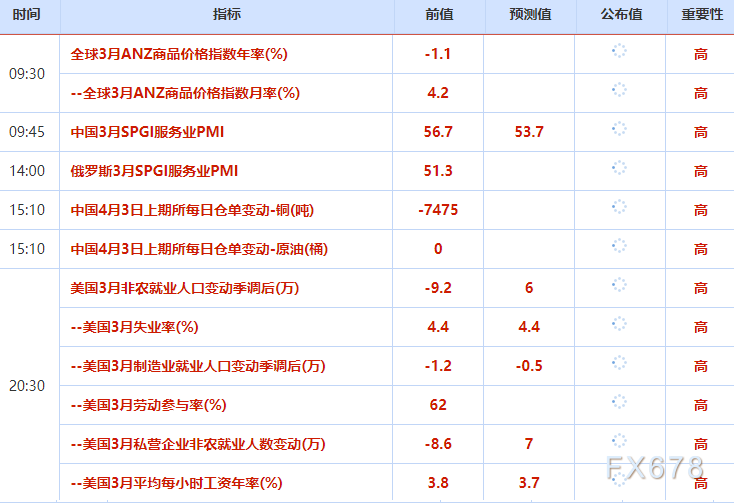
Key Focus of the Day
Stock Market
US stocks closed mixed on Thursday. The Dow Jones Industrial Average dipped 0.13% to 46,504.67 points, the S&P 500 rose 0.11% to 6,582.69 points, and the Nasdaq went up 0.18% to 21,879.18 points. Early market declines were triggered by Middle East tensions and soaring oil prices, but investor sentiment stabilized after diplomatic signals such as Iran and Oman drafting a passage protocol for the Strait of Hormuz and the UK stating that multiple countries were discussing solutions, alleviating supply concerns.
All three major indices posted their biggest weekly gains in four months this week, marking their first weekly increase in six weeks: the S&P 500 rose 3.36%, the Nasdaq by 4.44%, and the Dow by 2.96%.
Among sectors, utilities and real estate performed well, while consumer discretionary led the declines as Tesla's deliveries posted their weakest quarter in a year, causing its share price to fall by 5.4%.
In addition, Blue Owl set a redemption cap for its retail fund, triggering tension in the private credit market. The market is next watching for SpaceX's secret IPO filing and Friday's nonfarm payrolls data. Ahead of the Good Friday holiday, the VIX Fear Index fell to 23.87 points.
Gold Market
Gold prices tumbled on Thursday, pressured by a stronger US dollar and rising rate hike expectations. Spot gold fell 2.2% to $4,651.35 per ounce, and US gold futures settled down 2.8% at $4,679.70. US President Trump stated that attacks on Iran would persist, vowing to bomb Iran back to the "Stone Age." This sent oil prices surging, exacerbated inflation concerns, and lessened the possibility of rate cuts, putting pressure on non-interest-bearing gold.
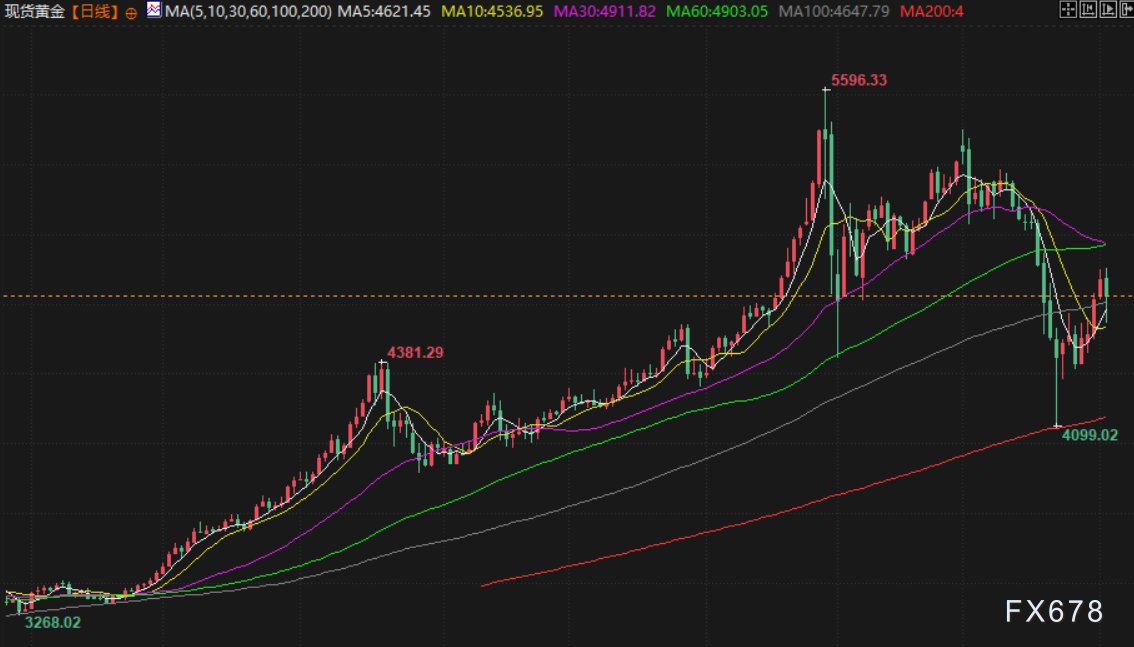
Since the outbreak of the Middle East conflict on February 28, spot gold has fallen 12% cumulatively. Market sentiment was further hit by Turkey's central bank gold reserves plunging by over 118 tons within two weeks (down 69.1 tons to 702.5 tons last week). On the demand side, softening gold prices boosted Indian gold trading prices to a premium for the first time in two months.
For other precious metals, spot silver plunged 3.7% to $72.38, platinum rose 0.9% to $1,981.95, and palladium increased by 1.9% to $1,497.00.
Oil Market
International oil prices soared on Thursday. US crude oil closed up more than 13%, at $112.06 per barrel, marking the largest single-day absolute gain since 2020; Brent crude futures closed up 7.78% at $109.03 per barrel. The surge was due to US President Trump's pledge to continue striking Iran and the lack of a timetable for ending hostilities or reopening the Strait of Hormuz.
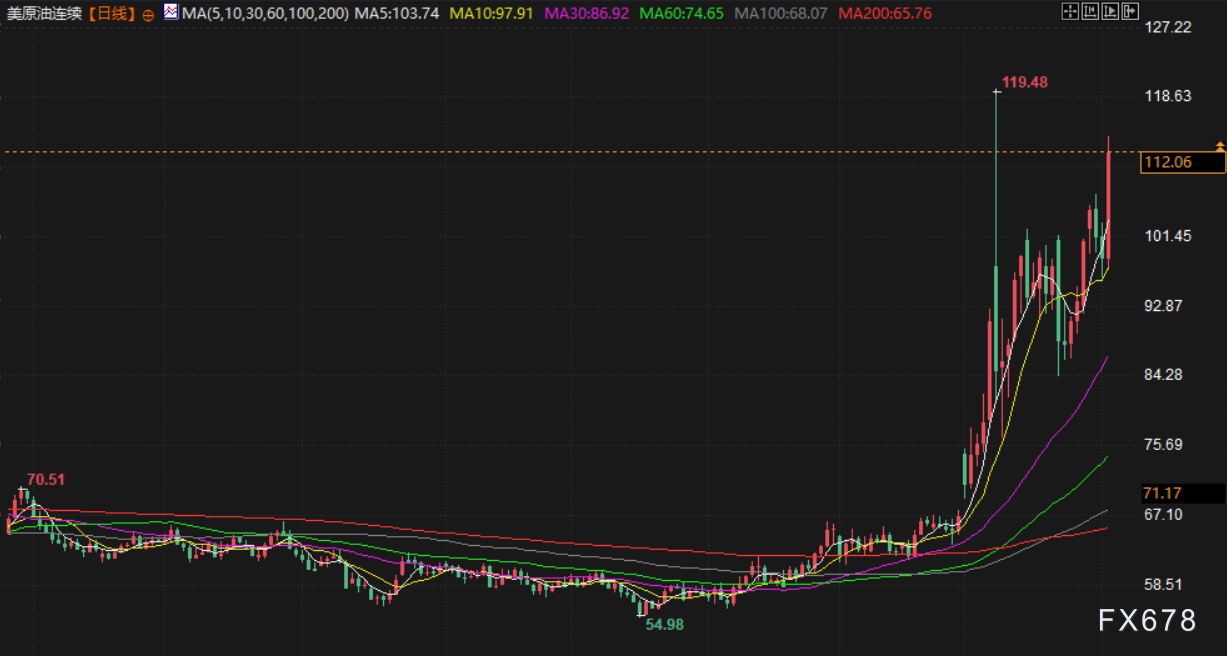
Trump declared that extremely fierce attacks would be launched within the next two to three weeks, vowing to bomb Iran back to the "Stone Age." This escalated market fears of lasting disruptions to oil supplies. Although Iran is drafting a protocol with Oman for monitoring vessel traffic through the Strait of Hormuz, traders are now focused on the risks facing Iranian oil infrastructure.
Recently, the premium of US crude contracts over Brent reached the highest level in nearly a year, and the spread between near-month and future contracts also hit record highs. Dallas Federal Reserve President Logan remarked that if the war ends quickly, the economic impact may be relatively mild, but uncertainties remain.
Citi expects Brent crude's average baseline scenario price in the second half of the year at $95 per barrel, potentially reaching $130 in an optimistic scenario; JP Morgan said oil prices could rise to $120–130 in the near term, and if the Strait of Hormuz remains closed until mid-May, prices may exceed $150.
Forex Market
The US Dollar Index rebounded sharply on Thursday after two days of declines, rising 0.46% to 100.02. Amid renewed concerns over Middle East conflict, President Trump vowed to launch more severe strikes against Iran within the next two to three weeks, without providing a timetable for reopening the Strait of Hormuz or ending the war. Iran's military responded with warnings of stronger attacks. Expectations for a quick end to the conflict were dashed and safe-haven demand surged.
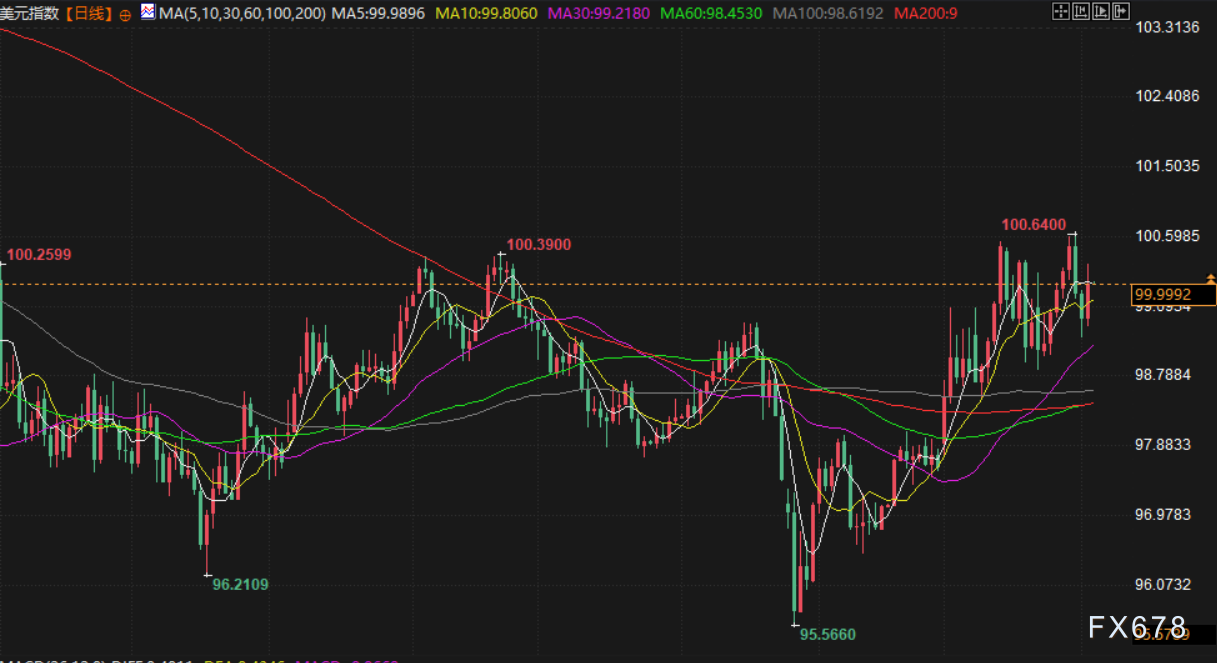
The US dollar rose 0.6% against the Swiss franc to 0.799 and climbed 0.5% against the Japanese yen to 159.57 yen, nearing the 160 level that could trigger intervention from Japanese authorities. The euro fell 0.45% to $1.1536, and the pound dropped 0.63% to $1.3222, giving up recent gains.
The market is also focused on Friday’s US nonfarm payrolls report, with 60,000 new jobs expected in March.
International News
According to CME "FedWatch": The probability of the Fed raising rates by 25 basis points in April is 0.5%, and the chance of holding rates unchanged is 99.5%. The probability of a cumulative 25 basis point rate cut by June is 6.0%, holding rates unchanged is 93.5%, and a 25-bp rate hike is 0.5%. By December, the probability of a cumulative 25-bp rate cut is 35.1% (up from 25.1% the previous day), holding rates unchanged is 50.2% (down from 73% the previous day), and a cumulative 25-bp hike is 14.7% (up from 1.9% the previous day).
Russian presidential aide Ushakov said in a Russian media interview that the Strait of Hormuz is open to Russia. Ushakov noted that the Middle East situation is severe, and added that the US has not made requests to Russia to mediate the Middle East crisis. (CCTV News)
Axios reports that on Thursday local time, the US military launched its first attack on Iran’s key civilian infrastructure. Earlier, Trump had threatened to bomb Iran “back to the Stone Age.” The attack on the Karaj B-1 Bridge near Tehran signals that US military strike targets are expanding and may only mark the beginning of attacks on energy, water, and transportation infrastructure. A US Department of Defense official said more bridges may be targeted. The bridge was struck because Iranian armed forces used it to secretly transport missiles and missile components from Tehran to western launch sites. Large boxes and containers carrying missile parts were shipped over the bridge and assembled at the launch sites. The bridge was also used for logistics support to Iranian military forces in Tehran.
On the evening of April 2 local time, Iran's Islamic Revolutionary Guard Corps Navy issued a statement saying it conducted strikes against the US Oracle data center in Dubai, UAE, as well as the Amazon data center in Bahrain. (CCTV International News)
On the evening of April 2 local time, Yahya Saree, spokesperson for Yemen’s Houthi rebels, issued a video statement stating that the Houthis, along with Iran and Lebanon’s Hezbollah, launched another joint military operation, firing a batch of ballistic missiles at targets in central Israel near Tel Aviv, hitting key Israeli facilities. (CCTV International News)
On April 2, United Nations Secretary-General Guterres addressed the media, once again calling on the US and Israel to stop their war against Iran, while urging Iran to cease attacks on neighboring countries. Guterres stated the war is causing great human suffering and has triggered devastating economic consequences. The current escalation of the Middle East crisis has lasted for over a month, with the scale of destruction expanding, indiscriminate attacks increasing, and strikes on civilians and civilian infrastructure on the rise. “We are on the brink of a wider war.” (Xinhua News Agency)
On April 2, Argentina’s Foreign Ministry announced in a statement that the Iranian chargé d’affaires at the embassy in Argentina, Mohsen Sultani Deherani, was declared persona non grata and required to leave within 48 hours. Argentina said this was in response to Iran’s April 1 statement. On March 31, Argentina designated Iran’s Islamic Revolutionary Guard Corps a “terrorist organization”. On April 1, Iran’s Foreign Ministry condemned this decision, calling it “illegal and baseless” and saying it would harm bilateral relations. (Xinhua News Agency)
On April 2, the Beik Expressway Bridge in Karaj, Iran—dubbed the highest bridge in the Middle East and a symbol of Iranian engineering—was damaged in attacks by the US and Israel. This bridge is regarded as Iran’s benchmark engineering project and among the world’s most complex engineering feats, serving as the core transport infrastructure of the Tehran–Karaj corridor, and was scheduled to open soon. The attack damaged the main bridge structure, and the relevant section is now fully closed. Local authorities issued an emergency warning, urging the public to avoid the area. The attack also caused partial power outages in Karaj. (CCTV International News)
On April 2, the International Monetary Fund (IMF) released its Article IV consultation report on the US 2026 economy. The report points out that as the impact of tariffs gradually fades and global oil prices fall, US core PCE inflation is expected to return to the 2% policy target by the first half of 2027. The IMF forecasts US GDP growth will accelerate slightly to 2.4% in 2026, but notes that the public debt ratio has climbed to 123.9% of GDP and the current account deficit remains large. At the same time, uncertainty in energy prices could place renewed pressure on inflation.
Iran’s parliament speaker Qalibaf posted on social media, claiming to have traced the flow of funds and accusing a small group of bankers and hedge fund managers of secretly meeting last week to hijack Washington’s Iran war policy, subsequently launching an operation. Qalibaf initiated a poll asking whether to “name names,” with options for “yes,” “no” and “Ackman: was your invitation lost?” (Ackman is an American Jewish businessman and hedge fund manager). Of nearly 16,000 votes, 70% chose “yes.” This is the first time Iran has directly accused Wall Street financial capital of manipulating US policy toward war with Iran. Qalibaf suggested he would release related names but has yet to provide concrete evidence.
Domestic News
The 15th Five-Year Plan outlines steadfast promotion of innovation in key technologies like new energy storage, vigorous development of new energy storage, and identifies it as a core support for the new energy system, officially incorporating it as a pillar strategic emerging industry at the national level. The newly released "White Paper on the Energy Storage Industry 2026" projects that by 2030, China’s cumulative new energy storage installations will exceed 370 million kilowatts, more than 1.5 times the end of the 14th Five-Year Plan. (CCTV News)
Disclaimer: The content of this article solely reflects the author's opinion and does not represent the platform in any capacity. This article is not intended to serve as a reference for making investment decisions.
You may also like
SOL Faces Influx of Exchange Deposits and Security Incident, Market Prospects Remain Unclear
Smart investors increase holdings in Japan ETFs as global tensions challenge ongoing reform efforts

General Motors Sees 9.7% Decline in Q1 Sales Due to Tariff Surge and Severe Winter Weather
uniQure Approaches April 13 Court Deadline Amid Stricter FDA Position on Gene Therapy Study
Trending news
MoreCrypto prices
More





