
AST SpaceMobile’s BlueBird 7 Launch Demonstrates That Tenfold Capacity Expansion May Ignite a D2D Competition With SpaceX

AST SpaceMobile: From Prototype to Scalable Infrastructure
AST SpaceMobile has successfully transitioned from developing prototypes to establishing a validated operational infrastructure. The company is now entering a pivotal phase before widespread adoption, where its ability to scale and form strategic partnerships will be crucial for rapid expansion. The turning point came with the launch of BlueBird 6, which achieved peak data speeds of over 120 Mbps directly to standard smartphones. This achievement confirmed that AST's core technology is not just theoretical but can function effectively on a large scale.
With this technical milestone achieved, AST's attention has shifted to real-world operational testing and expanding network capacity. The U.S. Federal Communications Commission has granted temporary authorization for direct-to-device satellite service trials, enabling AST to begin mobile broadband testing with its initial fleet of five satellites. This regulatory approval is a key step, bridging the gap between laboratory validation and commercial service readiness.
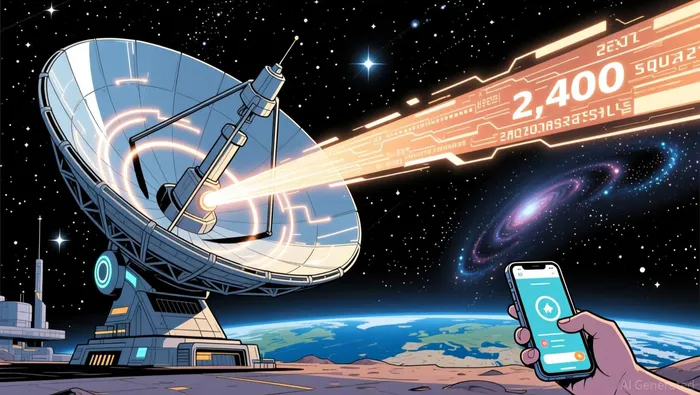
The next major advancement is represented by BlueBird 7, which is prepared for launch. This satellite features a phased array antenna covering roughly 2,400 square feet and is engineered to handle 10 GHz of processing bandwidth—a tenfold increase in capacity over earlier models. This leap in architecture is essential for supporting the massive data demands of a global direct-to-device network, marking a significant step in AST's journey toward exponential scaling.
Building the Infrastructure: Meeting 2026 Targets
With the BlueBird platform's technical capabilities now proven, AST SpaceMobile's focus is firmly on execution. The company's 2026 objectives depend on its ability to transform validated designs into a robust, scalable manufacturing and launch operation. The plan calls for deploying 45 to 60 satellites in 2026, requiring launches every one to two months. Achieving this will demand seamless coordination across engineering, production, integration, and launch logistics. The recent BlueBird 7 launch on the New Glenn rocket marks the first step in this ambitious rollout.
Currently, 29 Block 2 BlueBird satellites are in production, with a goal of having 60 ready for shipment within the year. Accelerating this pace is essential to keep up with the planned launch schedule.
Operational Insights and Launch Strategy
Experience gained from deploying the large-scale BlueBird 6 satellite has equipped AST's team to manage complex systems more efficiently. This expertise will streamline future launches, enabling the company to send satellites into orbit in batches of 3, 4, 6, or 8—an approach that is vital for maintaining the required launch frequency.
The New Glenn rocket's seven-meter fairing is a game-changer, allowing up to eight Block 2 BlueBird satellites per mission. This doubles the payload compared to standard five-meter launch vehicles, making it possible to meet aggressive deployment targets without needing twice as many launches.

Financial Strength and Execution Challenges
AST SpaceMobile's financial position is strong, with over $3.9 billion in cash at the end of 2025 and significant capital expenditures—$407 million in the fourth quarter alone. A recent convertible note issuance has further bolstered its resources. The primary challenge now is not funding, but executing on manufacturing and launch schedules. Success depends on the company's ability to meet these operational milestones consistently.
Strategic Positioning and Industry Competition
AST SpaceMobile is positioning itself as a critical alternative to SpaceX in the satellite telecom sector. This narrative is essential for attracting industry support and addressing concerns about a potential SpaceX monopoly.
Key partnerships with AT&T and Verizon form the foundation of this strategy. AT&T's long-term agreement through 2030 is a deliberate move to maintain network independence and avoid reliance on Starlink. Verizon's 2025 agreement, which includes a $100 million investment, further validates AST's approach. With T-Mobile's exclusivity with SpaceX ending in 2026, Verizon faces a strategic decision: align with SpaceX or support AST to maintain leverage in the market.
AST's competitive strategy also involves spectrum partnerships. Ligado Networks is seeking FCC approval to modify its L-band license to collaborate with AST, aiming to combine Ligado's spectrum with AST's satellite network. This move is seen as crucial for maintaining competition in the space-based mobile broadband market and preventing a single-player monopoly.
The FCC's temporary approval for service testing is a significant regulatory milestone, enabling AST to move from lab-based validation to real-world service trials. This step is vital for building confidence among partners and investors as the company approaches commercial rollout.
Ultimately, AST's competitive advantage is being shaped by its alliances and regulatory support, not just its technology. The company's continued existence is viewed as essential for a telecom industry determined to avoid a SpaceX-dominated future. The next steps involve solidifying the Ligado partnership and leveraging regulatory approvals to accelerate operational scaling ahead of the 2026 deadline.
Financial Outlook and Growth Prospects
AST SpaceMobile's financial resources provide a solid foundation for its ambitious infrastructure expansion. In 2025, the company secured over $3.5 billion in new capital, ending the year with approximately $3.9 billion in cash. This substantial war chest, enhanced by a convertible note offering, supports the company's capital-intensive growth plans. The main risk lies in execution—converting this liquidity into operational satellites and a functioning network before the funds are exhausted.
Revenue generation is still in its early stages. In 2025, AST reported over $70 million in revenue, with $54.3 million coming in the fourth quarter, primarily from hardware sales and government contracts rather than commercial satellite services. This is typical for a company still building its infrastructure, with significant revenue growth expected as the network scales and commercial services launch.
Looking ahead, management forecasts 2026 revenue between $150 million and $200 million, marking a substantial increase but still early in the adoption curve. The company is shifting from hardware sales and commitments to selling connectivity, a transition that will accelerate as the satellite constellation grows and beta testing yields positive results. The stock's recent volatility, including a 10.28% surge and a 52-week high of $129.89, reflects investor anticipation of this transition. With a price-to-sales ratio near 500, the market is betting on rapid future growth, leaving little margin for error.
Key Catalysts, Risks, and What to Monitor
AST SpaceMobile's future now depends on several near-term milestones that will either confirm or challenge its growth narrative. The most significant upcoming event is the beta launch scheduled for summer 2026, which will be the first substantial test of the network's commercial viability and user adoption. Success would demonstrate the network's reliability and capacity, shifting the company's story from hardware and partnerships to service delivery. Failure, however, would highlight the gap between proven technology and scalable operations.
Execution risk remains the primary concern. AST must maintain its aggressive pace of launching 45 to 60 satellites in 2026 to stay competitive. SpaceX, already offering commercial service with T-Mobile, will see its exclusivity with T-Mobile expire by late 2025 or early 2026, putting pressure on AST to scale quickly. Any delays in production or launches could allow SpaceX to strengthen its market position and reduce the urgency for partners like Verizon to support AST.
The stock's high volatility—17.8% intraday swings and a negative P/E ratio—reflects the market's sensitivity to these milestones. The recent 10.28% jump underscores how news can rapidly shift investor sentiment. The binary nature of upcoming events means that a successful beta launch could drive the stock higher, while setbacks could lead to sharp declines.
Investors should closely watch the alignment between satellite production and launch schedules. With 29 Block 2 satellites currently in production and a goal of 60 ready for shipment this year, the company's ability to accelerate manufacturing will be critical. The Ligado spectrum partnership, if approved, would further strengthen AST's competitive position, but the main focus remains on meeting launch targets and scaling operations.
Disclaimer: The content of this article solely reflects the author's opinion and does not represent the platform in any capacity. This article is not intended to serve as a reference for making investment decisions.
You may also like
SOL Faces Influx of Exchange Deposits and Security Incident, Market Prospects Remain Unclear

Smart investors increase holdings in Japan ETFs as global tensions challenge ongoing reform efforts

General Motors Sees 9.7% Decline in Q1 Sales Due to Tariff Surge and Severe Winter Weather

uniQure Approaches April 13 Court Deadline Amid Stricter FDA Position on Gene Therapy Study

Trending news
MoreCrypto prices
More





