
VGT Undergoes Significant Decline as Tech Sector Shift Highlights ETF Concentration Vulnerabilities

The Great Rotation: A New Era for Market Leadership
Financial markets have experienced a dramatic transformation, marking the end of the "growth at any cost" mindset that propelled mega-cap technology stocks for years. In the first quarter of 2026, a significant shift in capital allocation has taken place, moving away from dominant tech giants toward smaller value-oriented companies. This transition is evident in performance: the Russell 1000 Growth index has declined 4.8% year-to-date, while the Russell 2000 Value index has climbed 8.9%, highlighting a clear change in market leadership.
This rotation reached a peak in February, when the performance gap between value and growth stocks widened to 5.15 percentage points—the largest such reversal since the aftermath of the dot-com bubble. Growth stocks fell 2.56% that month, while value stocks rose 2.59%, creating a striking divergence that caught many institutional investors off guard. This was not a short-lived event, but the result of two major forces reshaping the market.
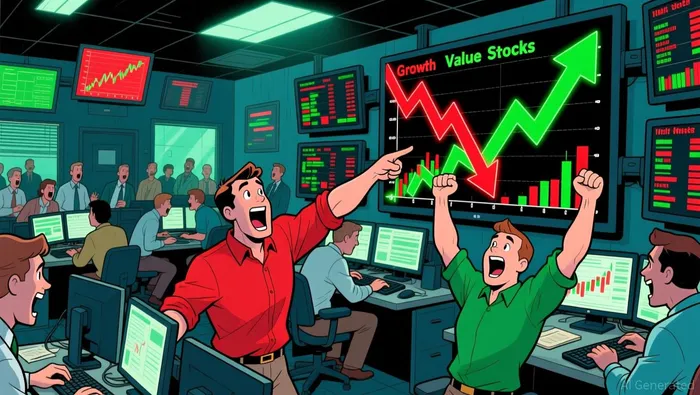
The first catalyst is the realization that the "Magnificent Seven" and similar tech leaders have entered a period of diminishing returns. The AI-driven rally, which pushed valuations to new heights, has now encountered skepticism. Alphabet’s unexpected bond issuance to fund AI infrastructure raised concerns about excessive capital spending, sparking worries about "AI Capex fatigue." Investors are questioning whether massive investments in GPUs and data centers will deliver sustainable profits. At the same time, the emergence of agentic AI models has threatened the traditional subscription-based revenue streams of leading SaaS companies, fueling a "software meltdown."
The second driver is a renewed focus on the tangible economy. As high-valuation tech stocks lose favor, investors are seeking stability in companies with physical assets and reliable cash flows. This is not merely a defensive move, but a fundamental reallocation of capital. Tech-focused ETFs such as VGT, XLK, and SMH now represent concentrated bets in a market that has broadly shifted away from their underlying growth narratives.
ETF Analysis: Comparing Concentration, Costs, and Capital Flows
For institutional investors, choosing among tech ETFs now involves careful consideration of concentration, fees, and liquidity. The ongoing shift away from growth stocks has made these differences more important than ever. The three major tech ETFs—XLK, VGT, and SMH—each offer distinct risk and return profiles based on their holdings and market positioning.
XLK, the largest technology ETF with $87.686 billion in assets, provides broad sector exposure but is heavily weighted toward a few mega-cap stocks. Its top ten holdings make up 62% of the fund, with Nvidia alone accounting for nearly 15%. This makes XLK highly sensitive to the performance of the largest tech companies—precisely those under the most scrutiny in the current market environment.
VGT, with $126.509 billion in assets, offers a more diversified approach at a lower cost. Its expense ratio of 0.09% is among the lowest in the sector, making it attractive for long-term investors seeking broad tech exposure. However, its wider range of holdings means it includes companies more exposed to the risks facing the software industry. VGT’s year-to-date return of -5.36% reflects the sector’s challenges, but its low fees provide some cushion for investors.

Yet, the most telling trend is not within tech ETFs themselves, but in the broader movement of capital. Investors have shifted heavily into fixed income, with ultra-short bond ETFs capturing nearly 45% of net ETF creations in March. Funds like the iShares 0-3 Month Treasury Bond ETF (SGOV) attracted over $8.5 billion, signaling a widespread move away from equity risk—including concentrated tech holdings—and toward cash-like safety.
In summary, these ETFs are not interchangeable. XLK represents a focused bet on a handful of large tech names, while VGT offers broader, lower-cost exposure. However, the prevailing trend is a broad exit from equities in favor of ultra-short Treasuries, reflecting a cautious institutional stance. The tools for tech exposure remain, but the supportive market environment has temporarily faded.
Sector Divergence: The Need for Selective Strategies
The broad rotation out of growth stocks has led to pronounced differences within the technology sector itself. Rather than a uniform sell-off, the market has become highly selective. While the overall tech index has stalled, semiconductor, memory, and storage companies have outperformed, while software stocks have lagged. This fragmentation challenges the effectiveness of broad sector bets and highlights opportunities for active selection.
Institutional fund flows confirm this split. The iShares Expanded Tech-Software Sector ETF (IGV) has seen significant outflows, reflecting investor concerns about software’s vulnerability to AI disruption and pressure on subscription models. Meanwhile, capital has rotated toward hardware-focused areas like semiconductors. As a result, the tech sector is now a collection of distinct sub-themes, each with its own momentum.
This volatility creates opportunities for discerning investors. High-quality companies can be overlooked during sector-wide selloffs, leading to mispricings. For instance, Microsoft and Palantir continue to demonstrate strong growth and profitability despite heavy selling, and Salesforce remains fundamentally sound. For institutional investors, these dislocations present attractive entry points for companies with durable advantages and healthy cash flows.
Additionally, as traditional growth strategies face headwinds, alternative approaches have gained popularity. Options-based income ETFs such as GPIX and GPIQ have attracted substantial inflows, offering a blend of equity exposure and income generation through call options. Each fund has drawn over $750 million in recent months, reflecting a strong appetite for strategies that provide both yield and downside protection in a volatile market.
Ultimately, the current environment demands greater selectivity. The internal rotation within tech—from software to semiconductors—requires moving beyond passive ETFs and embracing active management. Success will depend on identifying undervalued leaders and innovative strategies, rather than simply following sector trends.
Portfolio Construction: Balancing Risk and Opportunity
The analysis points to a clear conclusion for portfolio design: overweighting tech ETFs is no longer a defensive move, but a concentrated bet on a specific recovery in the sector. For institutional investors, this means making a decisive call. A heavy allocation to VGT or XLK requires confidence that the AI infrastructure cycle, potentially led by Nvidia’s Rubin chip, will reignite tech sector growth. Without this catalyst, such positions are simply momentum trades in a sector facing structural challenges.
The main risk is not a short-term pullback, but an ongoing and deepening rotation toward value stocks. The gap between growth and value has reached levels not seen since the early 2000s, and institutional flows show a clear preference for cash-like assets. If the real economy continues to outperform, tech valuations could face further pressure. Betting on tech now means going against prevailing market sentiment and the current premium on tangible cash flows.
- Key factors to monitor:
- The progress of AI infrastructure investments, especially the adoption of Nvidia’s Rubin chip.
- The stability or reversal of the growth-value performance gap. A sustained rally in growth stocks or renewed ETF inflows into tech would support a tech overweight, while a widening gap would reinforce the value rotation.
In practice, this creates a challenge for portfolio construction. Passive tech ETFs offer liquidity and broad exposure, but now represent high-conviction, high-risk bets. A more balanced approach may involve a modest tactical overweight in tech, paired with larger allocations to sectors benefiting from the rotation into the real economy. This structure hedges against continued value outperformance while maintaining exposure to a potential tech rebound driven by AI infrastructure. In today’s market, capital is not just shifting between sectors, but between fundamentally different investment themes.
Disclaimer: The content of this article solely reflects the author's opinion and does not represent the platform in any capacity. This article is not intended to serve as a reference for making investment decisions.
You may also like
Veteran Investor: I Have This Strange Feeling That XRP Is About to Do Something Stupid Again
Ethereum nears $2,000 as technical and on-chain analysis highlight accumulation zones
The Timeless Resilience: An In-Depth Chronicle of the Japanese Yen — From 360 to the Era of Carry Trade
Grayscale’s Q1 2026 Report Shows AI Crypto Lost Less Than Every Other Sector While the Market Bled
Trending news
MoreCrypto prices
More





