
APA’s Agreement in Egypt Depends on Achieving 13%-15% Output Increase — Will Effective Implementation Drive Cash Flow?

Renewed Investor Interest in Egypt: What Sparked the Shift?
Investor attention has recently turned back to Egypt, and the reason is clear. On March 31, 2026, APA CEO John Christmann held discussions with Egyptian President Abdel Fattah El-Sisi during the EGYPES 2026 conference. This high-profile meeting signals a strong political endorsement for APA’s strategic focus on Egypt, reinforcing the company’s commitment to the region.
President El-Sisi made it clear that Egypt values its ongoing partnership with APA, especially as the company pursues significant growth in the Western Desert. He pledged government support to resolve operational hurdles and address outstanding payments to foreign partners. Such direct backing from the country’s leadership sends a powerful message in a market where political risk is always a factor.
This meeting builds on APA’s successful renegotiation of its production-sharing agreements with Egypt in 2025. The March engagement marks a transition from new contract terms to active political support. While this boosts market sentiment and prompts a reassessment of risk, the long-term outcome will depend on how well APA executes under the fixed terms of the 2021 contract. The meeting reduces uncertainty but doesn’t alter the project’s core financial structure.
The Deal Structure: Fixed Economics and Its Implications
While the recent high-level talks have improved sentiment, the real risk and reward are determined by the fixed terms of the 2021 agreement. The contract follows a classic cost-recovery model, linking the joint venture’s cash flow to production levels and the government’s ability to pay down arrears.
The arrangement is straightforward: the APA-Sinopec joint venture receives a fixed 30% profit share on all output. This eliminates profit-sharing volatility but also limits upside potential. Additionally, the JV can only recover up to 40% of its investment from production before profit-sharing begins. For a project with significant accumulated costs, this cap restricts short-term cash flow generation.
The contract immediately benefits the JV by allowing it to reclaim nearly $900 million in previously incurred costs over five years, starting April 1, 2021. This provides a short-term cash boost but does not change the 40% recovery ceiling.
There’s also a substantial upfront cost: the JV paid a $100 million signing bonus to EGPC. This reduces the net benefit of the cost recovery program. With both the bonus and the 40% cap, the JV needs to achieve high production levels to realize meaningful profits, even with the fixed profit share.

In practice, this structure creates a binary scenario. If production grows as planned, the JV can work through the cost recovery limit and generate cash. If execution falters or government payments are delayed, the fixed terms offer little protection. While the meeting with President El-Sisi may reduce political friction, it doesn’t change the contract’s fundamentals. Success now depends on APA’s ability to deliver the targeted 13% to 15% annual increase in Egypt’s gross oil production.
Growth Outlook: Investment and Production Plans
The recent political support is important, but the contract’s impact will be measured by operational results—specifically, drilling activity and oil output. The agreement calls for a 13% to 15% annual increase in Egypt’s gross oil production, based on a clear plan for capital investment and scaling operations.
To achieve this, the JV aimed to double its rig count to 11 in 2021 and further increase to 15 rigs in 2022. This aggressive drilling schedule is the main driver of growth, translating contract incentives into real investment. The JV plans to boost its capital spending in Egypt by about $235 million in 2022, demonstrating a strong commitment to ramping up production.
Ultimately, these investments are targeted at hitting specific output goals. The contract’s projected 13% to 15% annual production increase is the benchmark for success. If the JV meets these targets, it can overcome the cost recovery cap and generate cash flow. If not, the fixed terms leave little room for error.
The focus now shifts to execution. With political support secured, the company must deliver on its capital-intensive growth strategy. The coming quarters will reveal whether the production targets are achievable or overly ambitious.
Risk Assessment: Execution and Structural Factors
While the meeting with President El-Sisi is a positive development, it does not eliminate the core risks. The investment case now depends on flawless execution within the constraints of a fixed-economics deal, set against Egypt’s broader energy landscape.
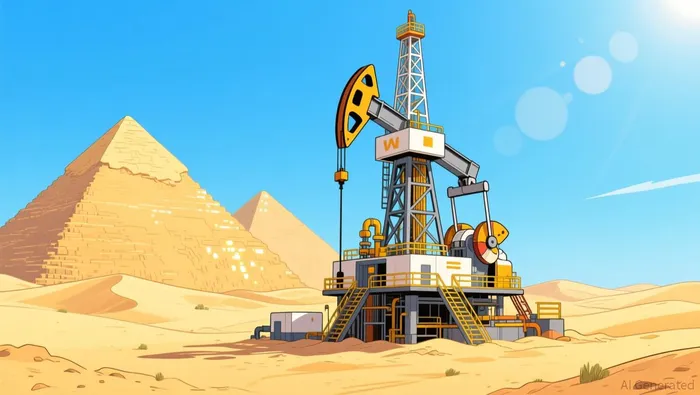
The most immediate risk is the capped upside. The JV’s fixed 30% profit share means it won’t benefit from rising oil prices. Unlike variable profit-sharing, this arrangement limits gains even if the global oil market strengthens—a trade-off for contractual certainty.
Beyond that, the JV faces a demanding execution plan. Achieving the promised 13% to 15% annual production growth requires doubling the rig count and investing hundreds of millions in capital—all within Egypt’s complex regulatory environment, where the state maintains tight control through joint ventures like EGPC. Political support helps, but operational challenges remain significant.
Additionally, Egypt’s energy needs shape the investment landscape. As a net importer of natural gas with aging oil fields, Egypt relies on foreign investment to sustain output. This creates ongoing demand for projects like APA’s, but also means new deals may be driven by necessity rather than competitive terms. While the government’s commitment to resolving operational issues is encouraging, the JV must still deliver on its ambitious production goals to unlock the contract’s cash flow potential. If the plan stalls, the fixed contract terms will cap returns.
Key Catalysts and What to Watch
The recent meeting with President El-Sisi has improved sentiment, but the investment case now depends on several near-term operational and financial milestones. Investors should focus on three main factors to assess whether APA is delivering on its promises.
- Production Growth: The most important metric is whether APA achieves the 13% to 15% annual increase in Egypt’s oil output outlined in the contract. Upcoming quarterly results will reveal if the company is on track, reflecting the impact of increased drilling and capital investment. Any shortfall would signal execution risk.
- Cost Recovery and Rig Deployment: Progress on the $900 million cost recovery program and the expansion to 15 rigs in 2022 are critical. Confirmation that backlogged costs are being reimbursed as scheduled is essential for cash flow. Delays or reductions in capital spending would undermine the growth story.
- Policy Stability: Egypt’s broader energy policy remains crucial. The government’s recent actions—such as reducing debts to international partners and planning an additional $750 million payment in Q1 2026—help restore trust and reduce financial pressure. Ongoing reforms in gas pricing and concession management support APA’s operations. Continued policy stability is vital for the JV’s long-term prospects.
In summary, the political catalyst is in place. The next phase is all about execution: meeting production targets, securing cost recovery payments, and maintaining a supportive policy environment. These are the concrete milestones that will determine whether the investment thesis holds up.
Disclaimer: The content of this article solely reflects the author's opinion and does not represent the platform in any capacity. This article is not intended to serve as a reference for making investment decisions.
You may also like
uniQure Approaches April 13 Court Deadline Amid Stricter FDA Position on Gene Therapy Study
Kiyosaki Predicts a 2026 Market Downturn: Insights from a Flow Analyst on Leverage Indicators

Picard Medical’s Manipulative Scheme Unveiled as Savvy Investors Withdraw, Legal Storm Approaches
Kyndryl Faces Legal Turmoil: Has the Market Already Accounted for the Worst-Case Scenario?
Trending news
MoreCrypto prices
More





