
TSMC’s N2 Node Growth: The Overlooked Constraint Driving AI’s Rapid Advancement

The Evolving Landscape of AI Infrastructure
The surge in artificial intelligence has moved past the initial rush for processors, shifting the industry's focus from chip acquisition to overcoming physical limitations in computing. Today, the main hurdles are not the chips themselves, but the supporting infrastructure—such as memory, cooling systems, and data transfer speeds. This transition marks a pivotal stage in AI adoption, where attention is directed toward the systems that enable chips to operate efficiently at scale.
This new phase is already producing industry leaders. Micron Technology, Vertiv, and Arista Networks have become essential players, facilitating the next wave of AI expansion. The most pressing challenge currently is High Bandwidth Memory (HBM). Micron has announced that its entire HBM output for the rest of 2026 is already secured through binding agreements. This complete sell-out signals a fundamental change, elevating high-end memory from a cyclical commodity to a critical, high-margin resource for advanced AI systems.
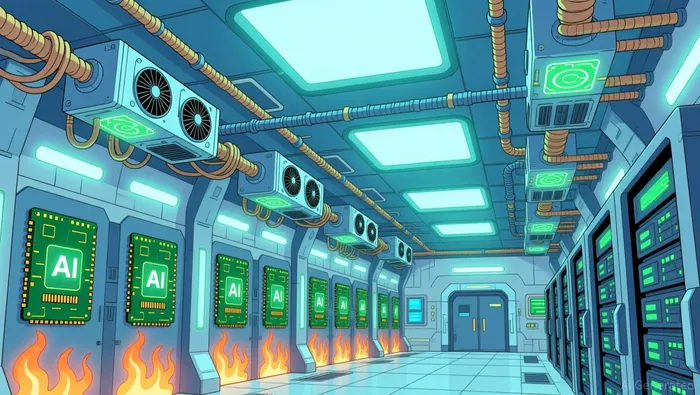
Meanwhile, Nvidia's upcoming Vera Rubin platform is set to accelerate the infrastructure race. The platform aims to significantly boost efficiency, promising a 90% reduction in AI inference costs and requiring 75% fewer GPUs for model training. This leap in performance has attracted substantial interest, with CEO Jensen Huang reporting $1 trillion in combined orders for Blackwell and Rubin chips through 2027. However, these advancements also increase demand for memory, as Rubin chips need 2.5 times more DRAM and 1.5 times more HBM than previous generations, further driving demand for suppliers like Micron.
TSMC: The Backbone of AI Expansion
The foundational infrastructure layer is emerging as the most strategic long-term investment. Taiwan Semiconductor Manufacturing Company (TSMC) sits at the center of this transformation. Its N2 node represents a historic leap in manufacturing technology. Demand for this node already surpasses the initial capacity of 40,000 wafers per month, prompting plans to scale up to 100,000 wafers monthly in 2026 and 200,000 by 2027. Featuring nanosheet gate-all-around transistors and backside power delivery, the N2 node redefines performance and efficiency for AI and high-performance computing. By expanding this capacity, TSMC is not just producing chips—it is laying the groundwork for the entire AI revolution. Investing in this infrastructure layer offers the most reliable path to capturing the sector's exponential growth.
Momentum Strategy for AI Infrastructure Investment
For investors seeking long-term exposure to AI infrastructure, a momentum-driven approach can be highly effective. By targeting TSMC when its 252-day rate of change is positive and its price closes above the 200-day simple moving average (SMA), and exiting under clear conditions (price drops below the 200-day SMA, after 20 trading days, or upon reaching take-profit or stop-loss thresholds), investors can harness growth while managing risk. This systematic strategy aligns with TSMC's pivotal role in AI scaling, offering a disciplined way to participate in the sector's rapid expansion.
Comparing Growth: Capacity vs. Compute
The ultimate test for infrastructure is its ability to scale ahead of demand. Comparing TSMC and Nvidia reveals two distinct yet complementary forms of exponential growth. Nvidia's trajectory is driven by relentless demand for AI compute, while TSMC's expansion provides the necessary capacity to support that compute.
Nvidia exemplifies product-led growth, posting record quarterly revenue of $57.0 billion, up 62% year-over-year. Its Data Center segment, the core of the AI surge, grew 66% year-over-year. CEO Jensen Huang describes this as a "virtuous cycle of AI," where demand accelerates across both training and inference.
TSMC, on the other hand, is expanding the physical infrastructure that enables this cycle. In January 2026, TSMC's revenue jumped 37% year-over-year, with combined January-February revenue up nearly 30%. The N2 node is a transformative step, with demand already outpacing supply and plans to ramp up production dramatically over the next two years.
This comparison highlights a crucial dynamic: Nvidia's growth is the result of a powerful product cycle, while TSMC's expansion is the necessary infrastructure build that must precede and sustain that cycle. Broadcom has identified TSMC's capacity as a bottleneck in the AI supply chain, underscoring the importance of manufacturing capability. In this phase, TSMC's aggressive capacity expansion is the ultimate investment in the infrastructure layer, which must grow exponentially to match the soaring demand for compute.

Valuation and Risk: The Price of Leadership
The market assigns Nvidia a premium for its execution, while TSMC's valuation reflects its indispensable role in infrastructure. Nvidia's shares have declined 7.9% over the past 120 days, reducing its premium but maintaining a high forward P/E of nearly 48. This valuation assumes flawless fulfillment of its $1 trillion order backlog for Blackwell and Vera Rubin chips through 2027. Investors are paying for the promise of a product that could redefine AI economics.
TSMC, meanwhile, holds a different kind of advantage. Its 72% share of the global foundry market is a strategic stronghold. As the exclusive manufacturer for Nvidia's most advanced AI chips, TSMC anchors recurring demand. Its valuation is built on tangible capacity and market dominance, rather than speculation.
Both companies face significant risks. TSMC's most immediate challenges are geopolitical and energy-related. The ongoing conflict in the Middle East threatens its power-intensive operations, as Taiwan imports nearly all its energy and relies heavily on natural gas. Any disruption to energy supplies through the Strait of Hormuz could impact TSMC's production, posing a systemic risk to the entire AI supply chain.
Nvidia's risks center on execution and competition. Its high valuation leaves little margin for error as it prepares to launch the Vera Rubin platform in late 2026. Delays or technical issues could quickly affect its stock price, as investors expect a flawless rollout. If efficiency gains fall short or competitors catch up, Nvidia's exponential growth could falter.
In summary, Nvidia represents a high-risk, high-reward bet on the next computing paradigm, while TSMC is the essential infrastructure build that must succeed for Nvidia's bet to pay off. Both are valued at a premium, but for different reasons: Nvidia for product perfection, TSMC for operational execution and resilience. As the AI supercycle scales, both are vital, but their risks are becoming increasingly apparent.
Key Catalysts and What to Monitor
The next few months will challenge the core assumptions behind both companies. Three factors will be decisive: TSMC's ability to expand capacity amid geopolitical uncertainty, Nvidia's delivery on efficiency promises, and the robustness of the supply chain. These catalysts will determine whether infrastructure or compute emerges as the superior exponential investment.
- TSMC's March 2026 Sales Report: Due April 10, this report will provide real-time insight into demand strength against the backdrop of the Iran conflict. With TSMC's dominant market share and exclusive role in Nvidia's chip production, any sign of weakening demand or production issues could impact the entire AI supply chain. The report will reveal whether the strong revenue growth continues or if recent declines signal trouble, especially given Taiwan's reliance on imported energy.
- Nvidia's Vera Rubin Platform Launch: Track the rollout and the promised 90% reduction in AI inference costs. Scheduled for the second half of 2026, the platform's success is central to Nvidia's growth narrative. If Rubin chips deliver on efficiency and performance, it will drive further demand for TSMC's capacity. Any setbacks could challenge the story of a seamless compute paradigm shift.
- Supply Chain and Geopolitical Risks: The ongoing conflict in the Middle East poses a direct threat to TSMC's operations. Disruptions to materials or energy supplies could bottleneck the entire AI stack, from Nvidia's chips to server infrastructure. Taiwan's critically low LNG reserves make any prolonged disruption a significant risk, potentially holding back even the most advanced compute capabilities.
Ultimately, the investment outlook is a race against time and stability. TSMC must demonstrate it can scale its N2 node rapidly while navigating geopolitical challenges. Nvidia must deliver on its efficiency promises to sustain product-led growth. The catalysts are clear, but converging risks demand close attention. The April sales report will be the first real test of demand amid these uncertainties.
Disclaimer: The content of this article solely reflects the author's opinion and does not represent the platform in any capacity. This article is not intended to serve as a reference for making investment decisions.
You may also like
SOL Faces Influx of Exchange Deposits and Security Incident, Market Prospects Remain Unclear

Smart investors increase holdings in Japan ETFs as global tensions challenge ongoing reform efforts

General Motors Sees 9.7% Decline in Q1 Sales Due to Tariff Surge and Severe Winter Weather

uniQure Approaches April 13 Court Deadline Amid Stricter FDA Position on Gene Therapy Study

Trending news
MoreCrypto prices
More





