
April 6th Financial Breakfast: Non-farm payrolls far exceed expectations, reversing rate cut bets; gold tests the 4600 mark; escalating Iran situation sends oil prices soaring nearly 3%

Huitong Finance, April 6— On Monday (April 6, UTC+8) during the Asian session, spot gold fell nearly 1%, trading around $4,620 per ounce, having opened as low as $4,614.03 per ounce, and could test the $4,600 per ounce mark during the day.
On Monday (April 6, UTC+8) during the Asian session, spot gold fell nearly 1%, trading around $4,620 per ounce, having opened as low as $4,614.03 per ounce, and could test the $4,600 per ounce mark during the day, as the U.S. March Nonfarm Payrolls unexpectedly reversed and market bets on a Fed rate cut continued to decrease; U.S. crude oil rose nearly 3%, trading near $114.42 per barrel, as U.S. President Trump again threatened to destroy Iran's power plants, while Tehran showed little sign of accepting U.S. demands to end the war.
Key Focus for the Day
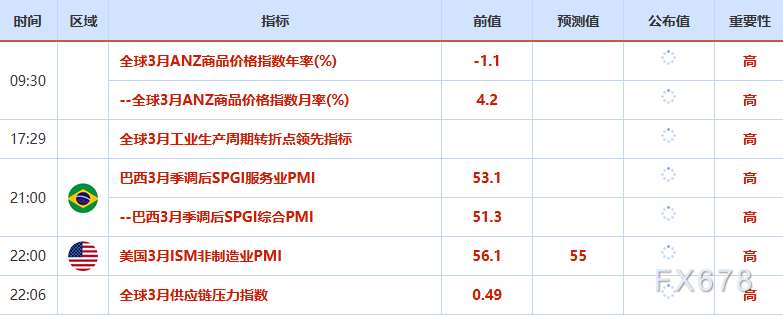
Germany, Australia, France, Spain, New Zealand, Italy, and the UK are closed for trading today due to the Easter holiday.
Stock Market
U.S. stocks closed mixed last Thursday, with the Dow falling 0.13%, the S&P 500 up 0.11%, and the Nasdaq up 0.18%. However, all three major indices posted their best weekly performance in four months, up 2.96%, 3.36%, and 4.44% respectively, marking their first weekly rise in six weeks.
Markets opened lower in early trade after U.S. President Trump threatened tougher action against Iran before Good Friday, sending oil prices surging, but subsequent diplomatic signals—such as Iran and Oman drafting a Hormuz Strait transit protocol and the UK stating multinational discussions of solutions—soothed investor sentiment. October crude oil futures priced at around $82/barrel indicate that markets expect the supply disruption to be temporary.
In terms of sectors, utility stocks and real estate stocks rose 0.6% and 1.5% respectively, as investors sought stable returns. In contrast, the consumer discretionary sector fell 1.5%, mainly dragged down by Tesla's 5.4% drop after delivering its weakest quarterly figures in a year.
Additionally, Blue Owl’s move to set redemption limits for two of its retail funds sparked tension in the private credit market, leading to a fall in its share price. Wall Street’s Fear Index (VIX) dropped to 23.87. Market attention also turned to SpaceX’s secret IPO filing (estimated value at $1.75 trillion) and the upcoming Nonfarm Payrolls data.
Gold Market
Amid a stronger dollar and warming expectations for rate hikes, gold prices fell 2.2% last Thursday. Spot gold stood at $4,651.35 per ounce, having touched a two-week high during the session, and U.S. gold futures closed down 2.8% at $4,679.70 per ounce.
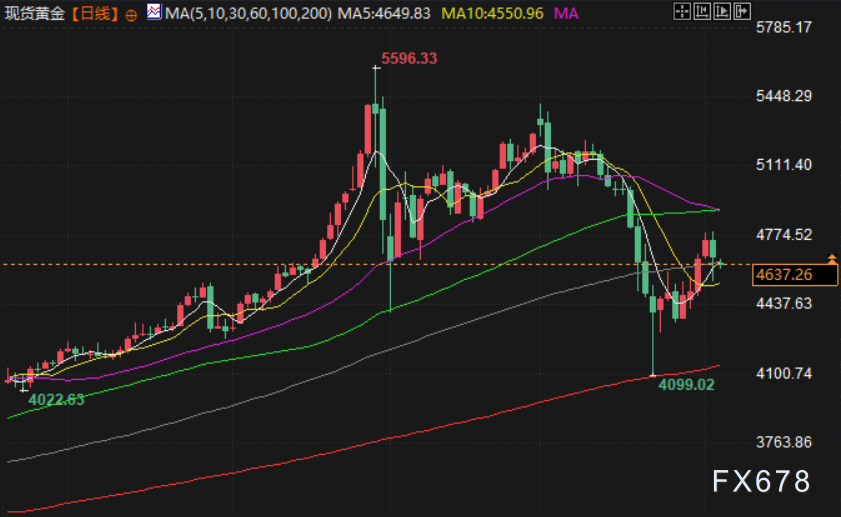
U.S. President Trump announced continued strikes against Iran, vowing to bomb the country “back to the Stone Age”. However, he gave no timetable to end the war, fueling a rise in oil prices, boosting inflation expectations, and thereby narrowing the room for central bank rate cuts.
Additionally, Turkey’s central bank gold reserves have plummeted by more than 118 tons in two weeks, dropping 69.1 tons last week to 702.5 tons, in order to ease the impact of war on the markets. On the demand side, as gold prices weaken, Indian gold trading prices saw their first premium in two months.
For other precious metals, spot silver tumbled 3.7% to $72.38, platinum rose 0.9%, and palladium increased 1.9%.
Oil Market
Oil prices surged last Thursday, with U.S. crude oil futures jumping 11.41% to close at $111.54 per barrel, posting the largest one-day absolute gain since 2020; Brent crude oil futures rose 7.78% to close at $109.03 per barrel. The surge was fueled by President Trump's vow to continue striking Iran, lack of a clear timetable to end hostilities, and uncertainty over the reopening of the Strait of Hormuz.
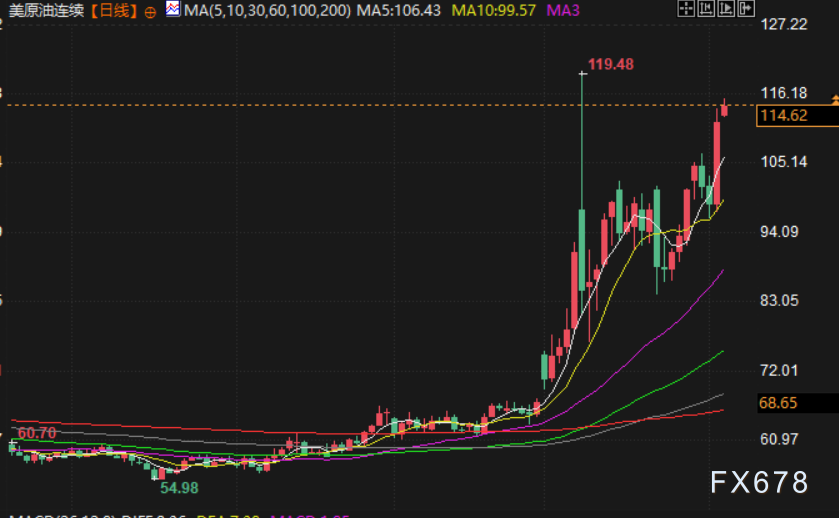
Trump said he would intensify military action, stating, “We will bomb them back to the Stone Age.” Traders are concerned that Iranian oil infrastructure could be at risk, further delaying the resumption of oil flows.
Although Iran is working with Oman to draft a protocol to monitor ship passage through the Strait of Hormuz, market anxiety remains high. The premium for near-month U.S. crude contracts over the next and seventh month contracts reached record highs, and U.S. crude traded nearly $3 higher than Brent, the highest in a year.
Federal Reserve Bank of Dallas President Lorie Logan commented that if the war is resolved quickly, the economic impact may be relatively mild, but uncertainty remains. Citi expects Brent crude's baseline average in the second half of the year to be $95/barrel, with an optimistic scenario at $130; JPMorgan says short-term prices could rise to $120-130, and if the Strait of Hormuz remains closed till mid-May, could break above $150.
Forex Market
As the Middle East conflict continues and Trump vows severe strikes against Iran, the dollar’s safe-haven status persists, putting pressure on other currencies. Last Friday in Asia, the dollar index was around 100.042, up roughly 2.4% in March. The euro edged down to $1.1532, dropping 2.21% in March—its biggest quarterly drop since Q3 2024; the pound traded at $1.3220, down 1.94% in March; the yen held steady at 159.62 per dollar, up 1.7% in March.
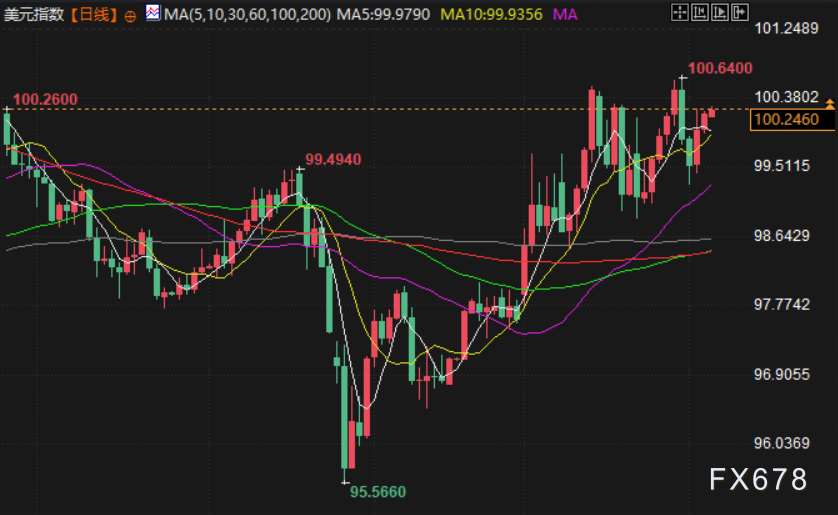
Despite recent dollar strength, surveys show forex strategists still expect the dollar to weaken over the long term. As risk aversion fades, the euro is expected to rise to $1.18 in six months and $1.20 in a year.
Standard Chartered analysts note that once the situation normalizes and oil prices fall back below $90, the euro/dollar is set to quickly move above 1.18.
Meanwhile, Asian currencies dependent on oil imports have dropped to six-month lows. The Indonesian rupiah fell to a record low of 17,026, the Philippine peso hovered around 60.814, the Korean won touched a new low not seen since 2009 at 1,536.9, and the Indian rupee rebounded after hitting 95.21 thanks to central bank intervention. Most major central banks held rates steady in March; this week, the Reserve Bank of New Zealand, the Reserve Bank of India, and the Bank of Korea will announce rate decisions. Markets expect India to keep rates unchanged at 5.25% and New Zealand at 2.25%, but war-induced energy price rises could bring forward rate hike timelines.
The Nonfarm Payrolls report released last Friday showed U.S. March seasonally adjusted nonfarm payrolls up 178,000, well above the 65,000 expected by the market, with the February figure revised further down from an initial drop of 92,000 to a decrease of 133,000. The report marked a dramatic turnaround from "negative growth" to well above expectations. The unemployment rate fell to 4.3%, better than the 4.4% forecast. Average hourly earnings rose 0.2% month-on-month, below the expected 0.3%, indicating easening wage pressures. As a result, market bets on a Fed rate cut in 2026 decreased.
According to the CME "FedWatch," the probability of a Fed rate hike of 25 basis points in April is 1.6%, and 98.4% for holding rates unchanged. By June, there’s a 1.8% chance of a total 25bp rate cut and a 96.6% chance of no move, with a 1.5% probability for a 25bp hike. By December, the chance of a total 25bp cut stands at 11.9% (down from 39% last Friday), 78.3% for no rate change, and 9.7% for a 25bp hike.
International News
On April 5 local time, U.S. President Trump did not provide a timetable for ending the war against Iran during an interview. Trump stated that if Iran does not open the Strait of Hormuz by the evening of April 7, the U.S. will target Iran's power plants. Later, Trump posted briefly on social media: "(U.S.) Eastern Time Tuesday (April 7) 8pm!" Public opinion believes this seems to be Trump again extending his so-called "deadline" for Iran. On March 26, Trump announced a 10-day delay for the destruction of Iranian energy facilities, extending the deadline to 8pm April 6 ET. This is his second time delaying this deadline. (CCTV News)
According to the Islamic Republic News Agency of Iran on the 5th, responding to U.S. President Trump's threat to destroy Iranian power plants and bridges, Iran’s permanent mission to the UN said Trump is trying to drag the Middle East into an endless war. The delegation said the United Nations should not remain silent on Trump's open threats to attack civilian infrastructure. The delegation described Trump's words as direct provocation against the Iranian people and clear evidence of intent to commit war crimes. (Xinhua News Agency)
On April 5 local time, eight member states of "OPEC+" held a meeting and decided to raise daily crude output by 206,000 barrels from May 2026, continuing the previous gradual rollback of voluntary production cuts. Participating countries included Saudi Arabia, Russia, the UAE, Iraq, Kuwait, Kazakhstan, Algeria, and Oman. No other adjustments were made to existing output policy.
On April 5 local time, Iran’s Islamic Parliament began reviewing plans for managing the Strait of Hormuz. The meeting decided to establish a committee of parliamentarians and experts to further examine the plan’s text and push for a final legal framework, providing the legal basis for Iran to exercise jurisdiction over the strait. On March 30, the Parliament’s National Security Committee had passed the plan, stipulating the control of Iranian armed forces and explicitly banning passage for ships from the U.S., Israel, and countries imposing unilateral sanctions on Iran. (CCTV News)
The Iranian Presidential Office's Deputy for Communications and Information said on social media that under the new legal framework, the Strait of Hormuz will only reopen once the war losses forced upon Iran have been "fully compensated" through a portion of transit fee revenue.
Japanese media reported on the 5th that impacted by the situation in the Middle East, Japan’s crude imports have plunged, raising widespread concerns. The government is considering releasing additional state oil reserves in May, equivalent to about 20 days of domestic consumption. According to Japan's Ministry of Economy, Trade, and Industry, as of the end of 2025, Japan's oil reserves will cover 254 days’ worth of consumption. Since March 16, due to the Strait of Hormuz disruptions, the government has released about 80 million barrels—enough for 45 days, the largest release since Japan established its strategic oil reserve system in 1978. However, this release has not quelled anxiety over oil supply shortages. Industry groups have urged more releases and the medical community is pressing for guaranteed naphtha supplies. Naphtha, a crude oil derivative, is a key raw material for dialysis equipment, medical gloves, and syringes. Industry insiders warn that if the situation continues, Japan could face a "naphtha crisis" in June, threatening patient health. Japanese media cited sources that the government is seeking alternative routes that bypass the Strait of Hormuz and securing crude oil sources outside the Middle East, expecting May imports to reach 60% of last year’s level and to fill the gap with state reserves. The plan is still under discussion. (Xinhua News Agency)
In the past few weeks, jet fuel prices have surged from $85–90 to $150–200 per barrel, posing major challenges to the global airline industry. Several airlines have begun to adjust strategies. On the 4th, KLM’s employee council chairman Manix Fortema warned that if Hormuz Strait shipping remains blocked, airlines may be forced to cancel flights within six weeks. Air France-KLM CEO Benjamin Smith stated the company is preparing for possible fuel shortages. Michael O’Leary, CEO of Europe’s largest budget airline Ryanair, said on April 1 the company may face a fuel supply gap of up to 25% in May–June, and that Europe will see tight jet fuel supplies in May. O’Leary also said airfares could rise sharply in April–June. (CCTV Finance)
On the 4th, finance ministers of Germany, Italy, Spain, Portugal, and Austria wrote to the European Commission, calling for a windfall tax on the excess profits of energy companies due to soaring oil prices triggered by the Iran situation. They stated the tax could fund temporary relief for consumers. Since the U.S., Israel, and Iran conflict erupted on February 28, European natural gas prices have soared more than 70%. (CCTV Finance)
IEA Executive Director Fatih Birol warned that if the Strait of Hormuz does not reopen, the crude and refined oil loss in April will be double that of March. Even if the conflict ends, it will take a long time for things to return to normal. “We are tracking all critical energy assets in the region hourly,” he said, referring to oil/gas fields, pipelines, refineries, and LNG terminals. “Currently, 72 energy assets are damaged, one-third of them severely or very severely,” he added.
Domestic News
U.S. pollster Gallup released findings on April 3, showing that China’s global approval will exceed that of the U.S. in 2025, with a median support rate for China's leadership at 36%—5 points higher than the U.S. Gallup noted this is the largest gap in favor of China in 20 years of polling. (CCTV News)
Recently, airlines such as Air China, Xiamen Airlines, and China United Airlines announced an adjustment to the domestic route passenger fuel surcharge. For tickets sold from (and including) April 5, 2026, the standard is: 60 RMB per passenger for routes up to and including 800 km, and 120 RMB for routes over 800 km. Infants entitled to 10% of the adult fare pay no surcharge. For children (including unaccompanied minors) paying 50% of the adult fare, wounded veterans, and police injured on duty, the surcharge is 30 RMB for segments up to 800 km and 60 RMB above 800 km. The effective date for the fee is based on the original ticket issue date; for tickets issued before April 5, 2026 and changed to after April 5, previously collected surcharges will not be refunded or supplemented. (Xinhua News Agency)
Disclaimer: The content of this article solely reflects the author's opinion and does not represent the platform in any capacity. This article is not intended to serve as a reference for making investment decisions.
You may also like
ZBT (ZEROBASE) Surges 53.7% in 24 Hours: Trading Volume Soars Over $140 Million, Driving Rebound
SOMI (Somnia) Volatile by 49.1% in 24 Hours: Trading Volume Surge Drives Rebound
BLEND (Fluent) 24-hour fluctuation of 41.2%: Driven by multiple exchange listings and Layer2 mainnet launch
Trending news
MoreCrypto prices
More





