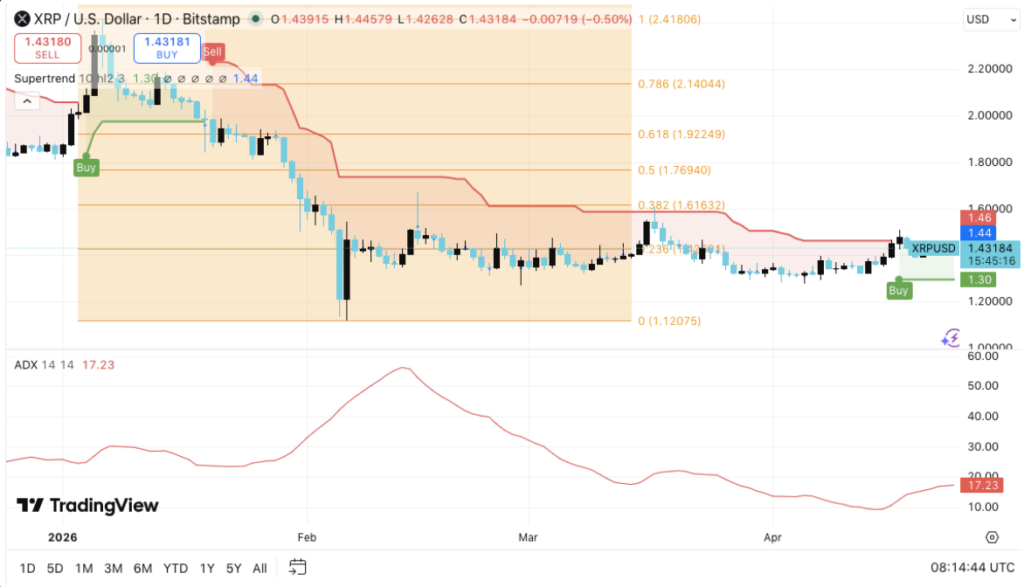
Uniswap’s UNI token has settled around $3.14 in April 2026, held down by bearish moving averages across multiple timeframes after declining from a multi-month high near $8.50 reached earlier this cycle. Polkadot has pushed into even more precarious territory, with DOT trading below its original price as sellers maintain structural control. Both assets face defined resistance zones with no immediate catalysts to force a breakout.
Uniswap: DEX Dominance Carries the Weight of a Prolonged Downtrend
The current price of Uniswap sits at $3.14, with UNI ranked No. 37 in the overall crypto ecosystem and a market cap near $1.99 billion. On the four-hour and daily charts, Uniswap is bearish, with the 50-day moving average falling and the 200-day moving average declining since early March 2026, reflecting broad structural weakness across all timeframes.
The DEX protocol itself continues to process significant volume, and Uniswap V4’s hooks system has added meaningful programmability to liquidity pools. However, protocol strength and token price performance have clearly decoupled in this cycle. Following a 21% rebound that briefly pushed UNI back toward $4, the declining 50-day EMA continued to cap the recovery, with the MACD and signal lines only approaching positive territory rather than confirming a reversal.

For buyers today, UNI’s entry at $3.14 reflects years of protocol development already priced in, with meaningful upside requiring a clear catalyst or macro rotation that has not yet materialized.
Polkadot: Below Original Price With Structural Reforms Still Working Through the Market
Polkadot is currently trading below its original price, with EMA200 and Supertrend both signaling bearish conditions, and both RSI and MACD confirming weak momentum through late March and into early April 2026. The irony is that, fundamentally, Polkadot’s tokenomics underwent its most significant reset since launch in March 2026.
A runtime upgrade initiated a hard supply cap of 2.1 billion DOT and redirected treasury burns to a new Dynamic Allocation Pool, with the first annual issuance cut of 53.6% taking effect in mid-March and slashing inflation from roughly 7.2% to approximately 3.1%. That is structurally bullish in theory, but the price has not yet responded.

DOT’s price has extended its decline with momentum remaining weak, key Fibonacci levels framing the damage, and the token now trading below the 0.236 retracement level at $1.39, which previously acted as support but has since flipped into resistance. The case for DOT depends on whether its supply reforms can attract sustained demand, a process that typically plays out over quarters, not days.
Conclusion
Polkadot’s supply reforms and Uniswap’s protocol upgrades are genuine positives, but neither comes with a closing deadline.