
Gold price rises over 1%, market focuses on US-Iran ceasefire agreement and CPI data

Huitong Network, April 10—— On Thursday (April 9), during the U.S. trading session, gold and silver prices saw moderate increases. The recently released U.S. inflation data did not exceed market expectations, and investors continue to focus on the durability of the fragile ceasefire agreement between Washington and Tehran, as well as the latest consumer price index data. Spot gold rose 1.7% to $4,796.50 per ounce, having touched a nearly three-week high in the previous session. Silver prices also saw a slight uptick, with the overall precious metals sector supported by a revival in risk appetite.
On Thursday (April 9), during the U.S. trading session, gold and silver prices saw moderate increases. The recently released U.S. inflation data did not exceed market expectations, and investors continue to focus on the durability of the fragile ceasefire agreement between Washington and Tehran, as well as the latest consumer price index data. Spot gold rose 1.7% to $4,796.50 per ounce, having touched a nearly three-week high in the previous session. Silver prices also saw a slight uptick, with the overall precious metals sector supported by a revival in risk appetite.
The U.S. core PCE price index released today, which serves as the Federal Reserve's preferred measure for underlying inflation, rose by 0.4% month-on-month in February 2026. This figure continues the previous two months’ 10-month high and is entirely in line with market expectations. Year-on-year, the core PCE price index increased by 3%, slightly down from 3.1% the previous month, but still well above the Federal Reserve's 2% target. The inflation data met expectations and did not cause significant market turbulence, but the persistently high inflationary pressures continue to keep investors cautious regarding the Fed’s rate path.
Details and Uncertainties of the U.S.-Iran Ceasefire Agreement
U.S. President Trump announced on “Truth Social” platform that he agreed to suspend attacks on Iran for two weeks, provided that Tehran “immediately, fully, and safely reopens the Strait of Hormuz.” Iranian Foreign Minister Abbas Araqchi responded that through coordination with Iran’s armed forces, safe passage of vessels through the Strait of Hormuz can be ensured during this period. The first round of negotiations will be held in Islamabad on Friday, focusing on Iran’s ten-point peace plan, which Trump called a “feasible basis for negotiation.”
However, the stability of the ceasefire agreement remains in doubt. Israel continues to bomb targets in Lebanon, Tehran insists Lebanon must be included in the ceasefire scope, and so far there is no sign that Iran has lifted the blockade of the Strait of Hormuz. According to Iran’s Tasnim News Agency, if attacks on Lebanon persist, Tehran may withdraw from the ceasefire agreement.
The ceasefire agreement has significantly alleviated market concerns about a prolonged conflict, leading to renewed risk appetite. Global stock markets generally rose, and the U.S. dollar faced significant pressure—the U.S. dollar index is currently around 98.80, down nearly 0.87% from the opening of the day.
Bob Haberkorn, Senior Market Strategist at RJOFutures, pointed out: “The weakening dollar helped gold regain its footing, but market participants remain cautious in interpreting the significance of the ceasefire.” He added, “The ceasefire news is very favorable for gold, but as cracks appear, gold prices have pulled back from recent highs.”
If negotiations break down or war escalates, it could push up energy costs and inflation, potentially forcing the Federal Reserve to maintain higher interest rates for longer, which would reduce the appeal of non-yielding gold. Despite being a traditional inflation hedge, gold’s short-term performance continues to be supported by the easing geopolitical tensions and dollar weakness.
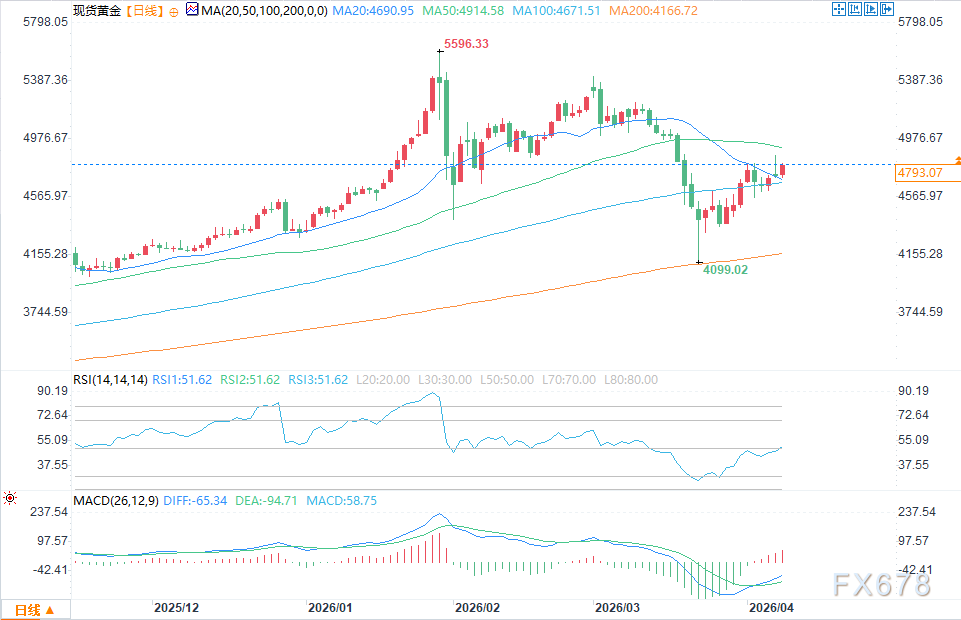
(Spot Gold Daily Chart Source: Yihuitong)
From the daily chart, spot gold is currently situated between major moving averages, below the 50-day simple moving average at $4,927.91, but above the 100-day simple moving average at $4,667.44, showing a neutral short-term range. Momentum indicators display the Relative Strength Index (14) near the middle level, and the Moving Average Convergence Divergence indicator remains in positive territory, indicating buyers still hold a slight advantage, though prices are capped by the upper trendline.
The short-term resistance is at the 50-day simple moving average, and a successful breakout would open up more distinct upward space. Initial support is near the 100-day simple moving average (around $4,667.89), and a drop below this could see a return to the downward trend. Although overall momentum has improved, investors should still keep a close eye on further developments of the ceasefire agreement and how inflation data guides the Fed’s policy.
Overall, the optimism brought by the U.S.-Iran ceasefire agreement and the weaker dollar are jointly supporting gold prices, but inflationary pressure and geopolitical uncertainty remain potential risks. Investors will continue to focus on the progress of Friday’s Islamabad negotiations and subsequent economic data to determine the medium-term trend in gold.
Disclaimer: The content of this article solely reflects the author's opinion and does not represent the platform in any capacity. This article is not intended to serve as a reference for making investment decisions.
You may also like
What to Expect in the Week Ahead (FOMC Rate Decision and Earnings from AAPL, GOOG, AMZN, META and MSFT)
ENSO (ENSO) fluctuates by 69.3% in 24 hours: Trading volume surges over 100 times, triggering speculative volatility
D (DarOpenNetwork) 24-hour amplitude at 50.4%: Active trading and capital rotation drive dramatic price volatility
Trending news
MoreCrypto prices
More





