
CPI data set to rock the market! Hormuz Strait blockade + Fed hawkishness—Can gold prices continue to rise?

Huitong Finance April 10 News—— The market is waiting for the US March CPI data, which is expected to show higher inflation due to rising oil prices, potentially further suppressing expectations for a Fed rate cut. The tensions in the Strait of Hormuz have strengthened the dollar, while Trump’s warning that Iran may resume strikes is putting pressure on gold prices. However, Israel and Lebanon will start negotiations in Washington next week, bringing hope of easing tensions. Technically, bears have the advantage, with $4,890-$4,915 as key resistance; the support below focuses on $4,732. In the short term, gold prices are likely to fluctuate within a range, awaiting CPI data and new developments in the Middle East.
Against the backdrop of continued volatility in global financial markets, spot gold prices are once again facing adjustment pressure. Although gold briefly attempted to break through the key psychological level of $4,800 on Thursday (April 9), it ultimately failed and soon attracted a new wave of selling. During Asian trading hours on Friday (April 10), gold briefly dropped to around $4,738. Currently, spot gold is trading near $4,755/oz, with a decline of about 0.2%. Despite this minor pullback, the precious metal overall remains within its familiar trading range, as market participants keep a close eye on the upcoming release of the latest US Consumer Price Index (CPI) data in search of clearer trading signals.
Current Gold Price Dynamics: Selling Pressure Emerges After Failed Breakout, Range-bound Pattern Remains
Gold (XAU/USD) failed to hold above the $4,800 mark on Thursday, which triggered a clear shift in sentiment and quickly attracted fresh selling, pushing prices down to some extent. This move reflects investors' waning willingness to hold short-term gold positions under the current uncertain environment.
However, on the whole, gold prices have not broken out of the previously established oscillatory range, indicating that the market is still in a wait-and-see mode lacking clear directional drivers. Most traders believe that only after key macro data is released will gold see a clearer breakout signal. The current price level is relatively balanced, showing neither a sharp collapse nor strong upward momentum, and reflects a cautious equilibrium overall.
Rising Inflation Concerns Again: US CPI Data in Focus, Fed Rate Cut Expectations Tested
The soon-to-be released March US Consumer Price Index (CPI) report is drawing considerable attention. Markets widely expect inflation data to rise further this month, mainly due to the recent sharp increase in oil prices driven by Middle East tensions. This potential upward pressure on inflation would directly reduce the odds of a short-term Fed rate cut.
In fact, the minutes of the March 17-18 FOMC meeting released on Wednesday clearly showed that Fed officials are cautious about the inflation risks brought by Middle Eastern energy price shocks, with no inclination to loosen monetary policy anytime soon. This hawkish tone has further strengthened market expectations for the Fed to maintain higher interest rates, thereby exerting downward pressure on non-interest-bearing assets like gold.
Escalation of Middle East Geopolitical Risk: Strait of Hormuz Tensions Support Dollar, Putting Noticeable Pressure on Gold Prices
One of the global market’s main focuses is the escalating tension around the Strait of Hormuz. This strategic passage is a vital route for global oil transportation, meaning any disturbance can quickly transmit to energy prices and inflation. Iran, after Israel launched intense attacks on Lebanon, announced the suspension of shipping activities through the Strait. Meanwhile, US President Donald Trump openly criticized Iran's poor performance in handling oil shipments in the Strait of Hormuz, stressing that this was not in line with previous agreements between the two sides. Trump further warned that if Iran's agreement eventually breaks down, the US will resume its strikes, undoubtedly raising market concerns about potential regional escalation.
These geopolitical risks are providing strong support to crude oil prices, thereby fueling global inflation expectations and reinforcing the Fed's hawkish stance, ultimately applying downward pressure to gold prices. Nonetheless, despite the appearance of bearish forces, the lack of follow-through selling means gold has not experienced a unilateral sharp decline in the short term, and short sellers must remain highly vigilant.
Diplomatic Efforts Offer Cushion: Israel-Lebanon Talks Start, US-Iran Talks May Stabilize Situation, Limiting Downside for Gold
It is worth noting that the Middle East situation is not only about tension. Israeli Prime Minister Benjamin Netanyahu has publicly stated he has ordered the immediate start of direct negotiations with Lebanon to resolve key disputes in the current fragile US-Iran ceasefire agreement.
According to reliable reports, US State Department officials confirmed that negotiations between Lebanon and Israel will officially take place in Washington DC next week. Additionally, key US-Iran talks are also planned to move forward in stages from Friday night into Saturday.
These positive diplomatic signals have left the market hoping that the Iran ceasefire agreement can effectively stabilize the region. This expectation is partly limiting further dollar appreciation, providing necessary downside support for gold prices and helping gold avoid a steeper drop.
Technical Analysis: Bears Temporarily Dominate Gold, Clear Key Resistance and Support Levels
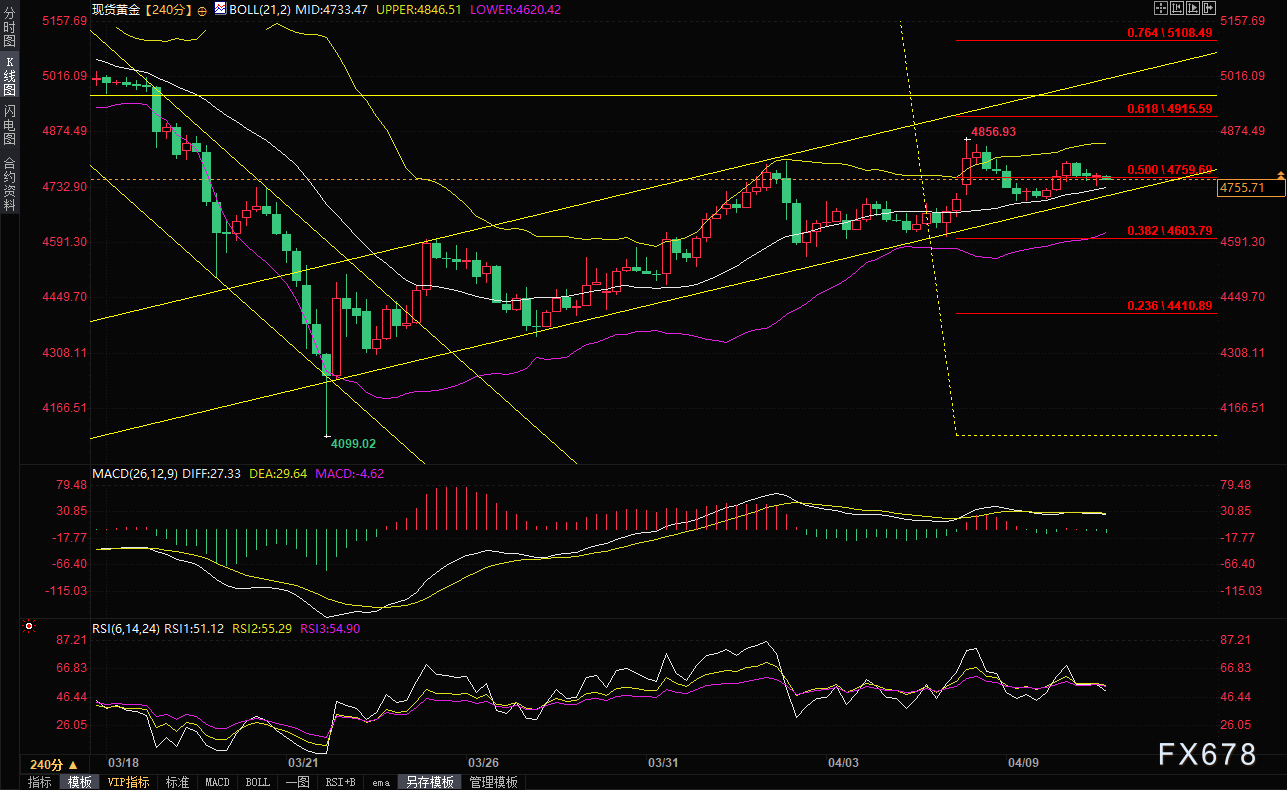
From a technical perspective, spot gold shows a neutral to bearish pattern on the 4-hour chart. Prices are currently under obvious suppression from the 200-period simple moving average, which coincides with the 61.8% Fibonacci retracement of March’s decline, forming a strong resistance hub around the $4,890-$4,915 zone. The presence of this key resistance is significantly capping the short-term upside for gold.
Meanwhile, the Relative Strength Index (RSI) is hovering near 55, indicating a moderate recovery in buying demand, but the MACD has slipped slightly into negative territory, suggesting that upward momentum is waning. If gold clearly breaks through the crucial resistance of $4,915, the next target will be $5,131.50, and a further rally may challenge the $5,419 high. Conversely, on the downside, initial support lies around $4,750, with more critical support at $4,732; if this level fails, gold may further test the $4,595 and $4,401 support zones, with more substantial structural support near $4,100.
Comprehensive Outlook: Geopolitical Risks Intertwined with Macro Data, Gold Prices Expected to Stay Range-bound Pending Clear Catalyst
In summary, the current small retreat in gold prices is mainly due to inflation worries fueled by escalating risks in the Strait of Hormuz and hawkish Fed expectations, with the upcoming US CPI data being the key catalyst for short-term movement. While bears have a technical advantage, expectations of stability from diplomatic efforts and the lack of sustained selling jointly limit gold’s downside potential.
Investors should closely monitor the soon-to-be-released inflation data and new Middle East developments to better grasp the next direction in the gold market. Against a backdrop of intertwined global uncertainties, while gold retains its appeal as a safe haven, it is likely to continue fluctuating within a range in the short term until a clearer macro or geopolitical signal emerges.
At 14:19 (GMT+8), spot gold was reported at $4,753.60/oz.
Disclaimer: The content of this article solely reflects the author's opinion and does not represent the platform in any capacity. This article is not intended to serve as a reference for making investment decisions.
You may also like
What to Expect in the Week Ahead (FOMC Rate Decision and Earnings from AAPL, GOOG, AMZN, META and MSFT)
ENSO (ENSO) fluctuates by 69.3% in 24 hours: Trading volume surges over 100 times, triggering speculative volatility
D (DarOpenNetwork) 24-hour amplitude at 50.4%: Active trading and capital rotation drive dramatic price volatility
ZBT (ZEROBASE) Surges 53.7% in 24 Hours: Trading Volume Soars Over $140 Million, Driving Rebound
Trending news
MoreCrypto prices
More





