
Hezbollah Rejects Ceasefire Agreement—Why Is This Actually Bullish for Gold?

FX168 Finance April 15th—— Hezbollah remains steadfast in its alignment with Iran’s “Axis of Resistance”, refusing to comply with the Lebanon-Israel negotiated agreement. This deep binding with Iran will continue to shape the trajectory of Middle Eastern geopolitics, becoming a core bargaining chip in US-Iran negotiations and a key catalyst for fluctuations in gold prices.
During the Asia-Europe session on Wednesday (April 15th), spot gold saw a rally and subsequent pullback, with an intraday high at $4,872/ounce (UTC+8), currently trading near $4,812 (UTC+8).
Amid the ongoing escalation of US-Iran conflict, a major new variable has emerged in the Middle East: Lebanon and Israel held their first direct diplomatic talks in decades in Washington. Defined by US Secretary of State Marco Rubio as a “historic opportunity”, this round of discussions is, in essence, an extension of the US-Iran rivalry on a proxy battlefield.
This meeting was prompted by intense conflict for over a month between Israel and Iran-backed Hezbollah militias, with the core root being a chain reaction triggered by US-Israeli coalition military strikes on Iranian territory.
Hezbollah’s Hardline: The Proxy Battlefield and Negotiation Leverage of Iran
As the core force of Iran’s “Axis of Resistance” strategy, Hezbollah actively joined the battlefield following the outbreak of the US-Iran war, serving as a key tool for Iran to restrain US and Israeli actions.
On March 2, Hezbollah, in solidarity with Iran, launched rockets at northern Israel (UTC+8), directly igniting the Lebanon-Israel conflict. This action was made possible by Iran’s long-term financial, military, and ideological support.
The Washington Game: Divergent US-Israel and Lebanon Agendas
Complex strategic maneuvering was on display at the Washington talks.
Israel's ambassador to the US, Yehiel Light, bluntly stated that the two sides agreed on the need to strip Hezbollah's influence from Lebanon—a clear expression of the US-Israeli strategic goal to sever Iran’s proxy network in the Middle East.
The Lebanese government, eager to end hostilities through diplomacy, had its ambassador to the US, Nada Hammad Mouawad, reaffirm Lebanon’s territorial integrity and sovereignty and called for a ceasefire and the resolution of the humanitarian crisis. However, Lebanon’s negotiating leverage remains constrained by complex ties to Iran and Hezbollah. Hezbollah senior official Wafik Safa has stated clearly that it will not abide by any agreements reached in the talks.
Spillover from the Battlefield: Lebanon-Israel Humanitarian Crisis Amid US-Iran Standoff
The severity of the battlefield situation further highlights the risk of spillovers from the US-Iran conflict.
Israeli airstrikes have killed at least 2,124 people in Lebanon and displaced over one million civilians. Last week alone, Israel launched hundreds of airstrikes within ten minutes (UTC+8), reducing downtown Beirut to ruins.
Israeli forces have penetrated southern Lebanon, attempting to establish a “security buffer zone”. Despite suffering losses in the 2024 conflict, Hezbollah remains capable of daily drone and rocket attacks on Israel, thanks to Iran’s steady backing.
Uncertainty Brewing: Gold Becomes the Geopolitical Risk Hedge
Currently, the US-Iran ceasefire agreement is set to expire on April 22 (UTC+8), but there are multiple signs of an extension. News of renewed negotiations and progress in Lebanon-Israel talks are interwoven, with Middle East geopolitical risk remaining elevated.
In this environment of growing uncertainty, the revival of risk appetite bodes well for a rebound in gold.
Easing geopolitical conflicts and expectations of a global financial market rebound will continue to support gold prices. Regardless of the outcome of US-Iran negotiations, fluctuations in the Lebanon-Israel situation will remain an important catalyst for gold price volatility, making it a core choice for investors hedging geopolitical risks.
Summary and Technical Analysis:
However, this heavily publicized negotiation, which Rubio called significant, does signal the US hopes for smooth US-Iran talks and gives both Washington and Tehran a way to continue negotiations. At the same time, Hezbollah, an important chip for Iran, has stated that it will not abide by the negotiated agreement, meaning its deterrent effect remains, supporting Iran’s continued negotiations.
Together with a two-week extension breaking the negotiation time limit and Iran’s willingness to make concessions on uranium enrichment, gold is likely to stay choppy and rebound.
Technically, spot gold is still running along the rising channel, with current support at the channel’s median, as well as the 5-day and 30-day moving averages.
Resistance lies at the upper edge of the channel, with a potential short-term breakout above this level.
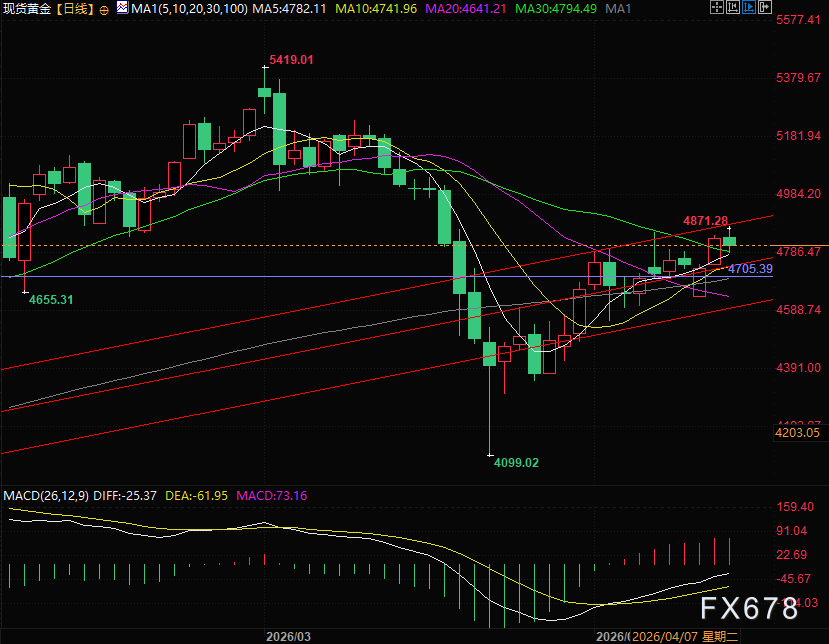
(Spot Gold daily chart, source: FX168 Finance’s Yihuitong)
As of 20:56 (UTC+8), spot gold was reported at $4,812/ounce (UTC+8).
Disclaimer: The content of this article solely reflects the author's opinion and does not represent the platform in any capacity. This article is not intended to serve as a reference for making investment decisions.
You may also like
What to Expect in the Week Ahead (FOMC Rate Decision and Earnings from AAPL, GOOG, AMZN, META and MSFT)
ENSO (ENSO) fluctuates by 69.3% in 24 hours: Trading volume surges over 100 times, triggering speculative volatility
D (DarOpenNetwork) 24-hour amplitude at 50.4%: Active trading and capital rotation drive dramatic price volatility
Trending news
MoreCrypto prices
More





