
Global Markets Are Too Optimistic! IMF and World Bank Warn: Don't Underestimate the Economic Impact of War

Odaily Star Daily learned that the International Monetary Fund (IMF) and World Bank have long been seen as symbols of free trade, capitalism, and financial market wisdom. Yet, during their Spring Meetings, a counter-mainstream view surfaced: investors are underestimating the economic losses brought by the Iran war. At various public forums, private dinners, and side events held in Washington this week, attendees gradually reached a consensus—that even if the US and Iran soon achieve a lasting peace agreement, the conflict's impact on the global economy could worsen significantly before it gets better.
Government officials and other participants at the meeting's opening stated that the world is experiencing more than ordinary shocks. They warned of genuine structural changes taking root, involving rising costs, elongated trade routes, and intensified geopolitical uncertainty, all of which would weaken global growth potential.
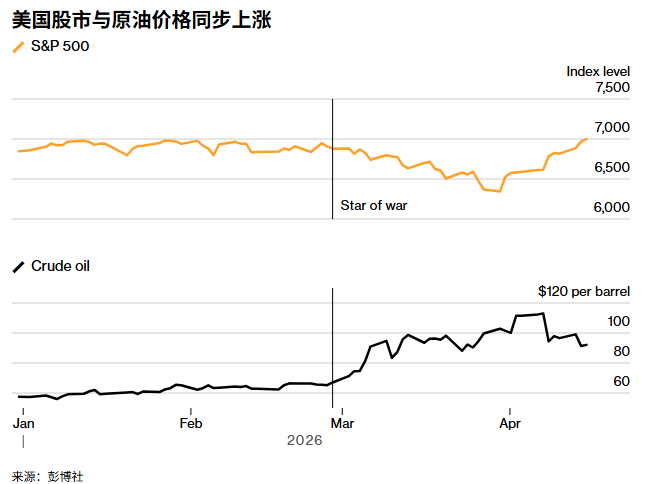
Qatar’s Finance Minister Ali Bin Ahmed Al Kuwari was candid at the IMF meeting on Wednesday: “What we are seeing is just the tip of the iceberg.” At that time, US stocks were nearing historic highs, while oil prices were under $100 per barrel.
Kuwari’s economy is severely impacted by liquefied natural gas exports, and he predicts that within the next one to two months, the current energy price shock will evolve into energy shortages for some countries, “even unable to light up their nations.” He warned that a food crisis triggered by fertilizer shortages will ensue and emphasized that Qatar supplies nearly one-third of global helium (essential for semiconductor manufacturing): “This war will bring massive economic impacts, and the crisis is imminent.”
Trump administration officials urged all sides to remain calm and restrained, especially central banks which should adopt a wait-and-see approach and delay interest rate hikes to cope with inflation. The US believes short-term pain is worth enduring since in the long term this will end the Iranian nuclear threat.
Temporary shock
US Treasury Secretary Scott Besant attempted to describe the conflict and resulting price spikes as temporary phenomena, expecting energy costs to fall quickly once hostilities end. “This war will end—be it three days, three weeks, or three months—but it will end,” he said, adding, “The market is forward-looking.” However, this optimism was difficult to accept broadly at the IMF and World Bank meetings just blocks from the White House.
Bloomberg economic research pointed out: “The US is seeking to break free from Iranian influence, with the market betting it can succeed, but it must overcome obstacles like control of the Strait of Hormuz, Iran’s nuclear program, and the Hezbollah conflict in Lebanon.”
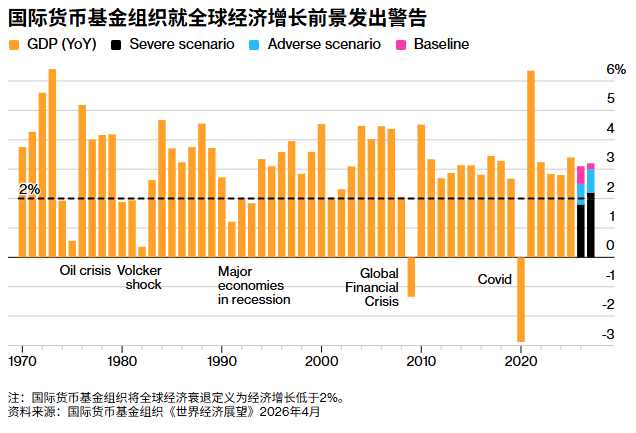
IMF Chief Economist Pierre-Olivier Gourinchas lowered growth projections on Tuesday and predicted the slowest global growth since the onset of the pandemic—with further downgrades expected. He noted that new US blockades of the Strait of Hormuz and other developments mean that the organization’s “adverse” scenario (global growth falling from a pre-war forecast of 3.3% to 2.5%) is increasingly likely.
“Every day, with every additional interruption to energy supply, we are one step closer to the adverse scenario,” Gourinchas said. European Central Bank President Christine Lagarde issued similar warnings regarding Europe’s growth trajectory.
Growing concerns are rooted in an understanding: even if the US and Iran swiftly end the war through negotiations, the six-week-long conflict will leave a lasting shadow on the global economy.
World Bank President Ajay Banga stated Tuesday: “Do not consider this as just another month of pain. Treat it as a prolonged test, because even assuming fighting stops and energy facilities avoid structural damage, it will take time for supply systems to stabilize.”
Although oil prices have surged, the full pain from what the International Energy Agency calls the largest energy shock in global history has not yet fully surfaced. Though the Strait of Hormuz has essentially been closed for six weeks, the last pre-war shipments from the Persian Gulf are only now arriving at their destinations.
“Whether viewed from energy or economic angles, March has been a very tough month for the world, and April will likely be worse than March,” International Energy Agency Director Fatih Birol said at the Spring Meetings.
Stock market rebound
Against such low spirits, attendees wondered why US stock markets, especially the S&P 500 Index, could rebound so swiftly from the initial wartime losses—on Tuesday, as IMF lowered global growth forecasts, the index hit an all-time high. On Wednesday, amid mixed signals such as possible extension of ceasefires and continued slow passage through the Strait of Hormuz, US stocks remained near record highs.
The answer is simple for some participants. “The market underestimates the severity of the situation,” said Alexis Crow, Chief Economist at PwC US, who consults global corporate clients. Crow and others believe this is mainly because the market fails to recognize the disruptions to supply chains caused by the war.
Many market players do not want to become victims of Trump’s “TACO”—the pattern of “Trump Always Chickens Out”—meaning that he drops radical actions when the market reacts unfavorably.
Additionally, investors this week are driven by "FOMO" (fear of missing out)—signs of easing tensions in the Middle East, optimism around artificial intelligence technologies, and US corporate earnings forecasts have prompted skeptical investors to abandon caution. “Investors find it hard to avoid fear of missing out,” said Matt Maley, Chief Market Strategist at Miller Tabak + Co.
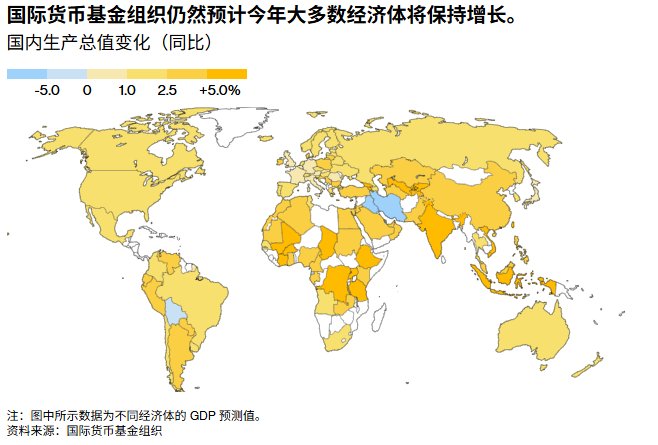
IMF President Kristalina Georgieva said another reason for market optimism is the relative health of the US economy and, as an oil exporter, its limited vulnerability to energy shocks. “But I must say, other regions of the world are not like this—they are already suffering great pain.” When asked directly whether the market should be more cautious, she responded: “Yes, it should, because the supply chain disruptions are quite significant.”
There are also doubts in Washington: After tariff shocks, the pandemic, and escalation of the Russia-Ukraine conflict, how much resilience does the global economy have left? These shocks have pushed debt levels higher and weakened many governments' ability to tackle another crisis in an increasingly divided world. Pierre Cayet, Head of Sovereign Advisory at Lazard investment bank, said in an interview: “No one knows how close we are to the breaking point, but economic, financial, and social resilience is not infinite.”
Though the IMF and World Bank emphasize readiness to address the crisis, there are growing calls for them to do more. Internal worries at the Fund about the severity of the crisis are spreading, with some warning that markets and certain policymakers are underestimating its impact. According to a source, the biggest concern is that the chain reaction from the energy shock could spill into global financial markets. The challenge, the person added, lies in delivering the right message without triggering panic.
Nigeria’s Minister of Finance and Economy Olawale Edun, speaking on behalf of the Group of Twenty-Four on Tuesday, called on the IMF and World Bank to mobilize more resources. He pointed out that the crisis is impacting developing nations at a time when the US and other wealthy countries have abruptly cut foreign aid, and many poor countries now spend more on debt repayments than they receive in aid or foreign direct investment.
Rebecca Patterson, veteran of JP Morgan and Bridgewater and now Senior Fellow at the Council on Foreign Relations, commented that many investors have overlooked one point: the current energy shock’s effects may resemble those of the COVID-19 pandemic. As with the 2020 global health crisis, “this is a rolling contagion.”
Discussing the aftermath of the Iran war, Patterson said, “Asia is the first to feel the impact of energy supply disruptions, and now Europe is starting to feel it too. The US will be next, as the last ships from the Gulf are just about to arrive.”
Disclaimer: The content of this article solely reflects the author's opinion and does not represent the platform in any capacity. This article is not intended to serve as a reference for making investment decisions.
You may also like
ORCA (ORCA) soars 72.3% in 24 hours: Short squeeze and regulatory announcement drive surge
MEZO (MEZO) fluctuates 59.3% in 24 hours: low liquidity drives price volatility
DENT (DENT) fluctuates 44.8% in 24 hours: Trading volume surges over 140% driving high volatility
Trending news
MoreCrypto prices
More





