(Kitco News) - The gold market is trading near its highs after the latest data showed consumer sentiment in the U.S. declining, while inflation expectations pulled back from last month’s one-year highs.
The University of Michigan announced on Friday that the preliminary reading of its Consumer Sentiment survey for May was 48.2. The data was worse than expectations, as the consensus forecast of economists called for a reading of 49.5, and it was also below April’s final reading of 49.8.
“Consumer sentiment was essentially unchanged this month, coming in a scant 1.6 index points below April’s reading and comparable to the trough reached in June 2022,” said Surveys of Consumers Director Joanne Hsu. “While the expectations index inched up, current conditions fell back about 9%, owing to a surge in concerns about high prices both for personal finances as well as buying conditions for major purchases. Real income expectations continued a decline that began in March. About one-third of consumers spontaneously mentioned gasoline prices and about 30% mentioned tariffs.”
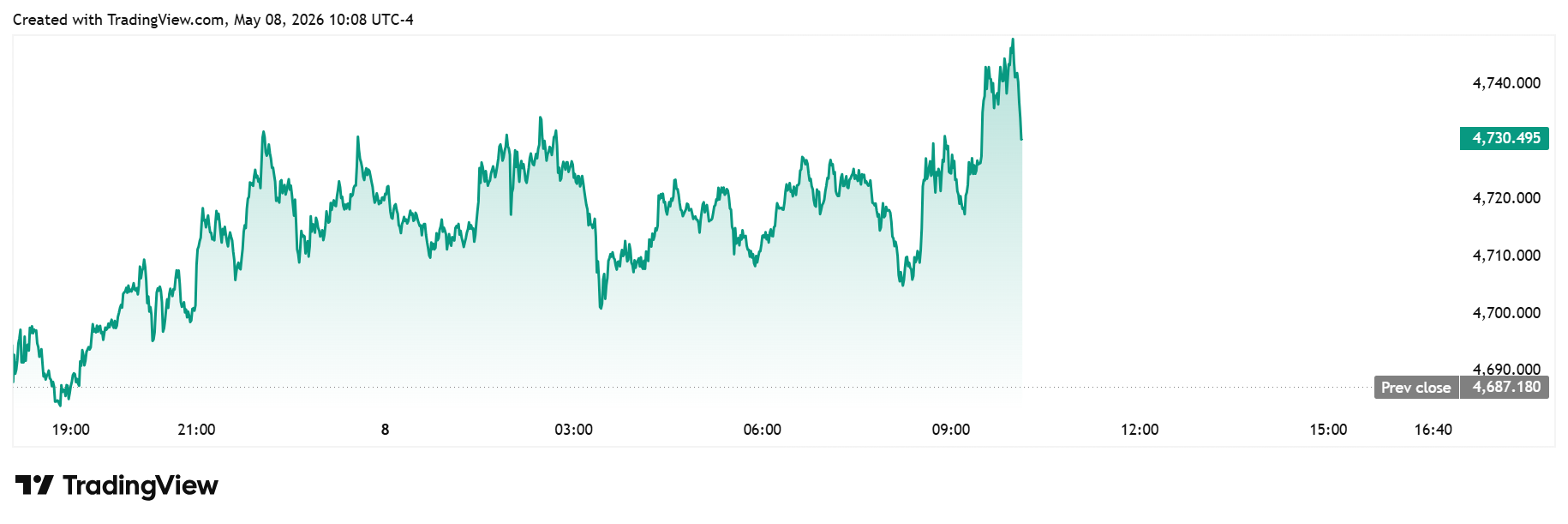
Spot gold shot to a fresh session high of $4,749.58 at the 10 am EST data release, with spot gold last trading at $4,730.42 per ounce for a gain of 0.92% on the day.
The May index reflected a drop in year-ahead inflation expectations, which had risen at their fastest pace since the ‘Liberation Day’ tariff announcement of a year ago in April, while longer-run inflation expectations also ticked lower.
Year-ahead inflation expectations softened a touch from 4.7% last month to 4.5% this month,” Hsu noted. “The current reading still substantially exceeds the 3.4% reading seen in February prior to the start of the Iran war, along with all 2024 readings and the 2.3-3.0% range seen in the two years pre-pandemic. Long-run inflation expectations inched down from 3.5% in April to 3.4% in May. In 2024, values ranged between 2.8% and 3.2%, while in 2019-2020, they were consistently below 2.8%.”
“Taken together, consumers continue to feel buffeted by cost pressures, led by soaring prices at the pump,” she added. “Middle East developments are unlikely to meaningfully boost sentiment until supply disruptions have been fully resolved and energy prices fall.”