
Soaring 38% in a single week! Micron's market capitalization surpasses $840 billion as the memory chip boom enters 'parabolic' growth

Source: Global Market Broadcast
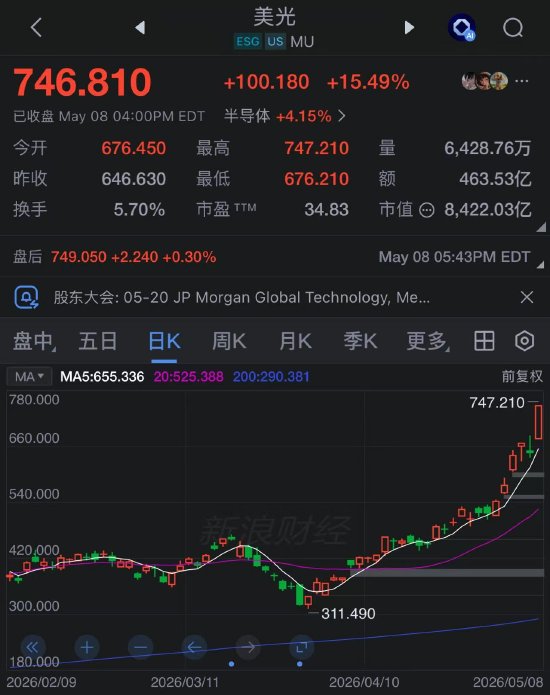
Affected by the global memory chip shortage, Micron Technology's stock price soared this week, with the optimistic sentiment in the entire semiconductor sector driving the stock higher.
On Friday, Micron's stock jumped over 15%, closing at $746.81. It rose nearly 38% this week and has climbed nearly 84% over the past month.
This marks Micron's best week since December 2008 (when the stock traded below $5 following the Great Depression). According to LSEG data, the company’s market cap currently exceeds $840 billion.
Micron is not the only outperforming chip stock. AMD rose 26% this week, hitting a 52-week high on Friday, with a market cap surpassing $740 billion. Intel climbed 25% this week and has more than doubled over the past month. This CPU maker is widely believed to be making a strong comeback.
Bank of America and Evercore point out that capital expenditure by hyperscalers—large-scale cloud providers—could exceed $1 trillion by the end of next year, with demand for memory chips becoming a hallmark of the current AI build-out phase.
Although GPUs (Graphics Processing Units) have previously been the focus of AI hardware construction, memory, storage, and CPUs are increasingly grabbing the limelight.
Against the backdrop of a memory chip shortage, memory manufacturers are seeing expanding selling prices and profit margins, while hyperscalers are complaining about rising costs of end-user goods and services.
DRAM and NAND are the two most in-demand types of memory. DRAM is faster but more particular, while flash-based NAND is slightly slower but more reliable. Both are crucial for AI processing.
Multiple equity research reports indicate that Micron, Samsung, and SK Hynix together produce over 90% of the world’s DRAM.
Like Micron, Korean memory chip manufacturers are also performing strongly. Samsung joined the trillion-dollar market cap club this week, alongside Apple, Alphabet (Google’s parent company), and Microsoft.
On Friday, it was reported that SK Hynix is approaching a number of global technology companies regarding investment intentions. These firms seek to invest in newly built dedicated memory production lines to boost output. The report also mentioned that one proposal involves equipment financing transactions related to EUV lithography machines, provided by clients.
Mizuho analyst Vijay Rakesh wrote in a research report this week, “Micron remains well positioned in memory, with leading DRAM process technology helping reduce costs year by year, while on the NAND side, increasing the number of layers improves cost structure and boosts wafer capacity.”
Researchers noted that in recent months, Micron's overall share in retail trading has been rising. According to data from Vanda Research, net buying volume reached a two-year high in mid-April. Vanda strategist Viraj Patel said on Friday that although overall retail investor stock buying has been somewhat muted compared to recent years, “it’s fair to say that Micron has captured a greater share of retail flows and attention.”
Disclaimer: The content of this article solely reflects the author's opinion and does not represent the platform in any capacity. This article is not intended to serve as a reference for making investment decisions.
You may also like
BILL (BillionsNetwork) fluctuates 44.8% in 24 hours: Leveraged trading launch and supply lock drive rebound
BSB (BlockStreet) fluctuates 55.2% in 24 hours: speculative rebound driven by $92 million surge in trading volume
ESIM (Depinsim) fluctuates 60.0% in 24 hours: low liquidity leads to sharp price volatility
Trending news
MoreCrypto prices
More





