
Gold Trading Alert: US-Iran Talks Collapse Again! Oil Price Soars by $3, Gold Price Gaps Nearly $40, This Week Focuses on US CPI

Huitong Network, May 11—— The US-Iran peace talks have broken down again, with Trump calling Iran's response "completely unacceptable". As a result, oil prices surged over 3%, with WTI reaching as high as $98.85/barrel, pushing inflation expectations higher and weighing on prospects for rate cuts, which in turn caused spot gold to gap down by nearly $40 to $4,678.91/ounce. In the short term, gold prices are under pressure, but geopolitical risks and a potential Fed policy shift continue to support gold’s medium- to long-term allocation value. This week, the US CPI data will be a key indicator.
News that the US and Iran failed to reach a consensus on a peace proposal hit the energy markets like a bombshell, sharply dampening gold’s safe-haven sentiment. On Monday (May 11), spot gold opened with a gap down and dropped nearly $40 to $4,678.91/ounce, while West Texas Intermediate (WTI) crude oil opened sharply higher, climbing as much as 3.66% to touch $98.85/barrel. On the surface, this is a seesaw effect caused by geopolitical conflict, but beneath it lies a three-way contest among global inflation expectations, the dollar’s trend, and Fed policy expectations.
Conflict Reignites: The Strait of Hormuz as the World's Energy "Throat"
The core of the current situation lies in the continued tension in the Strait of Hormuz. Although a Qatari oil tanker and a Panamanian bulk carrier were allowed to pass with Iranian approval,
Iran’s position remains just as tough.
As Trump prepares for his key visit to China, external pressure to end the Middle East war is mounting. But his comments over the weekend remained tough: "They have been defeated, but that does not mean they are finished." At the same time, hostile drones continue to frequently appear over Gulf states, and the conflict between Israel and Hezbollah in Lebanon has not subsided. All these signals indicate that geopolitical risks have not truly receded, but instead have entered a new tug-of-war stage.
Direct Triggers for Gold’s Flash Crash: Triple Pressure from Oil, Inflation and the Dollar
Last week, gold rallied on optimism over US-Iran peace talks, with spot gold climbing 2.15% for the week and closing near $4,715. However, after Monday’s reversal, gold quickly gapped down. This "expectations up, reality down" pattern highlights how gold currently behaves more like a "risk asset" than a traditional safe haven.
High oil prices directly drive up global inflation expectations. Rising energy costs ripple through transportation, manufacturing and other sectors, further intensifying market fears that the Fed may keep rates higher for longer or even delay rate cuts. This strengthens the Dollar Index while putting holding-cost pressure on non-yielding gold. In addition, the US April non-farm payrolls data exceeded expectations (115,000 jobs added, unemployment steady at 4.3%), reinforcing the labor market’s resilience and pushing back hopes for aggressive Fed easing this year.
Analysts point out that gold’s current trading logic is highly tied to prospects for easing tensions with Iran. When energy prices fall and inflation concerns ease, expectations for rate cuts rebound and gold finds support; the reverse then brings selling pressure. This week’s sharp drop in gold is a direct manifestation of this logic.
Macroeconomic Context: Fed Policy Shift and Gold’s Long-term Game
The market is now in a key transition phase for Fed leadership. Jerome Powell’s term is about to end, and Kevin Warsh is set to take over as chairman on May 15. Warsh is seen as relatively dovish by the market, so his appointment could lift market expectations for more accommodative future monetary policy.
The upcoming US April CPI and PPI data will be in the spotlight this week. If the CPI comes in below 3.0%, the dollar may weaken, real yields would drop, and gold could challenge resistance near $4,764 (UTC+8), potentially moving toward the $4,828–4,887 zone; but if CPI is hot (over 3.5%), it would strengthen the hawkish Fed narrative and could see gold retesting support at $4,630–4,666 (UTC+8).
Furthermore, the consumer confidence index has dropped to a record low of 48.2 due to higher gasoline prices, reflecting how expensive oil is truly weighing on the real economy. Over the longer term, if geopolitical conflict cannot be resolved quickly, persistently high oil prices will continue to test global economic resilience and provide potential safe-haven support for gold.
Gold Price Outlook: Short-Term Pressure, Long-Term Allocation Value Remains
All in all, gold will face further near-term adjustment pressure. The risk premium from the collapse of US-Iran talks has flowed more toward oil and the dollar, rather than gold. However, this divergence is not irreversible. Should there be substantive progress towards a ceasefire, a fall in oil prices, or marginally dovish Fed signals, gold’s rebound momentum could quickly return.
From a longer perspective, ongoing geopolitical uncertainty, high global debt levels, and the trend of central banks buying gold continue to support gold's strategic allocation value. Although gold prices have pulled back, as long as they hold key support, there is still hope to seek upward movement amid repeated risk events.
In summary, this round of gold's flash crash is the result of both a reversal in expectations for geopolitical conflict and resonance with macro data. Investors should closely monitor this week's US inflation data, follow-up statements from the US and Iran, and potential diplomatic developments during Trump’s visit to China. For the gold market, short-term volatility is intensifying, but the medium- to long-term logic remains intact.
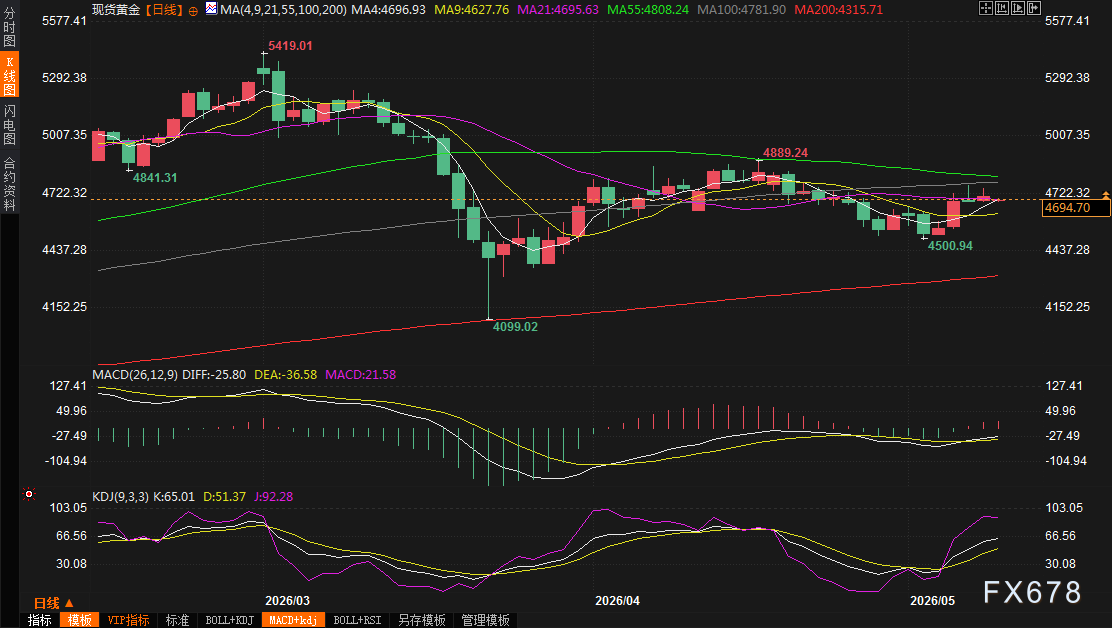
(Spot Gold Daily Chart, Source: Yihuitong)
At 07:30 (UTC+8), spot gold was quoted at $46,945.53/ounce.
Disclaimer: The content of this article solely reflects the author's opinion and does not represent the platform in any capacity. This article is not intended to serve as a reference for making investment decisions.
You may also like
SAGA fluctuates 44.9% in 24 hours: trading volume surges over 7 times and open interest rises, driving a rebound
SKYAI (SKYAI) fluctuates 59.8% in 24 hours: Whale accumulation and trading volume surge trigger sharp volatility
Emerging markets: Broadening gains persist in 2026 – HSBC
Trending news
MoreCrypto prices
More





