
The NFT market is set to soar from 2 billion to 60 billion: an irreversible art revolution under prejudice

The crypto community has criticized NFT as "dead", the art world has denounced it as a "scam", and the public is addicted to the joke of "right clicking to save JPEG" - this is the current public opinion landscape of the NFT market. But the data and facts have long deviated from this bias: the current NFT market size is about $2 billion, down 90% from its peak, while the traditional art market will reach $59.6 billion by 2025. On the surface, NFTs seem to be completely defeated, but in reality, there is the opposite truth: while everyone is staring at price charts, museums, blue chip galleries, and top collectors have already quietly built infrastructure for NFTs, and a revolution that is driving the NFT market from 2 billion to 60 billion is silently brewing.
This is not a speculative 'moon landing prophecy', but a necessary judgment based on the laws of art history, institutional actions, collection trends, and property rights reform. The value of NFTs never lies in the 'image itself', but in the core logic of reconstructing digital property rights behind it; The outbreak of its market is not the restoration of speculative fever, but the natural result of the formal integration of digital art into art history and the continuation of traditional art market iteration.
###1、 The hidden concerns of the traditional art market: shrinkage, concentration, and intergenerational discontinuity
Many people oppose NFT with the traditional art market, but overlook a key fact: the latter is not a thriving "safe asset pool", but is facing a structural crisis. According to the 2026 report by Art Basel and UBS (written by renowned analyst Dr. Claire McAndrew), the traditional art market size is expected to reach $59.6 billion in 2025. Although it is a 4% year-on-year increase, it is still below the peak of $67.8 billion in 2022 and has been declining for two consecutive years before experiencing a slight rebound.
The more hidden problem lies in the imbalance of market structure: the mid-range works market below $50000 has shrunk for more than a decade; In public auctions, works priced over $1 million only account for 1% of the total number of auction items, but contribute 54% of the market value. This means that the traditional art market is essentially a "$30 billion mass market+$30 billion top casino" - with billionaires trading works by Basquiat and Picasso at the top as efficient tax tools for capital transfer, while the mid-range market continues to hollow out.
The most fatal hidden danger is the intergenerational gap. The core participants in the market - buyers, distributors, and infrastructure operators - are all aging, and over the next two decades, more than $8 trillion in assets will be transferred from the baby boomer generation to their children and grandchildren. This generation of heirs who grew up in the Internet era did not grow up in the Sotheby's catalog bidding. They are familiar with the digital world, and their collection habits and aesthetic preferences for traditional art are bound to promote the transformation of the market to a digital form. NFTs may seem to be competing with traditional art, but in reality, they are taking on an aging and disconnected market gap.
###2、 Institutions have already taken action: museums take the lead in "naming" NFTs
There is a mature path for legalizing new media in the art world: artist exploration → critic ridicule → curator acceptance → museum follow-up → auction house and gallery entry → long-term price increase. Photography, video art, and installation art have all taken this path, and now, this path is being fully reproduced in NFT art at a speed far exceeding any new medium in history.
In the past four years, the "institutional backbone" of contemporary art in Europe and America has made formal commitments to digital and on chain art, which is a core signal that the NFT market is about to explode:
In 2023, MoMA in New York collected "Unsupervised" by Rafik Anador (including accompanying NFTs and visitor castable blockchain memorabilia) and Ian Cheng's generative NFT "3FACE" - the latter is a conceptual art that cannot exist without blockchain. It has been displayed in the museum lobby for nearly a year and has received three million visitors; In the same year, the Pompidou Center in Paris collected 18 NFT works by 13 artists, including CryptoPunk, Autoglyph, etc. Curator Marcela Lister positioned it as a natural continuation of the museum's existing avant-garde art collection; LACMA in Los Angeles has one of the world's most serious on chain art collections, receiving 22 blockchain art pieces donated by collector Cozomo de 'Medici. It also operates the first female digital artist collection fund in American museums, and the founder of Art Blocks donated the last Chromie Squiggle, symbolizing the origin of generative art, to the museum.
In addition, ICA Miami was the first major museum to collect NFTs, the Whitney Museum of Art has been collecting digital art and operating a digital exhibition platform for many years, and the AKG Art Museum in Buffalo held the first blockchain art survey exhibition in the United States - just as the museum hosted the first photography exhibition in the United States in 1910 (when photography was still not considered art), it is now once again at the forefront of new media; The exhibition of Jenny Holzer's "Light" at the Guggenheim Museum in 2024 will integrate AI and digital art into the core exhibition space.
The actions of these institutions are not gimmicks, but a formal recognition of the artistic value of NFTs - when the gatekeepers who decide what art is have entered the game, the market's repricing is only a matter of time.
###3、 The inevitability of art history: every revolution begins with ridicule
The crypto circle often ignores the laws of art history, while the art world instinctively understands that every art movement ultimately hailed as a classic was treated as a joke in its early days. The experience of NFT art is just a repetition of history.
In 1863, Manet's "Lunch on the Grass" was rejected by the Paris Salon and became the core exhibit of the unsuccessful salon, but was criticized by critics as "vulgar embarrassment". Today, it has become the cornerstone of modern art; In 1874, the exhibition by Monet and others was ridiculed by critics as "Impressionism" (initially an insult), and it was not until over a century later that Van Gogh's works broke through the price monopoly of ancient masters; In 1962, Andy Warhol's solo exhibition "Canned Campbell Soup" was publicly mocked by neighboring galleries using real cans. Today, this set of works is MoMA's most precious collection, with a single canvas privately sold for over $9 million; In 1967, Saul LeWitt proposed the idea of "ideas becoming machines for making art," which was seen as a fringe philosophy, and his wall paintings (essentially executable "smart contracts") are now distributed in major museums around the world, with auction records exceeding $1.6 million.
Comparing history, it can be seen that the development speed of NFT art has far exceeded any previous art revolution: Impressionism took 124 years from rejection to breaking auction records, Pop Art took about 50 years, Concept Art took about 35 years, and NFT art took only 7 years from the first NFT "Quantum" casting in 2014, the launch of CryptoPunks in 2017, to Christie's first major NFT auction in 2021.
The current NFT art is in the stage of Impressionism 1874 and Pop Art 1962- ridicule continues, but the process of institutional acceptance and collection accumulation has quietly accelerated. The first wave of NFT artists are still in the middle of their careers, and the historical scripts that priced Manet and Warhol are being replayed on them.
###4、 Blue chip galleries and auction houses: Vote for the future with action
If you want to judge the future of an art medium, you don't need to look at short-term prices, just look at the actions of blue chip galleries - they are the most conservative participants in the art world, signing contracts with artists who are expected to remain valuable 50 years later, and their core business is to provide reputation insurance for long-term collections. When they start laying out NFTs, it means that this transformation is irreversible.
Founded in 1960, Pace Gallery has represented the legacy of art masters such as Saul LeWitt and Mark Rothko. In 2021, it launched a dedicated NFT platform called Pace Verso, which collaborates with renowned artists such as Jeff Koons and teamLab to release NFT projects; In 2023, Pace held a solo exhibition for on chain native generative artist Taylor Hobbs in its flagship space in New York. His works were showcased in the same space as those of Roscoe and Calder, and Taylor Hobbs' QQ Casting Pass still achieved a secondary market valuation of $28 million from $17 million in a bear market.
Perth is not an exception: Lemanmoping became the first commercial gallery to accept cryptocurrency payments, HauserVoss showcased Jenny Holzer's NFT related works, and Gao Guxuan opened up cryptocurrency sales; At the auction house level, Sotheby's launched the metaverse market in 2021 and has sold over $100 million worth of NFTs, maintaining this position even as the industry abandons royalties; Christie's will launch its first fully on chain auction platform, Christie's 3.0, in 2022, continuing to delve into the field of digital art.
These institutions do not need to rely on NFT business for survival, their layout is essentially a "vote" - the most conservative and intelligent people in the art world have judged that on chain art will be the core direction of collections for the next 25 years.
###5、 Data evidence: NFT art has formed a stable value system
Those who laugh at NFT often ignore those established value benchmarks - these are not speculative foam in 2021, but "receipts" for NFT art to be recognized:
Beeple (Mike Winkelmann) has been creating digital paintings daily for thirteen consecutive years. In 2021, his work "Every Day: The First 5000 Days" sold for $69.3 million at Christie's, making him the third most expensive living artist in the world; Pak's' Merge 'set a record for the total public sales of living artists at $91.8 million; Dmitry Cherniak's Ringers # 879 ("Goose") sold for $6.2 million at Sotheby's during the bear market in 2023, setting the second highest auction price for generative art; Taylor Hobbs' Fidenza # 725 exceeded $1 million at Sotheby's auction, five times the high estimate; Rafik Anador is not only collected by MoMA, but also became the first artist to project on the exterior of a Las Vegas sphere, with works spread across globally renowned landmarks.
These are not isolated outliers, but rather a stable value group: a group of digital artists with seven or eight figure auction records, collected by museums on three continents, and represented by top galleries - a group that did not exist five years ago but has now become an undeniable force in the art world. The hype has long faded away, but the infrastructure that supports the value of NFTs continues to improve.
###6、 The Layout of New Meidiqi: Accumulation of Value in a Bear Market
The key to determining the future of an asset class depends on who is accumulating in a bear market - the current situation in the NFT market is that retail speculators are leaving, while real collectors are quietly laying out, comparable to the Medici family that funded the Renaissance, locking in future classics when new media was not widely recognized.
Collector Cozomo de 'Medici (named in honor of the Medici family) donated 22 generated artworks to LACMA in 2023, betting that on chain art will be recorded in art history; Anonymous collector Punk6529 purchased "Goose" for $6.2 million and operates the Metaverse Museum area, with a personal collection valued at over hundreds of millions of dollars at its peak; Flamingo DAO has gathered over a hundred member capital and holds a complete set of CryptoPunks and Autoglyphs, with a peak investment portfolio valuation of one billion US dollars; PleasrDAO purchases Wu Tang Clan album NFT and Edward Snowden NFT, supported by Anderson Horowitz, focusing on long-term collection of on chain art.
In addition, anonymous institutional collectors and family offices are also continuously accumulating NFTs - they do not hype or publicize them, viewing NFTs as "new systems with digital culture" rather than short-term trading targets. The launch of Christie's specialized on chain platform also confirms the growing power of this type of collection - the real picture of the market is completely contradictory to the public narrative of 'NFT is dead'.
###7、 Core innovation: NFT reconstructs digital property rights and rewrites the rules of the art game
The biggest misconception most people have about NFTs is that they are seen as a 'transaction category' rather than a 'property rights system'. Before the emergence of NFTs, the characteristic of digital culture was "unlimited distribution, zero ownership" - works could be spread infinitely but could not be truly owned, and most of the value flowed to the platform rather than creators and collectors.
NFT completely subverts this logic: it allows digital culture to be both infinitely disseminated and limitedly owned. The core value of art lies in its source, story, and cultural relevance, and blockchain technology has unprecedentedly upgraded these three points - on chain art is the first major art category with programmable, publicly available, and time stamped ownership history, fundamentally solving the core pain points of the traditional art market.
The traditional art market loses billions of dollars every year due to counterfeits, lost sources, and ownership disputes: the 165 year old New York Knodler Gallery went bankrupt due to the sale of fake Roscoe and Pollock works; The identity of Leonardo da Vinci as the author of "The Savior" sold by Christie's for $450 million is still controversial. And on chain art does not have these problems - the source is the medium itself, each former owner can verify, each transaction has a timestamp, each smart contract can be audited, and an artwork and its complete ownership history mathematically become the same object.
You can right-click to save JPEG, but you can never right-click to save the source and ownership on the chain - this is the core value of NFT and the key to its ability to take over the traditional art market and achieve explosive scale.
###Conclusion: From 2 billion to 60 billion is not a prediction, it is inevitable
When we integrate all the clues - the shrinkage and intergenerational gap of the traditional art market, the formal entry of museums and blue chip galleries, the inevitable laws of art history, the long-term layout of top collectors, and the property rights reform of NFTs - it is not difficult to conclude that the growth of the NFT market from $2 billion to $60 billion is not a groundless prediction, but the inevitable result of multiple trends resonating.
The current market value of $2 billion corresponds to an emerging asset class with top museum collections, conservative gallery endorsements, seasoned collectors' accumulation, a perfect property rights system, and an upcoming $8 trillion intergenerational asset transfer. It's like buying Warhol's works at second-hand car prices in 1965- those paintings are now sold for nine figures, and today's basic digital art is in the same low value zone.
The salon that mocked Manet has long been forgotten, the grocery store that mocked Warhol has gone unnoticed, and those who mock NFT art today will eventually be left behind by art history. The speculative frenzy of NFTs has passed, but the process of digital art entering art history has just begun. The growth of the market has never been about "NFTs coming back", but about digital art finally finding its own pricing system - and $60 billion is just the starting point of this revolution.
Disclaimer: The content of this article solely reflects the author's opinion and does not represent the platform in any capacity. This article is not intended to serve as a reference for making investment decisions.
You may also like
Crypto ETF Inflows Surge Across Major Assets
Uquid Business Powers Enterprise Commerce with Stablecoins
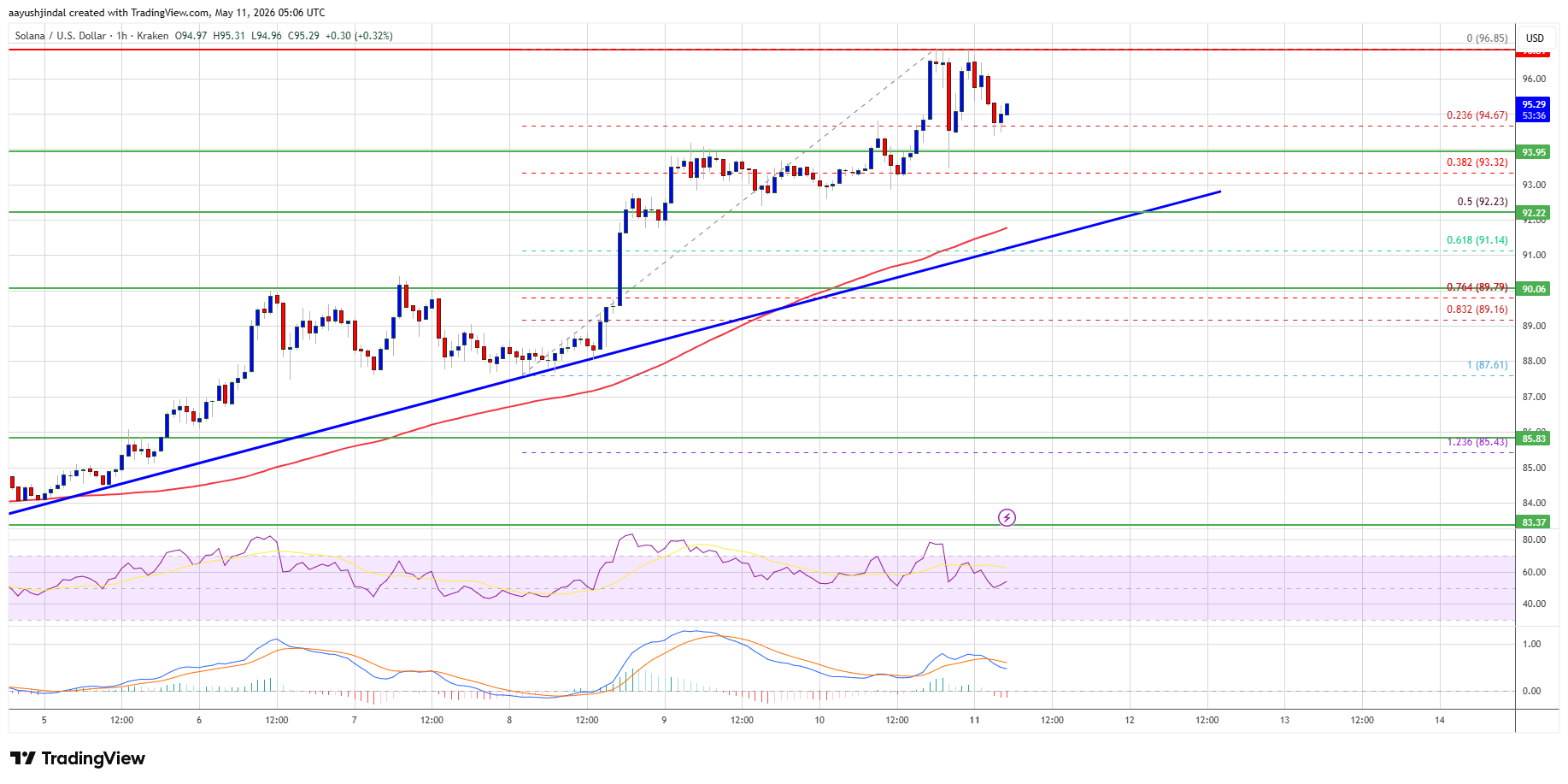
Solana (SOL) Breakout Setup Strengthens As Bulls Regain Full Control
Trending news
MoreCrypto prices
More





