
US dollar strengthens ahead of US CPI release, gold price falls under multiple pressures

FX168 Financial News, May 12 — Although the gold market approached a three-week high driven by a slight increase during the Asian session, it still failed to achieve a significant surge. Geopolitical tensions in Iran and hawkish expectations from the Federal Reserve have supported the US dollar, limiting the rise in gold prices. Currently, traders are closely watching US CPI data for signals of a sustained direction.
On Tuesday (May 12), gold prices started an intraday pullback from their three-week high during the Asian session, gradually declining and briefly falling below the $4,700 level. As of 15:15 (GMT+8), spot gold touched a low of $4,687.34 per ounce and is currently trading near $4,696. The market remains in a wait-and-see mode, anticipating guidance from the upcoming US CPI data. Additionally, ongoing tensions in the Middle East, with US-Iran peace negotiations on the brink of collapse, have enhanced the US dollar's safe-haven appeal, kept crude oil prices elevated, intensified global inflation concerns and solidified Fed's hawkish expectations. A slightly stronger dollar has further suppressed gold’s upside potential, with gold prices remaining under pressure and fluctuating in the short term.
Geopolitical Crisis Intensifies, Dragging Gold Lower After the Surge
Recently, negative news about the Middle East situation has been escalating, and the persistent stalemate between the US and Iran has greatly reduced expectations for a peace agreement. US President Trump officially rejected Iran's ceasefire proposal, and the two sides remain at odds on core issues such as the Iranian nuclear negotiations and the control of shipping in the Strait of Hormuz. The confrontation, ongoing for over two months, shows no signs of easing.
According to related reports, Trump has lost patience with the long-term blockade of the Strait of Hormuz and is dissatisfied with Iran’s attitude in the ceasefire talks. Several Trump aides revealed that, compared to the cautious approach of recent weeks, the US is now more seriously considering the resumption of large-scale military operations. The anticipation of escalating geopolitical conflict has surged, prompting safe-haven funds to flow back into US dollar assets, which in turn has put downward pressure on gold prices.
Inflation and Fed Expectations Disrupt, Stronger Dollar Suppresses Gold Prices
The market is generally worried that tensions in the Middle East will drive up energy prices, potentially reigniting global inflationary pressures. Market pricing shows roughly a 25% probability of the Federal Reserve raising interest rates again by the end of the year, further strengthening the dollar's trajectory. All eyes are now on the US CPI data, which will directly influence expectations for the Fed’s subsequent policy decisions, and thus affect the strength of the US dollar and gold pricing.
Driven by heightened hawkish expectations for the Fed, the US Dollar Index edged higher, while gold, as a non-yielding precious metal asset, came under significant pressure, with prices pulling back from the $4,773 to $4,774 range. However, based on market performance, the decline in gold didn’t trigger sustained heavy selling, with limited momentum from the bears; thus, investors shouldn’t blindly turn bearish on gold’s outlook.
Technical Patterns Sorted, Gold Moves into a Tug-of-War Range
From a technical standpoint, gold’s four-hour chart demonstrates notable resilience, gaining support and stabilizing below the 100-period simple moving average on Monday. The price rebounded from the 38.2% Fibonacci retracement of the April–May decline, subsequently breaking above the 61.8% retracement, forming an overall bullish technical structure.
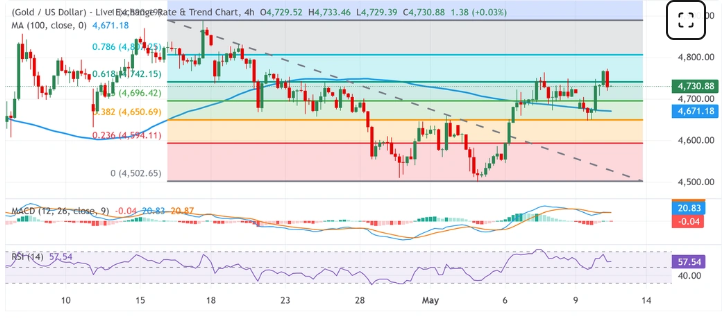
(Spot gold four-hour chart)
Momentum indicators show that gold’s upward momentum remains stable but has not entered a strong unilateral uptrend. The Relative Strength Index holds near 58, indicating mild bullish momentum; the MACD histogram runs slightly below the zero line, indicating a temporarily balanced bull-bear scenario.
Key resistance on the chart is concentrated around the 61.8% Fibonacci retracement at $4,742, followed by the 78.6% retracement near $4,807 and the previous swing high at $4,890. It is currently testing the 50% retracement level at $4,696. Next supports are near the 100-period moving average at $4,671, and further down the 38.2% retracement at $4,651 forms another critical defense. If prices weaken further, the structural support zones at $4,594 and $4,503 become key floors.
Summary
Overall, gold has been dragged lower in the short term by multiple factors including heightened Middle East tensions, a stronger dollar, and Federal Reserve rate hike expectations, pulling back from a three-week high and approaching the $4,700 mark. With geopolitical developments potentially escalating and US inflation data imminent, volatility may intensify ahead. Technically, the bullish structure has not been completely destroyed, and the selling pressure from bears lacks persistence; gold prices are now in a tug-of-war phase between bulls and bears. Ahead, close attention should be paid to the inflation data and changes in the Middle East situation for direction.
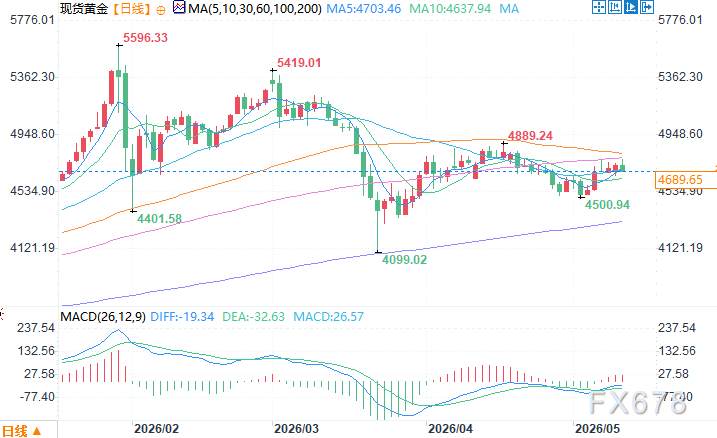
Spot gold daily chart Source: Yihuitong
May 12, 15:17 (GMT+8) Spot gold quoted at $4,696.65/oz
Disclaimer: The content of this article solely reflects the author's opinion and does not represent the platform in any capacity. This article is not intended to serve as a reference for making investment decisions.
You may also like
US Dollar: Neutral range trading outlook – TD Securities
Dow Jones Industrial Average futures slide as CPI hits 3.8%, China trip looms
Trending news
MoreCrypto prices
More





