
Ripple Diversifies Its Revenue Base Beyond XRP Sales. Here’s the Latest

Ripple sits at the center of one of crypto’s most active debates. Investors focus heavily on XRP’s price, but few pay attention to what Ripple actually earns.
The company has built a revenue model that operates across multiple streams, with XRP sales representing just one piece of a much larger picture.
In a recent post, crypto researcher SMQKE (@SMQKEDQG) put it plainly: Ripple’s business “does not rely on selling XRP.” That statement addresses a long-debated topic and shifts the conversation away from token sales toward what Ripple has actually constructed as a business.
Yes, Ripple has diversified its revenue base beyond XRP sales to earning returns from investments and its Line of Credit service.✅
Ripple’s business does not rely on selling XRP.🚫
They can make money in other ways.🔑
Documented.📝👇
— SMQKE (@SMQKEDQG)
Strategic Investments Generate Real Returns
Beyond its network operations, Ripple earns returns from strategic investments in blockchain and fintech ventures. These are not passive holdings. They represent active capital deployment across an industry Ripple knows well. Returns from this activity contribute to the company’s revenue independent of any XRP market activity.
This is a significant detail because it means Ripple’s financial health does not rise and fall exclusively with XRP’s price. The company generates income through traditional investment activity, much like an institutional fund operating inside the crypto space.
The Line of Credit Product
Ripple also operates a Line of Credit product. It provides on-demand liquidity for cross-border payments. This service targets a genuine pain point in global finance. Cross-border transactions are slow and expensive through legacy systems. Ripple’s product addresses that directly.
This product generates revenue through lending activity, not token sales. It positions Ripple as a financial services provider with a working product, one that competes in a market worth trillions of dollars annually.
RLUSD and Institutional Expansion
Ripple has expanded its ecosystem further with RLUSD, a U.S. dollar-backed stablecoin issued in partnership with BNY Mellon. That partnership with one of the world’s oldest and largest custodial banks signals serious institutional credibility. RLUSD has become a major player in the stablecoin space, adding another revenue-generating layer to the business.
The company is also moving into institutional custody and digital asset management services. These are high-margin businesses in traditional finance. Ripple’s entry into this space puts it in direct competition with established financial institutions, but with the advantage of native crypto infrastructure.
What This Means for XRP
The document SMQKE shared noted that these initiatives diversify Ripple’s revenue base beyond XRP sales. That diversity is important for XRP’s long-term price outlook.
A company generating revenue across multiple streams is a fundamentally stronger issuer than one dependent on token sales. Institutional investors evaluate the strength of the entity behind an asset. Ripple is building exactly the kind of profile that attracts that capital, and that capital will flow into XRP.
Disclaimer: The content of this article solely reflects the author's opinion and does not represent the platform in any capacity. This article is not intended to serve as a reference for making investment decisions.
You may also like
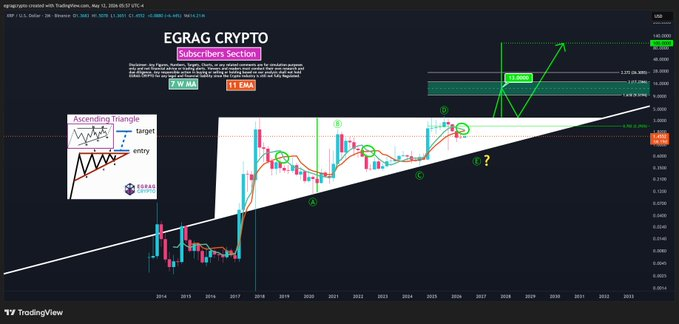
XRP Price Outlook Tracks EGRAG’s Macro Compression Setup
India : Narrow demand response weighs on GST – Societe Generale
BNB jumps past $660 with eyes now on $700 target
Trending news
MoreCrypto prices
More





