
Hidden "debt resolution strategy" in US-Iran rivalry: Oil prices and gold may rise together against intuition

FX168 Finance, May 13 —— The ceasefire game between the US and Iran has escalated, with the US encircling but not attacking. It may be leveraging high oil prices to create inflation and reduce debt, boosting equity assets, as both geopolitical and financial opportunities emerge.
On Wednesday (May 13) during Asian and European trading hours, international oil prices slightly retreated, but global risk appetite remains optimistic. Currently, oil prices and equity assets are even rising together, while precious metals still present a "bad news is a buy point" scenario.
The US-Iran ceasefire agreement remains fragile on paper, but in reality, neither side wants to break it.
Why is the US encircling but not attacking, and what is the story behind maintaining a tight balance?
Encirclement and Pressure: From Economic to Physical Blockade
Currently, the strategy of the US and its allies is still maintaining "maximum pressure" to force Iran to compromise.
President Trump has recently made frequent statements, not only claiming that the current blockade "has achieved the expected results," but also toughening his rhetoric: "If Iran does not make the right choice, we will resolve this matter completely."
This "using force to promote talks" posture reflects the US' aggressive mindset after gaining the upper hand in bargaining chips, where the proportion of the "stick" in negotiations now far exceeds that of the "carrot."
Coordinated Public Opinion, Non-Physical Pressure
Despite Pakistan's mediation, the structural contradictions in the negotiations remain significant.
Iran insists on demanding that the US compensate for war losses caused by years of sanctions, which Washington sees as a "political provocation."
For Trump, any form of "official compensation" is tantamount to admitting policy failure, which is an absolute political taboo within the Republican Party.
However, before his visit to China, Trump reiterated his support for Pakistan as a mediator between Iran and the US, praising Pakistan's Prime Minister Shehbaz Sharif as well as Army Chief Asim Munir. The two helped facilitate last month's formal and fragile Iran ceasefire agreement.
Reconstructing the Energy Trump Card: The US Oil Market's "Explosive" Counterattack
One core logic behind Trump's current confidence is: energy independence. On the 12th, Trump reiterated that inflation is "temporary."
He reaffirmed that US oil production is about to experience "explosive growth," which is not only aimed at stabilizing domestic oil prices but also serves as a strategic deterrent to Iran.
Once global oil prices fall due to increased supply from the US and Russia, Iran's path of earning foreign exchange through black market oil export premiums will be cut off. Trump aims to "flood the market," depreciating Iran's oil leverage.
Inflation Considerations and Subtle Maintenance of the Status Quo
Although inflation has brought significant pressure to the global economy, countries such as the US remain tacitly observant of developments. Remember that countries like the US and Japan currently have very high levels of national debt. The annual interest growth cannot keep up with GDP growth, and if things deteriorate to the point where the credit of their own currencies is affected, leading to capital outflows, that would be much more serious than rising inflation.
Future Evolution: How to Rebrand "Compensation"
Regarding Iran's five preconditions, especially the controversial "war loss compensation," the future situation may seek a soft landing through "transfer of interests."
To give both sides a way out, the US and Iran may, under Pakistan's mediation, reach an implicit "compensation package":
Phased unfreezing of restricted funds: The US may permit the phased release of billions of dollars of Iranian assets frozen overseas under the pretext of a "humanitarian fund."
In name, this would be a "return of property," not "official compensation," thus saving US face while relieving Iran's cash flow crisis.
Mutually agreed relaxation of oil exports: The two sides may reach an agreement to grant more oil import waivers to certain countries, even without removing all sanctions.
This disguised oil export liberalization will become the "economic dividend" that Iran actually receives.
This approach transforms compensation into technical access for repairing Iran's energy facilities and improving civil aviation safety, ultimately achieving an economic cooperation that masks political concessions.
Summary and Technical Analysis:
The current US-Iran game is at a stage where, although there is pressure on paper, every transaction is an opportunity.
According to this logic, the rise in oil prices comes both from the reality of the Strait of Hormuz being closed and the US’ approach to debt resolution. As the market becomes accustomed to high oil prices and inflation, with the arrival of corporate price-raising windows, a wealthy asset boom emerges. For the midterm elections, politicians only have to issue good benefits to the public and stir up enthusiasm to largely offset inflation’s negative impact on their electoral prospects.
Technically, Brent crude oil has broken through the key 0.768 Fibonacci level at 106.43 and is currently pulling back. As previously mentioned in repeated articles, rising oil prices actually fit the interests of all parties involved, and oil prices are likely to continue pushing up the valuation center. With the improvement of risk appetite, it's even possible to see oil and other interest rate-sensitive assets such as gold rising together.
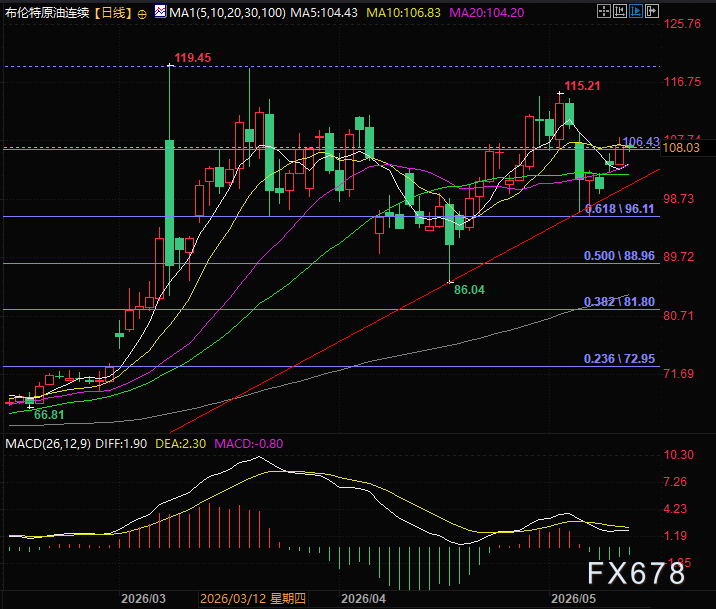
(Brent Crude Oil Futures Daily Chart, Source: FX168 Finance's Yihuitong)
At 16:12 Beijing time, Brent crude oil futures contracts are now quoted at $106.92 per barrel.
Disclaimer: The content of this article solely reflects the author's opinion and does not represent the platform in any capacity. This article is not intended to serve as a reference for making investment decisions.
You may also like
GBP/USD Price Forecast: Extends decline below 20-day EMA
LNG: Oil shock boosts fuel-switch economics – ING
Trending news
MoreCrypto prices
More





