Pressure is mounting on the European Union to ban Russian uranium imports, a shift that could strengthen the position of Canadian suppliers including Cameco (TSX: CCO) (NYSE: CCJ) as utilities race to secure alternative nuclear fuel sources.
The EU has already moved to phase out Russian oil, gas and coal, but uranium and nuclear fuel services remain embedded in Europe’s reactor fleet. Russia still accounted for nearly one-quarter of the bloc’s uranium enrichment services last year, while state-owned Rosatom continues to supply fuel across the continent.
A spokesperson for the European Commission told MINING.COM that work on a proposal to phase out Russian nuclear fuels was “ongoing”.
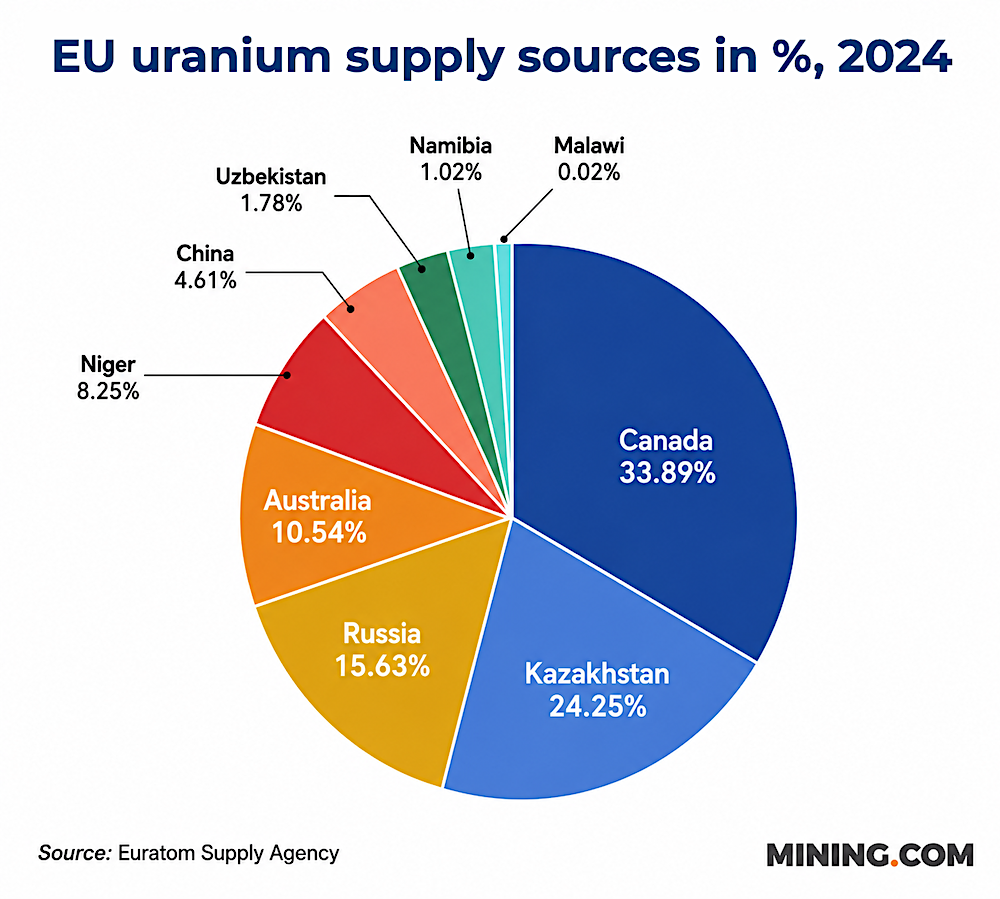
Canada supplied more than 30% of the EU’s uranium imports in 2024, making it the bloc’s largest source of the fuel.
“Cameco is well positioned to benefit from Europe’s move away from Russian nuclear fuel, though much of the shift has already occurred through utility self-sanctioning rather than formal EU bans,” a company spokesperson told MINING.COM. “While Russian uranium itself is increasingly consumed domestically, Canada has been the EU’s largest uranium supplier since 2022, and Cameco’s high-grade, geopolitically secure assets align with utilities’ focus on supply security.”
Energy security, climate goals
The shift comes as Europe expands nuclear generation to bolster energy security and meet climate targets after Russia’s invasion of Ukraine exposed the risks of depending on imported fossil fuels.
Poland is advancing plans for its first nuclear plant using Westinghouse AP1000 reactors, while Bulgaria plans to add two more AP1000 units at Kozloduy. Cameco owns 49% of Westinghouse. CEO Tim Gitzel recently said the company also sees opportunities in Slovakia, Slovenia and Croatia as countries seek long-term uranium supply deals and alternatives to Russian technology.
Replacing Russian fuel services, however, will be slow. Rosatom controls about 43% of global uranium enrichment capacity, far ahead of rivals Urenco and Orano. Mykhailo Babiichuk of Kyiv-based think tank DiXi Group said uranium mining supply can be diversified within a few years, but replacing Russian enrichment services could take up to a decade because Western capacity remains limited.
“Overall, while front-end diversification is progressing, a complete phase-out of Russian nuclear fuel cycle services is a medium- to long-term process rather than a rapid shift,” Babiichuk said.
For reactors designed around Russian fuel systems, the transition is already underway. Westinghouse has signed supply agreements for Soviet-designed VVER reactors in countries including Finland, Bulgaria and Slovakia, while Ukraine has fully shifted away from Russian nuclear fuel. Cameco said those conversions could lock utilities into Western fuel supply chains for decades.
A long goodbye
All eyes are now on Hungary where Rosatom is is building the delayed Paks II nuclear project there, though analysts say a future government could reconsider the arrangement as political support for closer EU alignment grows.
Even without a formal EU ban, utilities have already begun distancing themselves from Russian supply chains. The broader restructuring of Europe’s nuclear fuel market may ultimately cement Canada’s role as one of the West’s most important uranium suppliers.
Andreas Walstad has written extensively about energy issues for almost two decades. Dividing his time between London and Brussels, he has a special focus on energy policy and regulation. He regularly speaks and moderates discussion panels at conferences.