Colombia is pressing Glencore (LON: GLEN) to begin planning now for a post-coal future at its Cerrejón mine, setting up a high-stakes debate over whether one of the world’s largest open-pit coal operations can wind down without triggering economic shock.
The push follows calls from President Gustavo Petro’s government for early transition talks around the Cerrejón complex. The concession runs until 2034, but officials say waiting until the final years of the operation could leave the coal-dependent region of La Guajira vulnerable to severe economic and social disruption.
Cerrejón produced 16.8 million tonnes of coal in 2025, down from 19.2 million tonnes a year earlier, according to a report by Chilean mining consultancy GEM. The operation supports more than 12,000 direct and contractor jobs and includes a 150-km railway and Caribbean export port that underpin much of the economy in the northern province of La Guajira.
“The real choice in this case is between a managed transition and an unmanaged shock,” Juan Ignacio Guzmán, head of GEM, said in the report, which examined the risks of an accelerated closure.
The consultancy argued that abrupt political intervention without replacement industries, financing and community safeguards could destabilize municipal budgets, local suppliers and environmental programs across the region.
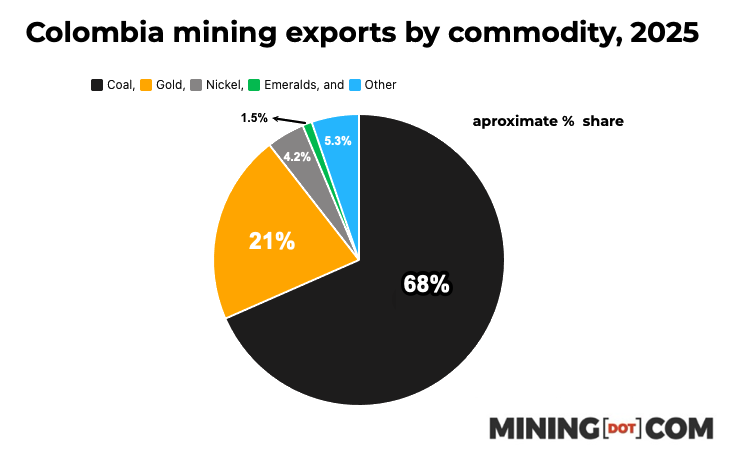
Cerrejón remains one of Colombia’s most important export assets and a major source of royalties, taxes and employment. GEM estimates the coal complex contributes about $166 million annually in royalties and supports roughly $86 million in local procurement spending.
Production declines could trigger a cascade of economic impacts affecting suppliers, municipal budgets, contractor employment and social services in one of Colombia’s poorest regions, the report said.
Energy transition test
The debate has become a test case for Colombia’s broader energy transition strategy. Petro has banned new coal and hydrocarbon exploration contracts while promoting wind and solar investment in La Guajira, a region with some of Latin America’s strongest renewable-energy potential.
Cerrejón has also faced years of environmental and social criticism over water use, coal dust and the displacement of Indigenous Wayuu communities. Environmental groups argue the eventual closure of the mine could reduce pressure on scarce water resources in the arid region, while unions and local leaders fear a poorly managed transition could devastate the local economy.
GEM said international mine-closure experience shows the greatest risks emerge when shutdowns are driven by political conflict, legal uncertainty or financial stress before governments and communities are prepared. It cited cases including First Quantum’s (TSX: FM), South Africa’s Blyvooruitzicht and Zambia’s Kabwe, where abrupt shutdowns or weak remediation planning triggered fiscal stress, unemployment and long-term contamination problems.
The consultancy recommended a “managed transition compact” involving the Colombian government, Glencore, Cerrejón management and local communities. Proposed measures include ring-fenced transition financing, worker retraining, supplier-conversion programs, environmental assurance funding and long-term plans for reusing rail, port and logistics infrastructure after mining declines.
The report highlights the pressure on Glencore is less about forcing an immediate shutdown than positioning Cerrejón at the centre of Colombia’s long-term shift away from coal.
For Petro’s government, the mine has become both a practical and symbolic test of whether the country can the country can cut fossil fuel dependence without repeating the economic and social turmoil seen in abrupt mine closures elsewhere.