
US Stock Market Closing Review: Danger Signals Appear! US Treasury Yields Hit Near 19-Year High as Money Pours In and a "Sell Signal" Emerges

On Tuesday (May 19), the U.S. stock market closed lower, with the S&P 500 recording its third consecutive day of decline as surging U.S. Treasury yields put new pressure on the ongoing bull market.
At the close, the S&P 500 Index fell 0.67% to 7,353.66 points; the Nasdaq Composite Index dropped 0.84% to 25,870.71 points; the Dow Jones Industrial Average lost 322.24 points, down 0.65% at 49,375.88 points.
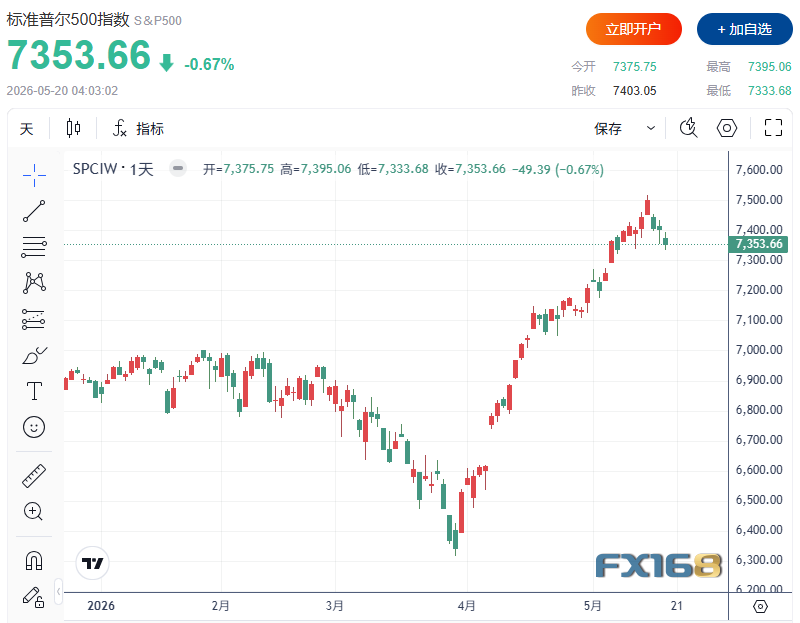
(Image source: FX168)
Traders continued to monitor oil market movements. Previously, U.S. President Trump announced the cancellation of planned military strikes against Iran, causing oil prices to fall back in the short term, but concerns over the Middle East situation, energy supply, and inflationary pressures have not subsided.
U.S. Treasury yields spike, “bond vigilantes” return to the market
Volatility in the bond market is emerging as a new variable for the U.S. stock bull market.
On Tuesday, the 30-year U.S. Treasury yield briefly rose to 5.198%, the highest in nearly 19 years. The 10-year U.S. Treasury yield climbed 6 basis points to 4.687%, marking the highest level since January 2025. The 10-year U.S. Treasury yield is an important reference for mortgage, auto loan, and credit card rates.
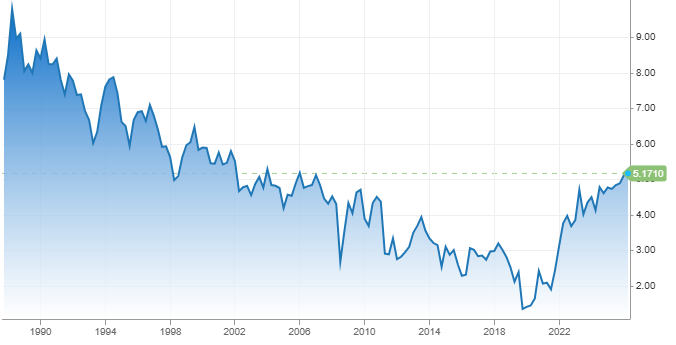
(Image source: CNBC)
The yield increase comes amid a series of data last week showing a resurgence of U.S. inflationary pressure after the Iran war pushed up oil prices. Higher credit card and mortgage rates may suppress consumer spending, while an increase in long-term rates could also weigh on economic growth and expose the risk that some chip stocks are currently overvalued.
Will McGough, Chief Investment Officer of Prime Capital Financial, said: “Bond vigilantes are now in action. Everyone is starting to realize that energy prices may remain high and further drive inflation pressures that have already lagged behind events.”
So-called “bond vigilantes” refers to institutional investors who express dissatisfaction with inflationary monetary policy by selling government bonds.
McGough also mentioned that before Kevin Warsh is sworn in as Federal Reserve Chairman this Friday, investors may be sending a signal to the Fed: the central bank has already fallen behind in addressing inflation. He said: “There has always been a narrative in the market that a new Fed chair typically gets tested by the market. If you believe in this theme, then clearly the bond vigilantes are testing him right now.”
Oil prices pull back slightly, but Iran risks remain unresolved
Crude oil prices dipped slightly on Tuesday. On Monday night, Trump announced the cancellation of a planned military strike against Iran after three leaders from major Middle East countries urged him to “hold off.”
U.S. WTI crude oil futures slipped 0.82%, settling at $107.77 per barrel. International benchmark Brent crude oil futures fell 0.65% to $111.37 per barrel.
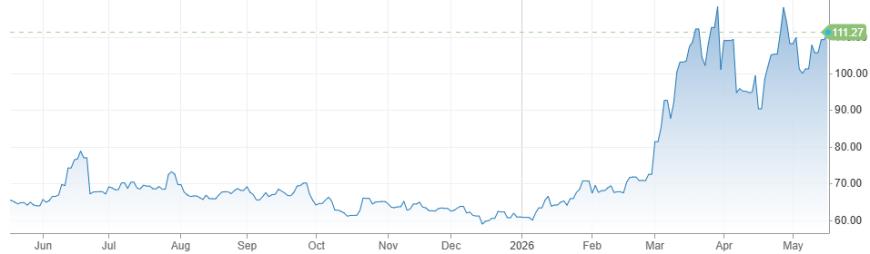
(Image source: CNBC)
However, geopolitical risks have not fully subsided. According to The Wall Street Journal, citing three U.S. officials, the U.S. has seized a tanker in the Indian Ocean linked to Iran. This news keeps market attention on whether U.S.-Iran tensions might escalate again.
Trump’s latest comments on Iran helped the S&P 500 and Nasdaq recover some losses in late trading on Monday, though both indexes still closed lower for the second straight day.
Chip stock declines ease, Nvidia earnings a key test
Semiconductor stocks had mixed performances on Tuesday, with recent selling pressure easing.
The Philadelphia Semiconductor Index was down over 1% intraday, as investors took profits amid concerns about valuations and the sustainability of data center spending. However, the index later recouped losses to finish roughly flat.
Nvidia will release its first quarter results after the close on Wednesday. The stock closed nearly 1% lower on Tuesday, but rebounded from its intraday low. Micron Technology finished flat, reversing a brief decline at the open. Qualcomm fell more than 4%, and Broadcom dropped 2%.
Jed Ellerbroek, portfolio manager at Argent Capital Management, said: “After an epic rally, this pause is justified.”
He also noted that the timing of this reversal is interesting, as it comes just days before the world’s largest chip stock is set to announce potentially very strong earnings and guidance.
U.S. stocks had rallied strongly ahead of recent pullback; buying the rally may be a sell signal
Before the recent pullback, U.S. stocks saw sustained rallies. Both the S&P 500 and Nasdaq hit record highs last week, while the Dow also briefly regained the 50,000 level.
However, a widely-watched Bank of America Securities fund manager survey showed investors are shifting from cash to equities, with the overall cash allocation ratio dropping from 4.3% to 3.9%.
Bank of America views an overall cash level below 4.0% as a sell signal. After reviewing 24 similar signals since 2011, the bank found that the median market drop over four weeks following the signal is 1%, with the worst case a drop of 29%, and the best case a 4% rise.
Michael Hartnett, Investment Strategist at Bank of America Securities, said on Tuesday: “The capitulation of the bull market is nearly complete. Early June is a good time to take profits, and bond yields will determine the extent of any pullback.”
Disclaimer: The content of this article solely reflects the author's opinion and does not represent the platform in any capacity. This article is not intended to serve as a reference for making investment decisions.
You may also like
BTC price ‘bull trap’ at $76.5K? Five things to know in Bitcoin this week
Goldman Sachs exits XRP, Solana ETF exposure in Q1 2026
Bitcoin lost its hold on $80K, but three events may send it back sooner than markets expect
Indian Rupee Falls to Record Low Against Dollar, Loses Over Half Its Value Since 2009
Trending news
MoreCrypto prices
More





