
US Treasuries, big news! Gold and silver prices plunge, SHFE gold drops sharply in an instant, suspected "fat-finger" trade, Analyst: May be related to US Treasuries

On the evening of May 19th, Beijing time, US Treasury bonds dropped.
Meanwhile, both gold and silver saw sharp declines.
“However, events like these are isolated and short-lived. The fact that prices can rapidly revert to a reasonable range demonstrates the futures market’s pricing efficiency and self-correcting mechanisms,” Gu Fengda said. “A ‘fat finger’ incident does not produce any new macro or fundamental information, so it will not change the mid-to-long-term pricing logic of gold.”
As for the future trend of gold prices, international investment banks are beginning to show more caution in their outlooks.
In a report released on May 17th, JPMorgan noted subdued short-term demand for gold, as reflected in stagnant trading activity and demand indicators. Recently, total open interest and trading volume in COMEX gold futures have continued to be sluggish, net managed money futures positions have lingered around low levels, and ETF inflows have likewise been light. The bank has revised its average gold price forecast for 2026 downward from $5,708/oz to $5,243/oz, citing the weakening short-term demand for gold.
In early May, Morgan Stanley also sharply cut its gold price expectations, lowering its latest target for gold in the second half of 2026 to $5,200/oz, well below the previous expectation of $5,700/oz.
Meanwhile, soaring yields on long-term US Treasuries are testing the resolve of global bond investors: on one hand, there is a chance to lock in yields near multidecade highs; on the other, risk looms that the bond market could fall even further.
Citigroup recently remarked that as concerns about inflation spread across the market, bond traders are now aiming for a new target yield of 5.5% on the US 30-year Treasury note.
Jim McCormick, Citi’s London-based macro rates strategist, noted that after long-end yields surged to 5.16% this week—a new high since 2007—market attention may shift to testing the 5.5% threshold. The last time this yield reached that level was 22 years ago.
The Goldman Sachs team believes that some valuation metrics are beginning to look attractive, but still recommends caution. Barclays and Citi strategists are warning clients that the 30-year yield may break above 5.5%, reaching levels not seen since 2004. The head of research at BlackRock advises investors to reduce exposure to developed market government bonds, including US Treasuries, in favor of equities.
These views suggest the market is grappling with how to price in divergent scenarios: from persistent inflation amid economic resilience, to an economic slowdown triggered by rising energy prices. In the meantime, the upcoming Federal Reserve chair Kevin Walsh and US Treasury Secretary Scott Baycent, who has pledged to lower borrowing costs, face mounting pressure.
Gregory Peters, Co-Chief Investment Officer at PGIM Credit, said: “While these yields are attractive to me, I remain cautious.” He noted he is underweight the 30-year Treasury, as he expects the term premium—the extra compensation investors require for holding long-dated bonds—to continue to rise. “The global bond market is in turmoil and investors are losing confidence.”
Meanwhile, Sara Devereux, global head of fixed income at Vanguard, noted that the yield on the 10-year US Treasury note is now approaching the upper end of its expected range within the $31 trillion US Treasury market.
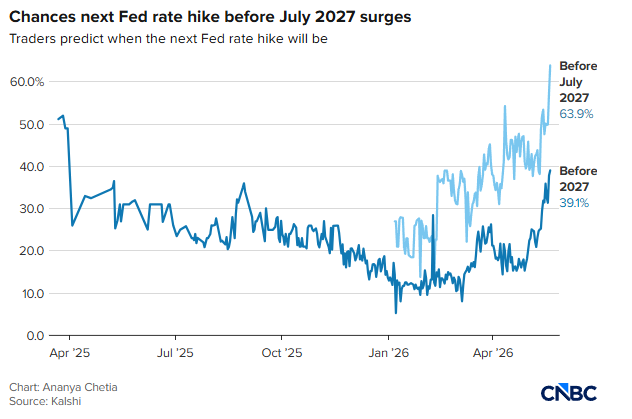
In recent weeks, global bond yields have risen sharply as the Iran war pushed up energy prices, exacerbating inflation pressures and forcing central banks like the Fed to consider rate hikes. On top of that, market worries about the US budget deficit and signs that the world’s largest economy remains resilient mean that investors are demanding greater compensation to hold longer-dated debt.
If yields continue to climb slowly, one concern is that the long end could become unanchored, with the market adapting to a new trading range. Previously, some traders believed that a 4.5% yield on the 10-year and 5% on the 30-year Treasuries would attract investors looking to lock in high yields, but the latest round of sell-offs has already pushed past both these levels.
Ajay Rajadhyaksha, chairman of Barclays Global Research, stated: “Yields may already be at their highest for the year, but that alone is not a reason to buy duration.” Barclays is advising clients to steer clear of long-term bonds: “The forces driving this round of selling—fiscal deterioration, defense spending, sticky inflation, and slow central bank action—will not disappear overnight.”
The resulting tension is what Goldman Sachs strategists call “uneasy value emerging.” By multiple measures, long-term US Treasuries are indeed starting to look attractive, but conditions could easily worsen further before they improve.
George Cole’s team at Goldman Sachs believes that investors wishing to bet on a rally in the bond market should consider adopting trade structures that can limit downside risk if rates continue rising.
The strategists wrote: “We would wait for one of two catalysts: either a deeper sell-off that truly tests risk asset performance, or credible de-escalation and restoration of energy flows. Only then would it be time to add long-duration exposure.”
Editor: Guo Jian
Disclaimer: The content of this article solely reflects the author's opinion and does not represent the platform in any capacity. This article is not intended to serve as a reference for making investment decisions.
You may also like

Trending news
MoreCrypto prices
More





