
New Zealand Dollar remains flat below 0.5850 due to increased risk aversion

NZD/USD remains flat after experiencing volatility, hovering around 0.5830 during the Asian hours on Wednesday. The pair maintains its position with a bearish tilt as the US Dollar (USD) receives support from safe-haven flows.
This increase in risk aversion followed fresh threats from US President Donald Trump regarding potential military strikes on Iran. US President Donald Trump recently threatened to resume attacks on Iran in two or three days as part of a push for a deal to end the war. This came after a brief pause in planned hostilities following a new proposal by Tehran to end the US-Israeli conflict, per Bloomberg. Meanwhile, an Iranian official stated that the US threat of a massive assault would be met resolutely, asserting that Iran is fully prepared to confront any military aggression.
US inflation risks are also rising due to these war-driven energy price pressures, with earlier spikes in oil reinforcing expectations that the Federal Reserve (Fed) may need to maintain higher interest rates for longer or even tighten policy further. Traders are pricing in a 40.1% probability that the Fed will raise interest rates by 25 basis points (bps) by year-end, according to the CME FedWatch tool.
On the monetary policy front, Federal Reserve Bank of Philadelphia President Anna Paulson noted that current policy is mildly restrictive, which is helping to keep inflation pressures in check while maintaining a stable labor market. Paulson indicated that the current policy rate is suitable for applying downward pressure on inflation, though an appropriate rate increase remains possible if economic growth exceeds potential or if new inflation threats arise.
Traders weighed the People’s Bank of China’s (PBOC) decision to hold its benchmark lending rates steady, looking for clues on the economic outlook of New Zealand's top trading partner following a string of disappointing Chinese data on Monday.
The PBOC left its Loan Prime Rates (LPRs) unchanged for the 12th consecutive month in May, as widely expected. The one-year LPR, which anchors most corporate and household loans, remains at 3.00%, while the five-year LPR, the benchmark for mortgage pricing, was held at 3.50%.
Disclaimer: The content of this article solely reflects the author's opinion and does not represent the platform in any capacity. This article is not intended to serve as a reference for making investment decisions.
You may also like
Ripple Ranked Ahead of Revolut and Perplexity on CNBC List
SEC tokenized stock exemption could move equities onto crypto rails
Japan recognizes foreign-issued crypto stablecoins as legal electronic payment methods
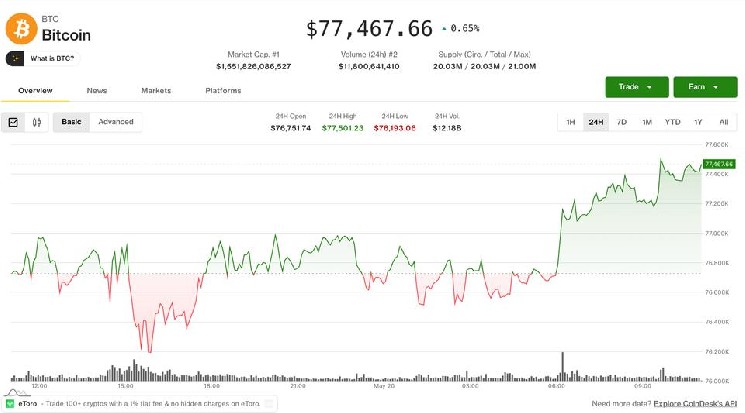
Bitcoin holds near $77,400 as derivatives signal caution
Trending news
MoreCrypto prices
More





