
Nvidia Vera Rubin rack priced at $7.8 million, double that of Blackwell! Not just memory, nearly all components are seeing price increases

The price of Nvidia’s next-generation AI server rack is rapidly soaring.
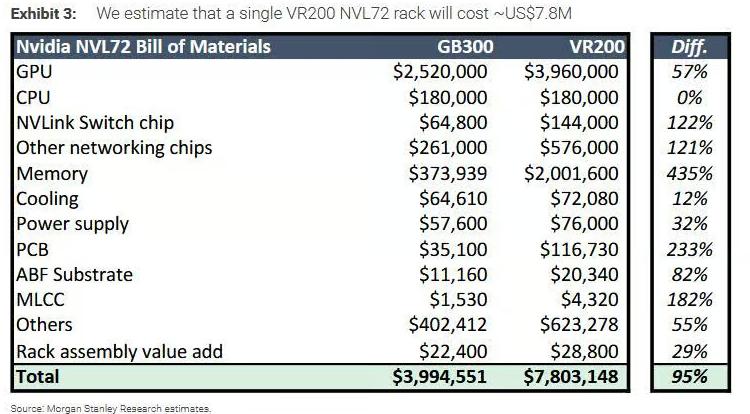
According to a report by Morgan Stanley analyst Howard Kao released on May 22, Nvidia’s upcoming Vera Rubin (VR200) rack will cost about $7.8 million when purchased from ODMs (Original Design Manufacturers), while the current GB300 Blackwell rack is priced at under $4 million. This means the price of a single rack has nearly doubled in just one generation.
It is worth noting that after Nvidia released its quarterly earnings report on the same day, its stock closed down by nearly 2%. However, memory-related stocks surged 6%-10%. The reason lies in the logic revealed by this report: the beneficiaries of the price surge are not limited to Nvidia itself.
Memory: From Supporting Role to Leading Role
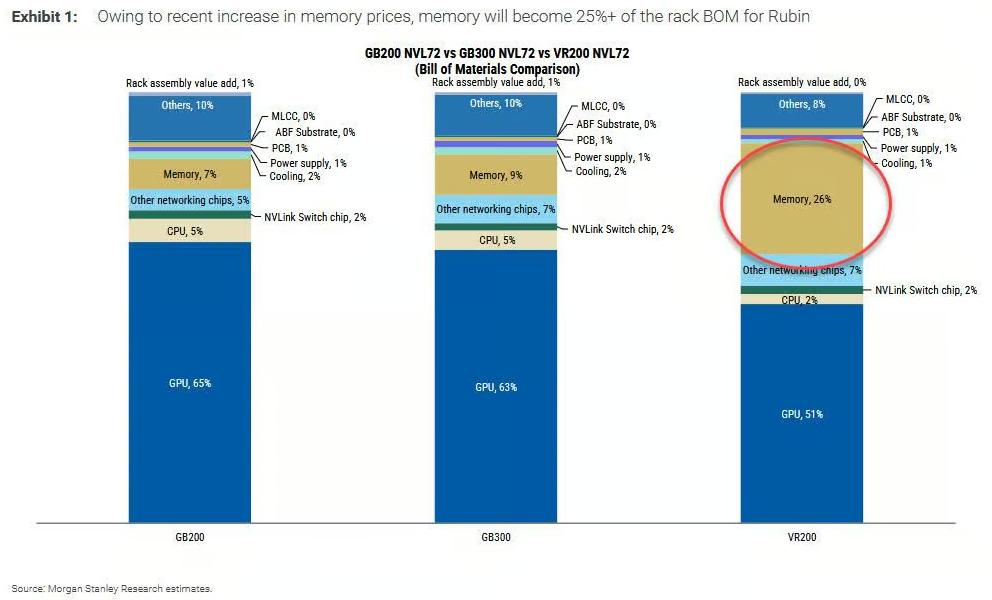
Memory is the strongest driving force behind this round of price hikes.
Analysts point out that since Nvidia introduced the GB200 NVL72, memory prices have risen dramatically. Under the previous cost structure, memory only accounted for 5%-10% of the material cost (BOM) of a GB200 NVL72 rack. However, with the VR200, the proportion has soared to 25%-30%, with the cost rising by as much as 435%.
This surge in the memory proportion directly compressed the share of GPUs in the total rack cost—the GPU dropped from about 65% in the GB200 to about 51% in the VR200.
Not Just Memory—Virtually Every Component Is Rising in Price
Morgan Stanley’s supply chain survey shows that the price increases are comprehensive:
PCB (Printed Circuit Board): Cost increased by 233%
PCB content has jumped from around $35,000 for the GB300 to about $117,000. The reason is that Rubin introduces new modules (such as ConnectX modules and mid-layer PCBs), and the number of layers and material grades for the boards have both been enhanced. For example, the compute board has been upgraded from a 22-layer HDI PCB in the GB300 to 26 layers, and the material grade from M7 to M8; the switch tray PCB has increased from 24 layers to 32 layers. Additionally, a 44-layer mid-board PCB has been added in the compute tray, which did not exist in the GB300.
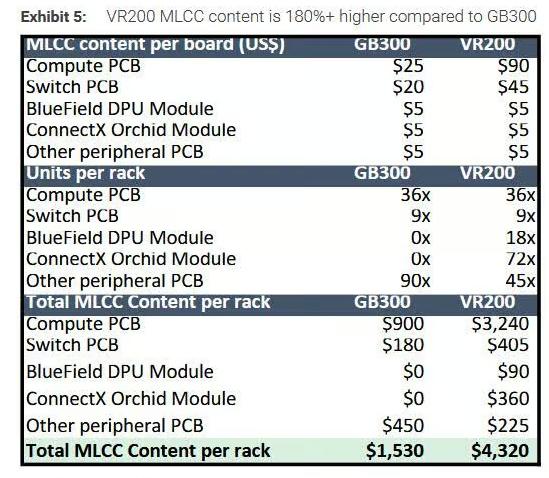
MLCC (Multilayer Ceramic Capacitors): Cost increased by 182%
Each VR200 rack’s MLCC content is about $4,300, while the GB300 was only around $1,500. The newly introduced BlueField and ConnectX modules have also driven additional MLCC demand. Analysts believe this is the direct reason for the current surge in MLCC demand among high-end AI servers, with ODMs competing to build up inventories—production of Rubin racks is expected to begin in the second half of 2026.
ABF Substrate: Cost increased by 82%
The number of NVLink and ConnectX chips in the VR200 is twice that of the Blackwell system, thus substrate usage has also risen. The unit price for the Rubin GPU’s ABF substrate is about $200, compared to around $100 for Blackwell, a 100% increase.
Power supply costs increased by 32%; cooling material by 12% as well.
Hyperscale Cloud Providers May Bypass Nvidia to Purchase Memory Directly
Analysts highlighted a key variable: the procurement method for SOCAMM (Small Outline Compression Attached Memory Module). If hyperscale cloud providers purchase memory modules directly, the rack price could drop to about $6.7 million.
In the base scenario, Nvidia is responsible for sourcing SOCAMMs and resells them at a 70% gross margin, bringing the rack price to about $7.8 million. However, if hyperscale cloud providers (such as Microsoft, Google, Amazon, etc.) choose to procure SOCAMMs directly—bypassing Nvidia’s markup—the rack price will drop to about $6.7 million.
This variable directly impacts Nvidia’s memory business revenue and is a key area for ongoing market monitoring.
ODMs: Margins Shrink, but Absolute Profits Are Rising
The market previously expected that, as compute tray designs become more "standardized," ODMs would see reduced value-add opportunities for Rubin racks. But analysts reached the opposite conclusion.
The report estimates that ODM value-added will rise by 35%-40%, from about $108,000 per rack in the GB300 to about $149,600 per rack in the VR200. This aligns with the stance expressed by Wistron management in the Q4 2025 earnings call—Wistron clearly stated ODM value-add in USD terms will improve for Rubin racks.
However, gross margin is indeed declining: ODM gross margin for the GB300 is about 2.7%, dropping to approximately 1.9% in the VR200. Analyst Kao commented, “Investors should focus on the growth of absolute dollar profits, not just the margin percentage.”
The Consignment Model Quietly Spreads—Long-term Risks Should Not Be Ignored
Analysts also referenced a noteworthy trend: an increasing number of ODMs are starting to mention the consignment business model.
Hon Hai was the first to mention this model during its Q4 2025 earnings call. Quanta later said in its Q1 2026 earnings call that parts of its projects are expected to switch to the consignment model in the second half of 2026.
A consignment model means the customer (the cloud provider) procures core components directly, and the ODM is responsible only for assembly. This alleviates working capital pressure for ODMs, but also reduces their revenue scale.
Analysts note it is still unclear to what extent projects might shift to consignment. However, if the predicted “absolute profit growth” fails to materialize, there may be long-term concerns about this trend.
Power and Liquid Cooling: The Next Upgrades
Supply chain investigations show that the standard for the Vera Rubin platform is a 110kW power module, but at least one US cloud provider has adopted an independent HVDC (High Voltage Direct Current) power rack on the Vera Rubin platform. Analysts expect 800V DC will be widely used on the Rubin Ultra platform, launching in the second half of 2027. Delta has already partnered with at least three US cloud service providers to drive the adoption of HVDC platforms, with initial deployments expected in the second half of 2026.
On cooling, the Vera Rubin racks will adopt a fully liquid-cooled design (fanless), and the total value of liquid cooling components per rack is about $72,080.
Disclaimer: The content of this article solely reflects the author's opinion and does not represent the platform in any capacity. This article is not intended to serve as a reference for making investment decisions.
You may also like
XRP Leaves Stalled Politicians in the Dust as an Institutional Stampede Fuels the Next Price Cycle
Bitcoin left behind in the geopolitical melee
Here’s why Worldcoin, Venice Token, FET, ICP prices are rising

NEAR Protocol Price Prediction: NEAR Surges Over 40% as Open Interest Climbs Above $470 Million

Trending news
MoreCrypto prices
More





