
Indonesian commodity

Indonesian President Prabowo has announced national control over the export of major commodities, causing significant market turmoil. The spot price of Indonesian palm oil has plunged by more than 30% over two trading days.
On May 20, Prabowo announced in parliament that the government would establish a state-owned enterprise as the sole exporter of multiple major commodities such as palm oil, coal, and ferroalloys. All exports must go through a government-designated company under the sovereign wealth fund Danantara, and the new regulation will be implemented in phases starting from June 1.
Following the announcement, the spot bidding price of crude palm oil at Indonesia's Dumai port plummeted around 23% on Wednesday to 11,777 rupiah per kilogram (about $0.67), and further dropped to around 8,000 rupiah on Thursday, with a cumulative decline of over 30% in two days.
The impact of this policy has spread outward. On Thursday, benchmark palm oil futures on the Kuala Lumpur exchange dropped as much as 2.5% intraday, marking the largest single-day drop in two weeks; the stock price of London-listed palm oil producer AEP Plantations plunged more than 20% in early trading on Wednesday.
Policy Core: Monopoly of Exports and Crackdown on Fraud
When speaking in parliament, Prabowo made it clear: "All sales of our natural resources, from palm oil and coal to ferroalloys, must be conducted through a government-designated state-owned enterprise as the sole exporter, and prices for all major commodities must be determined in our own country."
This move aims to stop the long-standing issue of under-invoicing in exports and to give authorities greater pricing power. Indonesian Trade Minister Budi Santoso stated that specific regulatory details for the export of palm oil, coal, and ferroalloys would be issued before Friday. Danantara CEO Rosan Roeslani said the regulator would honor existing long-term contracts, but if contract prices are below global benchmarks, those contracts will be reviewed.
Prabowo did not specify the scope of ferroalloys, but analysts have indicated that this scope may include certain nickel products—nickel is a key raw material for making stainless steel and electric vehicle batteries.
Market Panic: Buyers Are Observing, Sellers Are Dumping
According to Bloomberg, citing traders who declined to be named, the sharp drop in spot prices directly reflects the chaotic market condition. Buyers, worried that the new regulations may delay shipments and cause inventory build-up, have withdrawn from bidding; meanwhile, some sellers have slashed prices significantly to clear inventory before the new rules take effect.
Warren Tay, a trader at Eco Palm International Sdn. in Kuala Lumpur, stated, "The bid prices for Indonesian crude palm oil have fallen sharply, and most buyers have shifted to a wait-and-see stance." He also pointed out that Indonesian authorities may intervene quickly to restore the domestic palm oil market to normal conditions.
Indonesia's daily spot price quotations are a real-time indicator of domestic supply and demand, provided by state-affiliated plantation groups to refiners, traders, and exporters through a local bidding system.
Widening Spread and Short-term Export Competitiveness Boosted
Marcello Cultrera, palm oil trader and CEO of Malaysian agtech firm Apricus 8 Sdn., said that on Wednesday, Indonesia’s crude palm oil export price was at a discount of about $97.50 per ton compared to Malaysian futures, the largest spread since February this year. He stated that if this deep discount persists, it could trigger a phased surge in Indonesia’s export volumes.
However, in the medium to long term, risks may go in the opposite direction. If export management becomes disorderly, overseas buyers may turn to competing producers such as Malaysia, Thailand, and Latin America. Indonesia is the world's largest palm oil producer, accounting for more than half of the global supply. Any major adjustment to its export policies would have a profound impact on the global edible oil market structure.
Disclaimer: The content of this article solely reflects the author's opinion and does not represent the platform in any capacity. This article is not intended to serve as a reference for making investment decisions.
You may also like
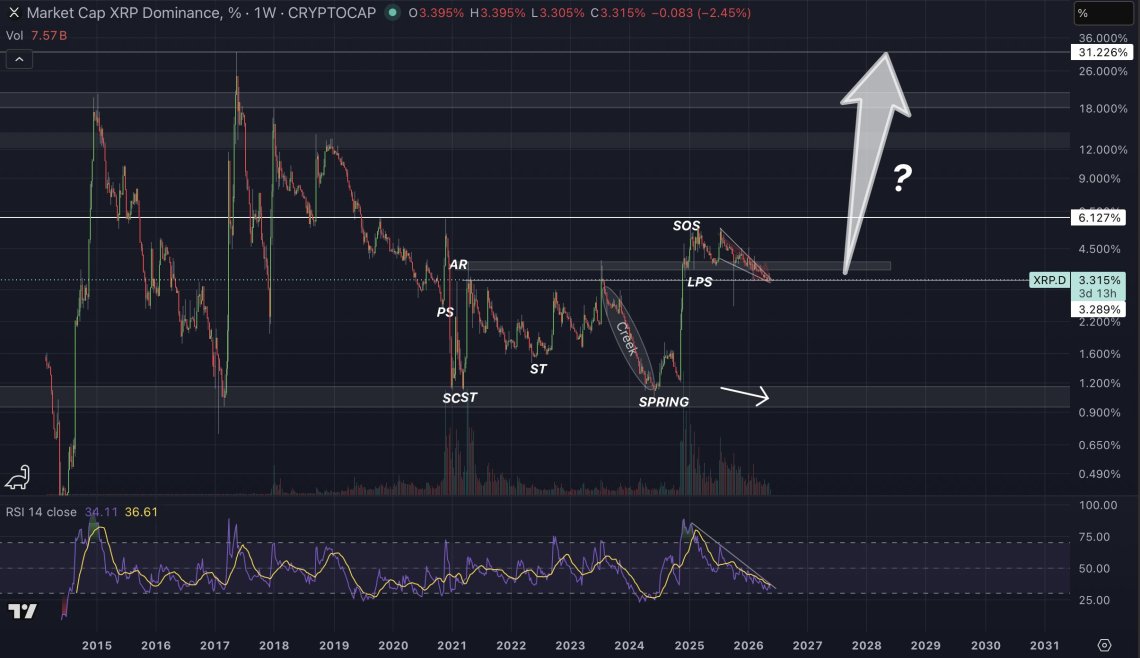
Analyst Maps XRP’s Path To 31% Of The Entire Crypto Market
Why Bitcoin Cash traders can expect a relief rally after BCH’s 25% price bleed

Trending news
MoreCrypto prices
More





