
Fed's hawkish outlook pushes up the dollar and US bond yields, gold faces increased downside pressure after breaking below key moving averages

Huitong Finance, May 22 — International gold prices remained weak during the European session on Friday, holding above the $4500 psychological level. However, the sustained strength of the US dollar and hawkish expectations from the Federal Reserve have clearly pressured gold’s performance. The market has essentially ruled out the possibility of rate cuts in 2026, with expectations now shifting towards at least one rate hike this year. In the short term, gold’s technical outlook remains bearish.
In the international gold market, Friday’s European trading session saw continued weakness, with spot gold (XAU/USD) consolidating around the $4500 mark. While gold prices temporarily held this key psychological level, the overall trend remains under pressure.
The current core narrative in the market revolves around “expectations of high Federal Reserve interest rates”, “US dollar strength”, and “uncertainty in the Middle East”.
As markets gradually accept that US interest rates will stay elevated for a longer period, the US Dollar Index continues to hold near six-week highs, exerting significant pressure on gold.
As gold itself does not generate interest income, when US Treasury yields continue to climb, capital tends to flow into high-yielding dollar assets instead.
Meanwhile, market expectations for the Federal Reserve’s policy path have also become increasingly hawkish.
The recently released minutes of the Federal Reserve’s April meeting showed that most officials are concerned about inflation remaining persistently above the 2% target and believe the Fed may need to tighten policy further if inflation proves stubborn.
The market has now largely ruled out the possibility of a rate cut in 2026.
Currently, the market is even beginning to bet on at least one rate hike by the Federal Reserve this year.
This expectation has directly fueled the ongoing rise in US Treasury yields and further strengthened the US dollar uptrend.
Additionally, although uncertainties remain in the Middle East, market risk sentiment has improved compared to earlier periods, which has also weakened some of the safe-haven buying in gold.
Recently, negotiations between the United States and Iran have continued to make progress. While both sides report narrowing differences, key issues remain unresolved.
The issues of Iran’s uranium enrichment and the control of the Strait of Hormuz are still the main obstacles in the negotiations.
US Secretary of State Rubio stated that Iran’s attempt to impose fees on vessels passing through the Strait of Hormuz has become a significant impediment to the agreement’s progress.
At the same time, US President Trump emphasized that the US will not accept a charging mechanism for the Strait of Hormuz and stated that the US will reclaim Iran’s highly enriched uranium stockpile.
This means gold is not currently attracting significant safe-haven inflows.
Meanwhile, high international energy prices are also impacting market expectations for future inflation.
The market is concerned that, if energy prices continue to rise, US core inflation could rebound again, forcing the Federal Reserve to maintain higher interest rates for an extended period.
This “high inflation + high interest rates” environment is generally unfriendly for gold overall.
From a global asset allocation perspective, markets are still clearly favoring US dollar assets.
The US Dollar Index recently climbed to near six-week highs, while US Treasury yields also remain elevated.
However, analysts also point out that there has not yet been a clear panic-driven selloff in gold, indicating some long-term safe-haven funds remain on the sidelines.
Especially with ongoing instability in the Middle East, there is still some safe-haven support for gold on the downside.
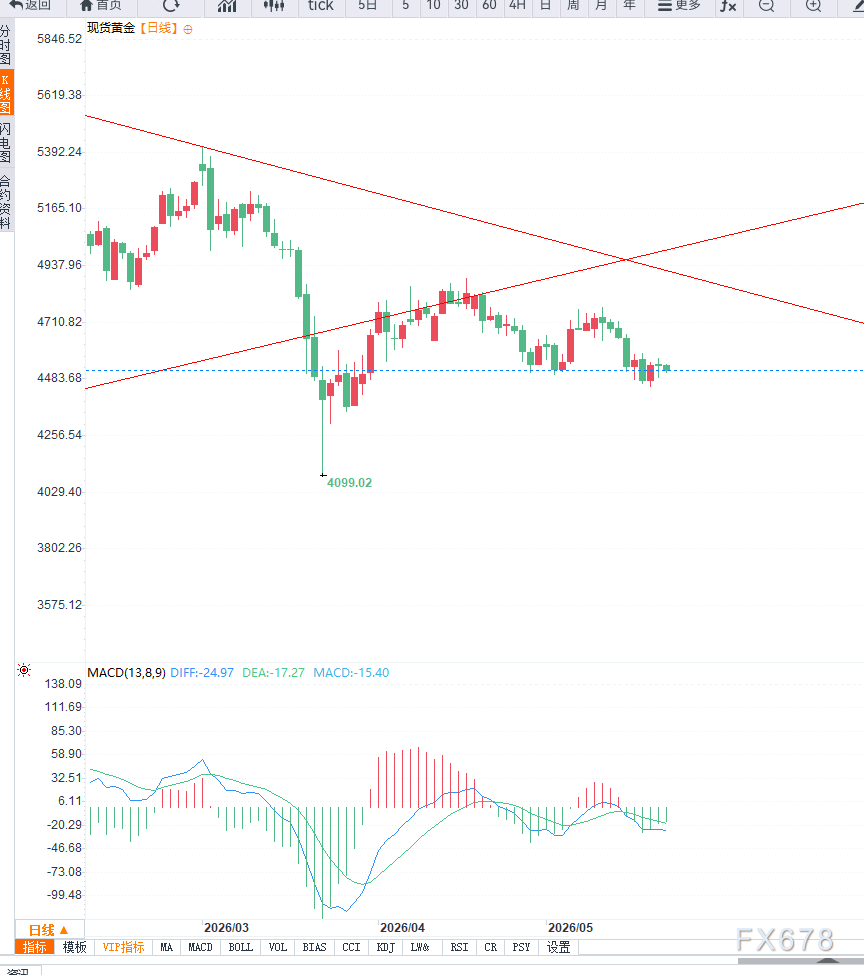
Technically, gold remains in a pronounced descending channel overall.
The daily chart shows that, after forming a short-term top around $4700, gold has entered a medium-term correction structure.
Currently, gold prices continue to trade below the major moving averages, reflecting that the overall bearish trend remains dominant.
The daily MACD indicator has formed a clear death cross, and the green momentum bars continue to expand, indicating medium-term downside momentum is still strengthening.
The RSI indicator remains near 45, showing that although the market is not in oversold territory, it is still running weak overall.
The primary support below is near the psychological $4500 level; if this is breached, prices could further test the $4420 and $4360 regions.
The $4360 area is also a key technical support at the lower edge of the current descending channel.
Major resistance overhead is found around the $4650–$4660 region.
The core contradiction in the current gold market lies in the “tug-of-war between geopolitical risk support and pressure from high interest rates.”
Although uncertainty in the Middle East persists, the market is now more focused on the risks of the Federal Reserve maintaining high interest rates for longer.
The simultaneous strength of the US dollar and US Treasury yields has significantly weakened gold’s attractiveness as part of a portfolio.
Technically, gold remains in a medium-term downward channel; despite short-term signs of stabilization, the bearish trend has yet to truly reverse.
Going forward, the market will closely watch US inflation data, Federal Reserve policy expectations, Middle East developments, and the trend of the US Dollar Index.
Disclaimer: The content of this article solely reflects the author's opinion and does not represent the platform in any capacity. This article is not intended to serve as a reference for making investment decisions.
You may also like
Bitcoin credit play SATA surges as ASST stock joins capital markets
Bitcoin Drops Below $77,000 as Waller Speech Suggests Fed Rate Hike Risk
HYPE Rally Targets $58 After Breakout
Kalshi-backed prediction market advocacy group debuts with support from former Trump aide
Trending news
MoreCrypto prices
More





