
A Comprehensive Guide to Starship’s “Flight 12”: Debut of the Third-Generation Starship and SpaceX’s “Ultimate Roadshow” Before Going Public

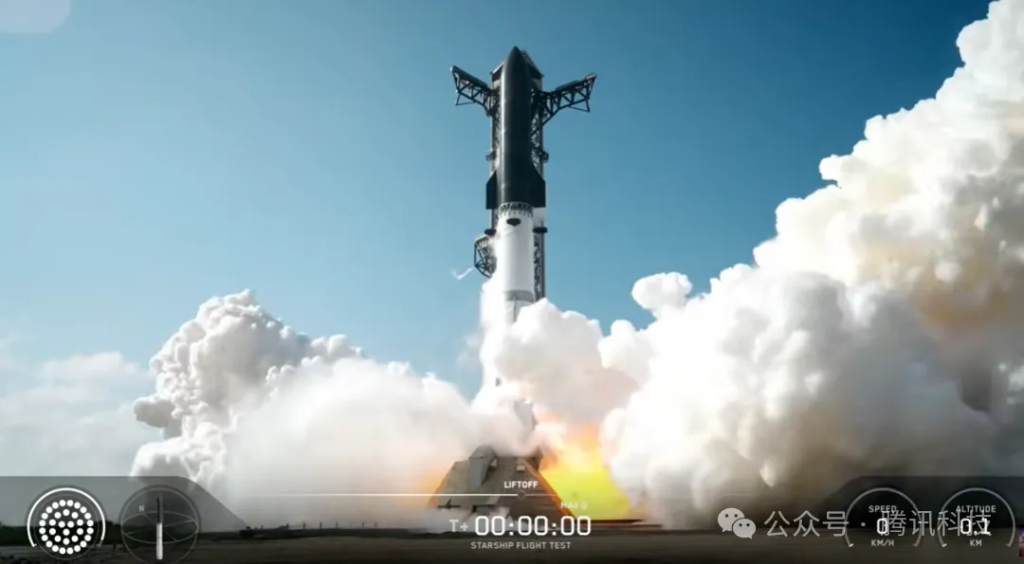 Starship "Twelfth Flight" launch scene. Source: SpaceX
On May 23, Eastern Eighth District time, SpaceX, under Elon Musk, conducted the twelfth integrated flight test of Starship (hereinafter referred to as "Twelfth Flight"). This flight consisted of the Ship 39 spacecraft and the Booster 19 Super Heavy booster. It marks both the debut of the Starship V3 configuration and the first use of Launch Pad 2 (PAD 2), which was specifically built for V3.
The combined Starship vehicle for this flight reached a total height of about 124 meters. The Booster 19 Super Heavy booster is approximately 71 meters tall and is equipped with 33 Raptor 3 engines. The Ship 39 spacecraft is about 53 meters tall, and its propulsion system, avionics, and thermal protection have all been redesigned according to the V3 standard.
The entire mission followed a suborbital trajectory, lasting over one hour. According to the scheduled plan, around seven minutes after launch, the Super Heavy booster performed a controlled splashdown in the Gulf of Mexico. The upper stage of the spacecraft, after deploying 22 simulated Starlink satellites, began reentry into the atmosphere to execute its return procedure, finally splashing down in the Indian Ocean near the coast of Western Australia.
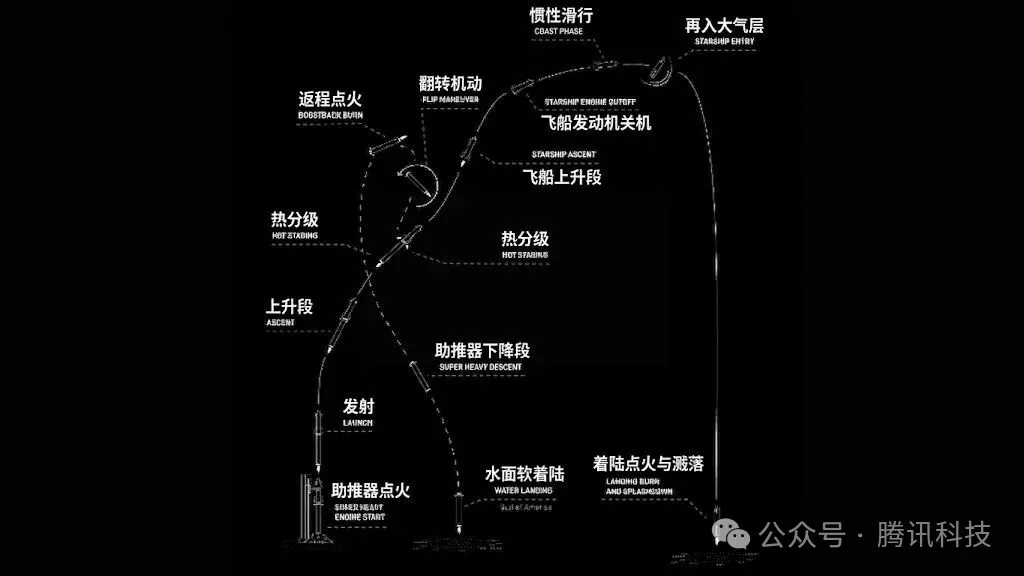 Diagram showing the main stages of Starship V3's suborbital flight. Source: SpaceX
During the flight, the spacecraft also performed maneuvers that challenged the rear fin structural limits and executed a dynamic tilt maneuver to simulate the future flight path of a return to the spceport landing. Every action was aimed at gathering data for the fully reusable final form.
According to SpaceX’s official statement, the upper stage of the spacecraft successfully splashed down and exploded on breakup.
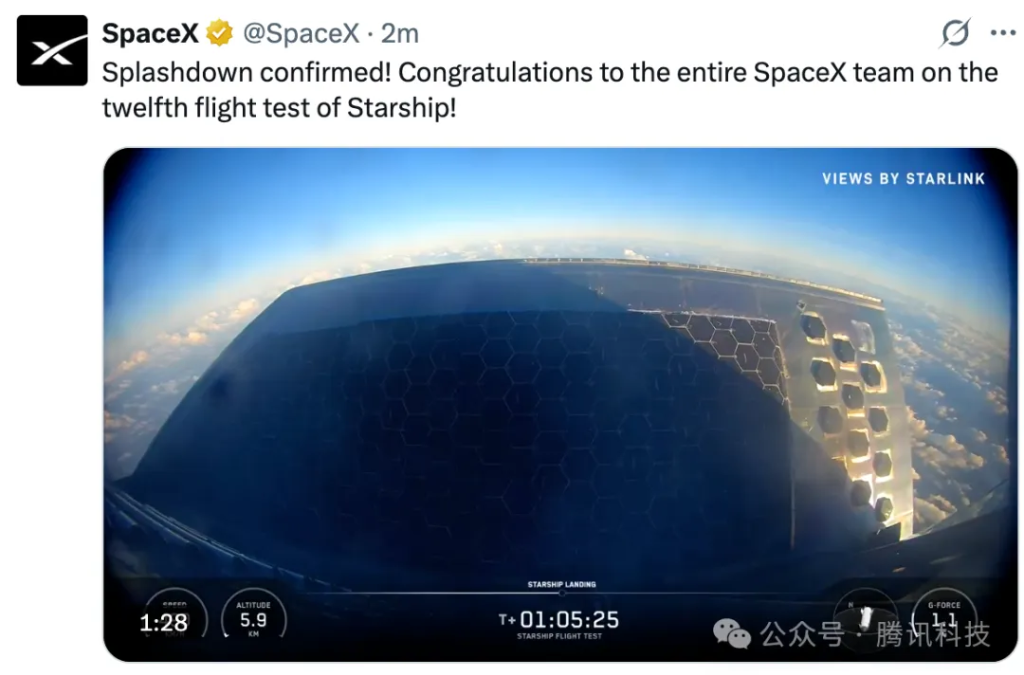
Three New Elements Deployed after Seven Months
"Twelfth Flight" came almost exactly seven months after the previous Starship launch.
SpaceX simultaneously played three new cards in this mission: First, the Starship V3 ship (Ship 39); second, the Super Heavy V3 Booster (Booster 19), equipped with 33 brand new Raptor 3 engines; third, Launch Pad 2, which was rebuilt from scratch.
The first combination of three entirely new systems in a single mission is extremely rare in the aerospace industry, and the propellant fueling system was completely redesigned for this purpose.
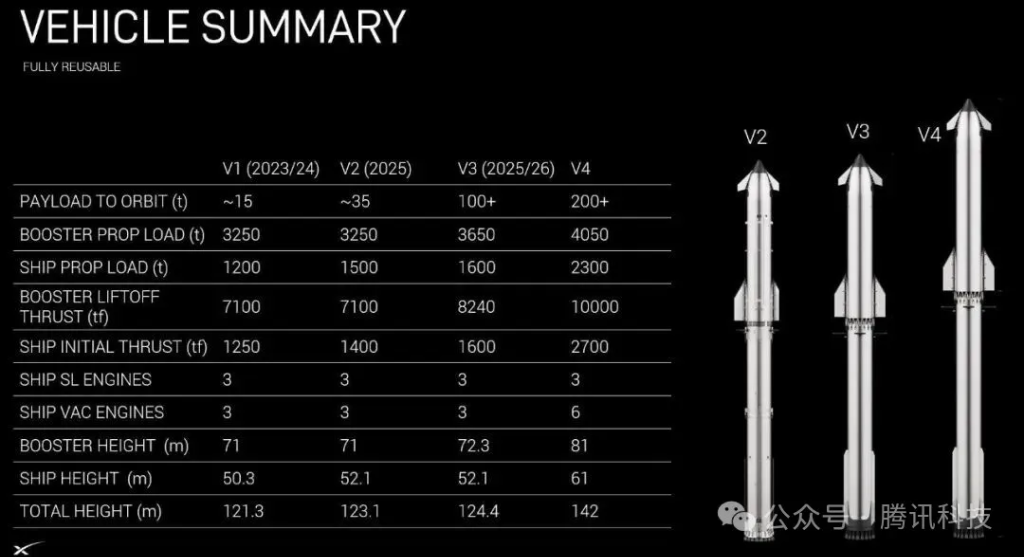 Parameter configurations of different Starship versions. Source: @elonmusk
SpaceX’s mission description indicates that the cryogenic propellant storage area has increased in both capacity and the number of pumps, allowing the rocket to be fueled at a higher rate. The "chopstick" catch arms on the launch tower are now shorter, permitting faster movement; the main actuator was changed from a hydraulic to an electromechanical system to better track the spacecraft during future capture operations.
The launch pad base structure and clamping device were completely redesigned, equipped internally with a bidirectional deflector cone and an upper deck deflector plate, aimed at eliminating the need for post-launch base ablation refurbishment. On one side of the base, a reinforced shelter separates the oxygen and methane fluid systems of the booster into different rooms, shortening the distance to the rocket and improving safety.
Because all systems were being matched for the first time, SpaceX clearly stated before the mission that launch tower catch recovery would not be attempted.
A "Physical Examination" Drama Unfolds in Space
The thermal protection system has always been Starship's biggest weakness. In a podcast in February 2025, Elon Musk admitted: "The biggest problem left for Starship is making the thermal protection system reusable. No one has ever made a reusable orbital-class thermal protection system."
"Twelfth Flight" addressed this problem quite bluntly. One thermal protection tile was deliberately removed during liftoff to measure the aerodynamic load differences on adjacent tiles when a tile is missing. Several tiles were purposely painted white as reference markers for onboard cameras to track changes during the flight.
For this flight test, the spacecraft deployed 22 simulated Starlink satellites, a significant increase from the 8 or 10 carried on previous missions.
According to SpaceX’s mission description, the final two of the 22 simulated satellites deployed were assigned special tasks to inspect the spacecraft. These two satellites, equipped with cameras, were ejected from Starship’s "PEZ dispenser" and scanned the entire thermal protection system of the Starship during flight, sending real-time images back to ground operators. This test aimed to validate methods for evaluating the integrity of the thermal tiles in future missions.
The thermal protection system was not entirely untested before. In earlier flights, SpaceX's spacecraft did indeed survive reentry and splashdown in the ocean.
However, Musk pointed out in the podcast: On previous flights, many tiles were lost, meaning that large-scale refurbishment was unavoidable before reuse. In his words, "If you want to land, refuel, and fly again, you cannot go through the tedious process of checking 40,000 tiles one by one."
The New Starship Redesigned From Head to Toe
The Starship V3 used for "Twelfth Flight" is different from the previous generation in all aspects, with all changes centered around the same goal: making reuse simple, cheap, and fast.
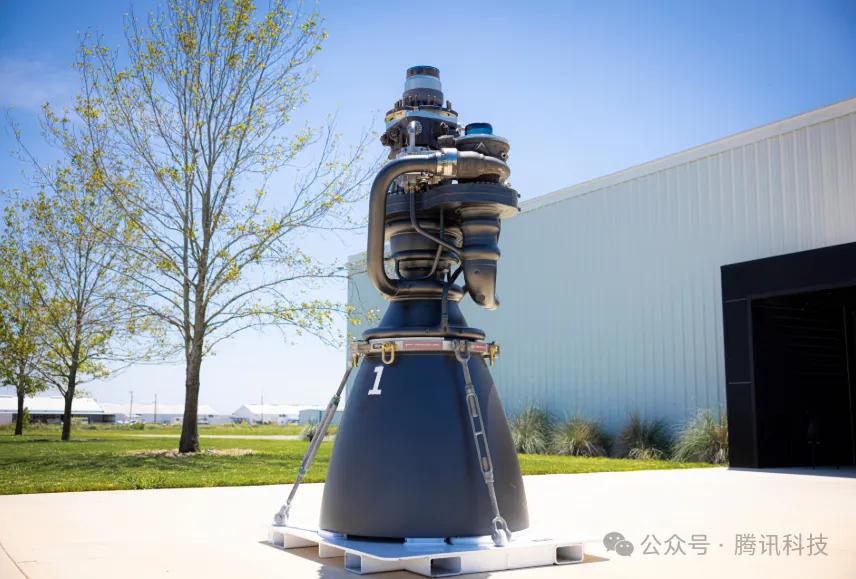 Raptor 3 engines provide greater thrust. Source: SpaceX
First, the Raptor 3 engine data has seen significant improvements. Thrust for the sea-level version increased from 230 tons to 250 tons, and the vacuum version from 258 tons to 275 tons. While thrust increased, weight decreased; each engine’s mass dropped from 1,630 kg to 1,525 kg.
Even more crucial are the weight reductions at the vehicle level. SpaceX’s mission documents explain that simplifying the engines themselves as well as support hardware on the vehicle side enables a mass saving of about 1 ton for each Raptor 3 installed.
Raptor 3’s sensors and controllers are now integrated inside the engine and directly covered by the engine’s own thermal protection system. This means neither the spacecraft nor the booster requires separate engine shields; all engines utilize a newly designed ignition system.
On the booster side, the number of grid fins for the Super Heavy V3 has been reduced from four to three, but the area of each fin has been increased by 50% and greatly strengthened. New catch points have been added, their positions lowered to reduce heat exposure from Starship’s engines during stage separation. The grid fins’ axes, actuators, and mounting structure have been moved inside the booster’s main propellant tank for better protection.
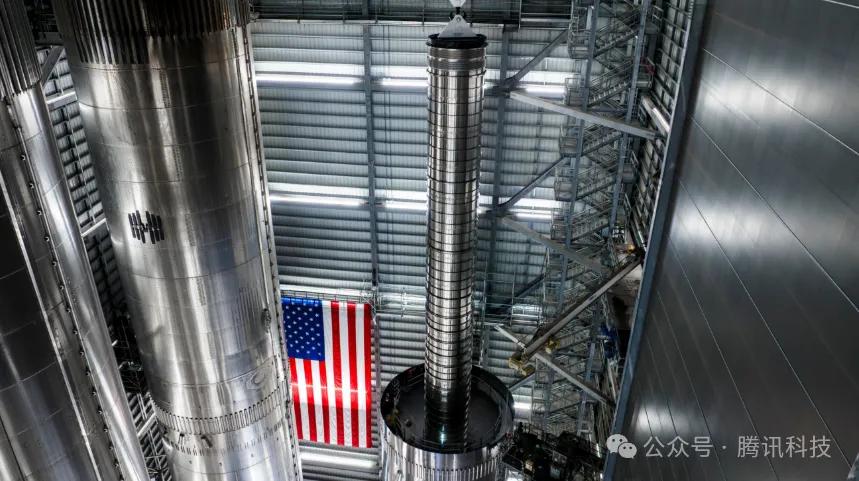 The grid fins, propellant feed pipes, and thermal protection system of the Super Heavy V3 booster have all been improved. Source: SpaceX
An integrated thermal separation ring replaces the previous disposable interstage protectors; when the spacecraft engines ignite, flames directly impact the booster’s main tank forward dome, which is now protected by internal tank pressure and a non-structural steel layer. The propellant distribution system has been completely redesigned to ensure all 33 engines can ignite simultaneously and rapidly.
Changes to the spacecraft are also systematic. The aft fin actuator system was changed from two actuators per fin to one actuator with three motors, thus increasing redundancy while reducing mass and cost.
A high-powered electrically driven cryogenic recirculation system was added, as well as a system specifically for managing interactions between cryogenic propellant and engines during long-duration coasting. This prepares the craft for deep-space, long-duration missions. Four conical fairings and transfer connections were added to the leeward side for docking and in-orbit propellant transfer hardware.
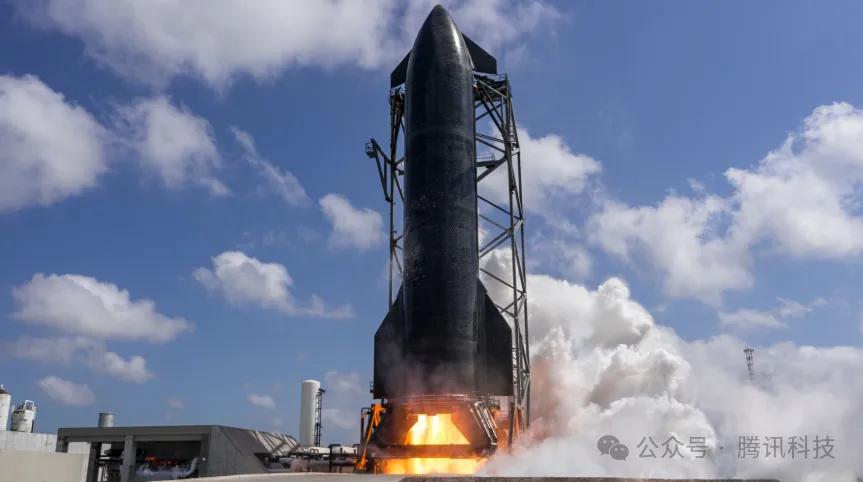 SpaceX has completely redesigned the propulsion system of Starship V3. Source: SpaceX
The avionics system has also been upgraded. The spacecraft and booster feature about 60 custom avionics units, integrating batteries, inverters, and high-voltage power distribution into a single component, giving the entire vehicle a peak power output of about 9 megawatts.
A multi-sensor navigation system enables precise autonomous flight at all mission stages. A new type of precision RF sensor is used to measure propellant level in microgravity, paving the way for in-orbit propellant transfer in the future. Fifty camera angles cover the entire ship, streaming real-time images via Starlink at 480 Mbps.
Operational in the Second Half of the Year?
Just two days before the "Twelfth Flight" launch, SpaceX filed a prospectus with the U.S. Securities and Exchange Commission as part of its IPO plan. For the first time, it disclosed the scale of its investment in Starship: the company has spent over $15 billion on Starship, including $3 billion invested in 2025 and nearly $900 million in the first quarter of 2026.
The prospectus explained the urgency of the V3 maiden flight in one sentence: "We expect Starship to begin orbital payload delivery in the second half of 2026."
SpaceX also clarified that the current Falcon 9 and Falcon Heavy cannot deploy next-generation satellites. A single Starship launch can carry 60 Starlink V3 satellites—each capable of 1 terabit per second throughput—or 50 V2 Mobile satellites, which are to be launched in 2027 to offer more comprehensive direct-to-device services.

But the prospectus also warned that any shortcomings or delays in mass production, launch cadence achievement, reusability, or follow-on capacity for Starship "would delay or limit our ability to execute our growth strategy, including the deployment of next-generation satellites, global satellite-to-mobile connectivity, and orbital AI computing, which could have a material adverse effect on our business, financial condition, results of operations, and future prospects."
The document particularly emphasized, "The massive deployment of AI computing satellites would only be economically attractive if Starship is fully reusable."
According to the prospectus, the Starship V3 can deliver up to 100 tons to orbit. Future versions will increase that to 200 tons, eventually achieving as much as 1 million tons annually. SpaceX even mentioned using Starship to mine rare materials like helium-3 on the Moon, with such materials being brought back to Earth at much lower cost, positioning the Moon as a "strategic industrial and transportation node."
SpaceX’s prospectus did the math: once Starship is running stably and reliably, the per-kilogram orbital delivery cost will drop to 1% of the historical average cost of space launches—or even lower.
A Final Push Before Trillion-Dollar Valuation
The timing of the "Twelfth Flight" coincided precisely with the most sensitive period preceding SpaceX’s IPO.
Franco Granda, a senior analyst at research firm PitchBook, commented: "SpaceX’s IPO largely depends on whether the market buys into its future story. In our view, this flight is the most crucial catalyst before its public offering."
Attention isn’t limited to investors. NASA’s lunar landing schedule is a hard constraint for Starship. According to the Artemis Moon return program, NASA has selected Starship as the crewed lunar landing system and plans to land astronauts on the Moon in 2028.
Before the launch, G. Scott Hubbard, former director of NASA Ames Research Center and physicist, stated frankly that the risks are "enormous." He explained: the government is letting corporations lead development of critical missions like the crewed lunar landing system through commercial contracts rather than direct government operation. As a result, the awarded company must now deliver results that can withstand scrutiny.
Antoine Gernier, partner and head of space business at strategic consultancy Analysys Mason, commented before launch: "If this launch goes off without a hitch, it will genuinely pave the way for broader space infrastructure and lunar contracts."
From its maiden flight in 2023 to now, Starship has completed twelve flights to reach V3. The significance of this flight is not in any single data point, but in the fact that SpaceX could completely rebuild the rocket and still fly it successfully through the entire course.
NASA’s lunar contract is ticking, the IPO valuation awaits validation, and the dream of Martian migration still needs a spacecraft that can really take off and land like an airplane.
Disclaimer: The content of this article solely reflects the author's opinion and does not represent the platform in any capacity. This article is not intended to serve as a reference for making investment decisions.
You may also like
Ripple and Stellar highlighted in $XRP global payment vision
This Bitcoin Momentum Signal Preceded Last October’s Crash — Another Downturn Incoming?

Smart money moves $431 million into ETH despite ETF outflows
MAK fluctuates by 40.2% in 24 hours: price surges from low before falling back near opening level
Trending news
MoreCrypto prices
More





