cryptoticker.io
The Chinese Yuan (CNY/USD) has surged to a fresh three-year high against the US dollar, climbing steadily toward the 0.1473 level. This sustained currency appreciation comes on the back of intense geopolitical friction and landmark structural shifts in the global energy trade—most notably, reports that Iran has accelerated the settlement of its crude oil exports using China's currency to bypass Western financial networks.
As the strategic chokepoint of the Strait of Hormuz experiences severe supply disruptions in energy history due to the ongoing regional conflict, the long-debated emergence of the "petroyuan" is rapidly turning from a theoretical concept into an active market reality, leaving clear technical marks on the foreign exchange charts.
Is the Petrodollar Dead?
The traditional petrodollar system is facing its most significant structural challenge in half a century, but it is not collapsing overnight. The displacement of the dollar in Iranian energy settlements represents a localized erosion of greenback hegemony rather than an immediate liquidation of the global reserve currency.
While the US dollar remains the dominant medium for international trade and liquid treasury markets, bilateral trade networks operating outside of the SWIFT system are expanding. Investors are closely monitoring how this monetary fragmentation will redirect global liquidity—and whether it will ultimately serve as a massive macro catalyst for decentralized digital assets.
Petrodollar Analysis: The Yuan's Bullish Run Against the Dollar
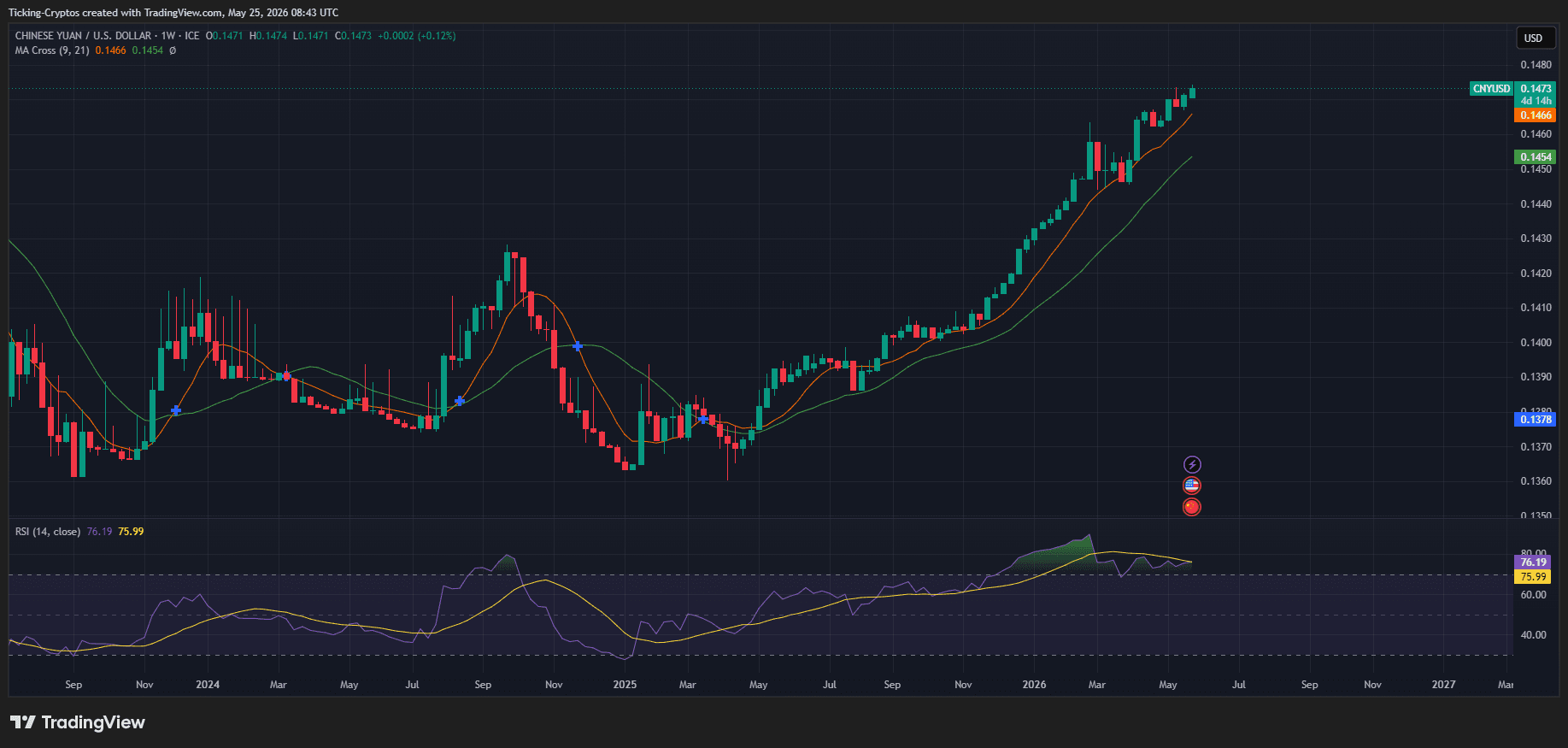
A closer look at the weekly CNY/USD chart reveals the undeniable strength of the Renminbi over the past year. Following a cyclical bottom in late 2024 near 0.1365, CNY/USD entered a powerful, well-defined ascending channel.
CNY/USD Weekly Chart Technical Highlights:
- Current Price: 0.1473 (3-Year High)
- Moving Average (MA) Cross: 9-period MA (0.1466) strongly leading above the 21-period MA (0.1454)
- RSI (14): Sitting at 76.19 (Overbought territory, indicating intense buying momentum)
The 9-week moving average has consistently acted as dynamic support throughout this rally, confirming sustained institutional capital inflows into the Chinese currency. However, with the Relative Strength Index (RSI) pushing deep into overbought territory at 76.19, a short-term consolidation phase around these multi-year highs remains highly possible before the next leg up.
Understanding the Petrodollar vs. Petroyuan
To grasp the magnitude of this market shift, it helps to understand the underlying mechanics:
- The Petrodollar System: Established in the 1970s, this arrangement dictates that global commodities—primarily crude oil—are priced and settled exclusively in US dollars ($USD$). This forces foreign nations to maintain massive dollar reserves, reinforcing the greenback's status as the global reserve currency.
- The Petroyuan: This refers to the settlement of oil and gas transactions using the Chinese Renminbi ($RMB$ or $CNY$). By pricing crude oil in yuan, energy-exporting nations can trade directly with the world’s largest manufacturing hub while entirely avoiding US banking rails and potential sanctions exposure.
US-Iran War: Iran Embraces the Yuan
According to reports covering the ongoing macroeconomic fallout of the conflict, the volume of yuan-denominated crude oil trades has picked up substantially. China’s Cross-Border Interbank Payment System (CIPS) recently recorded a single-day transaction record, reflecting a massive influx of cross-border clearing outside of the dollar's purview.
While prominent institutions like the Federal Reserve point out that the dollar still commands the vast majority of global FX transactions, analysts admit that a "golden window" for international renminbi usage is opening. High energy costs and weaponized financial infrastructure are prompting emerging market economies to diversify their capital reserves.
How Will This Affect the Crypto Market?
When fiat currencies experience institutional fragmentation, alternative monetary networks naturally attract capital. The rise of a multi-currency energy market could impact cryptocurrencies—specifically Bitcoin ($BTC)—in several distinct ways.
1. Acceleration of the Sovereign Bitcoin Narrative
If nation-states can no longer rely on a single global reserve currency to protect their purchasing power or guarantee trade execution, decentralized, politically neutral assets become highly appealing. Bitcoin operates outside the control of both Washington and Beijing. A weakening petrodollar infrastructure reinforces the thesis that Bitcoin is an immutable, cross-border settlement layer.
2. Increased Liquidity in Offshore Crypto Corridors
Interestingly, reports indicate that some shipping entities and independent merchants have begun utilizing a combination of the yuan and localized crypto channels to facilitate trade settlements. As traditional FX channels fragment, the broader digital asset space serves as a liquidity bridge for cross-border commerce.
3. A Macro Hedge Against Fiat Inflation
The ongoing energy shock has forced global central banks to reconsider their timelines for monetary easing. If a fragmented oil market leads to persistent structural inflation, traditional fiat cash will continue to lose its purchasing power. Investors tracking the Bitcoin price index often view the digital asset as a hard-capped scarcity play, akin to digital gold, capable of outpacing geopolitical inflation.
Summary of Economic Indicators
The table below illustrates the shifting metrics observed across global markets during this monetary transition:
| CNY/USD Exchange Rate | Hits 3-year high at 0.1473 | Increased trade settlement density & capital inflows into China. |
| US Dollar Index (DXY) | Facing localized technical resistance | Fragmenting demand in bilateral energy contracts. |
| RSI Momentum (CNY/USD) | Elevated at 76.19 | Parabolic demand for Renminbi liquidity over western fiat options. |
| Bitcoin ($BTC) | Acting as a non-correlated macro hedge | Growing demand for neutral, censorship-resistant value stores. |