
Weekly Outlook: Serious Divisions Between the US and Iran, Next Week’s Trouble for Gold Isn’t Nonfarm Payrolls!

U.S. stocks closed May at new historic highs, extending the rebound from March lows as confidence grows over the imminent reopening of the Strait of Hormuz.
This week’s market action somewhat foreshadows the possible market reaction after a deal is reached: As investor hopes for the Trump administration nearing a peace agreement rose, bond yields fell, oil prices retreated, and major indices generally rallied. The Nasdaq Composite has risen over 8% since the end of April.
Brent crude oil recorded the biggest monthly drop in six years, falling more than 19%. U.S. WTI crude dropped nearly 17% in May, marking its worst performance since April 2025.
Gold prices experienced another volatile week, accelerating to the downside midweek after another U.S. attack on Iran, triggering a gold sell-off; then on Thursday, gold crashed to a weekly low of $4365.85/oz as traders prepared for the April PCE inflation report and Q1 GDP revision.
Following reports of potential U.S.-Iran deal progress that helped cool oil prices and ease some of this week’s inflation concerns, gold rebounded Thursday night and extended gains Friday. Softer U.S. Treasury yields also supported the move, sending gold prices surging to a weekly high of $4594.92/oz on Friday, but momentum slowed, with spot gold closing the week at $4539.03/oz.
Heading into the new week, investors will focus on the health of the U.S. economy and labor market, as a busy slate of economic data releases could significantly impact Fed rate expectations. The latest Kitco News Weekly Gold Survey shows Wall Street has reignited optimism about gold’s short-term outlook, but despite the rebound into the weekend, general retail investor sentiment has turned bearish.
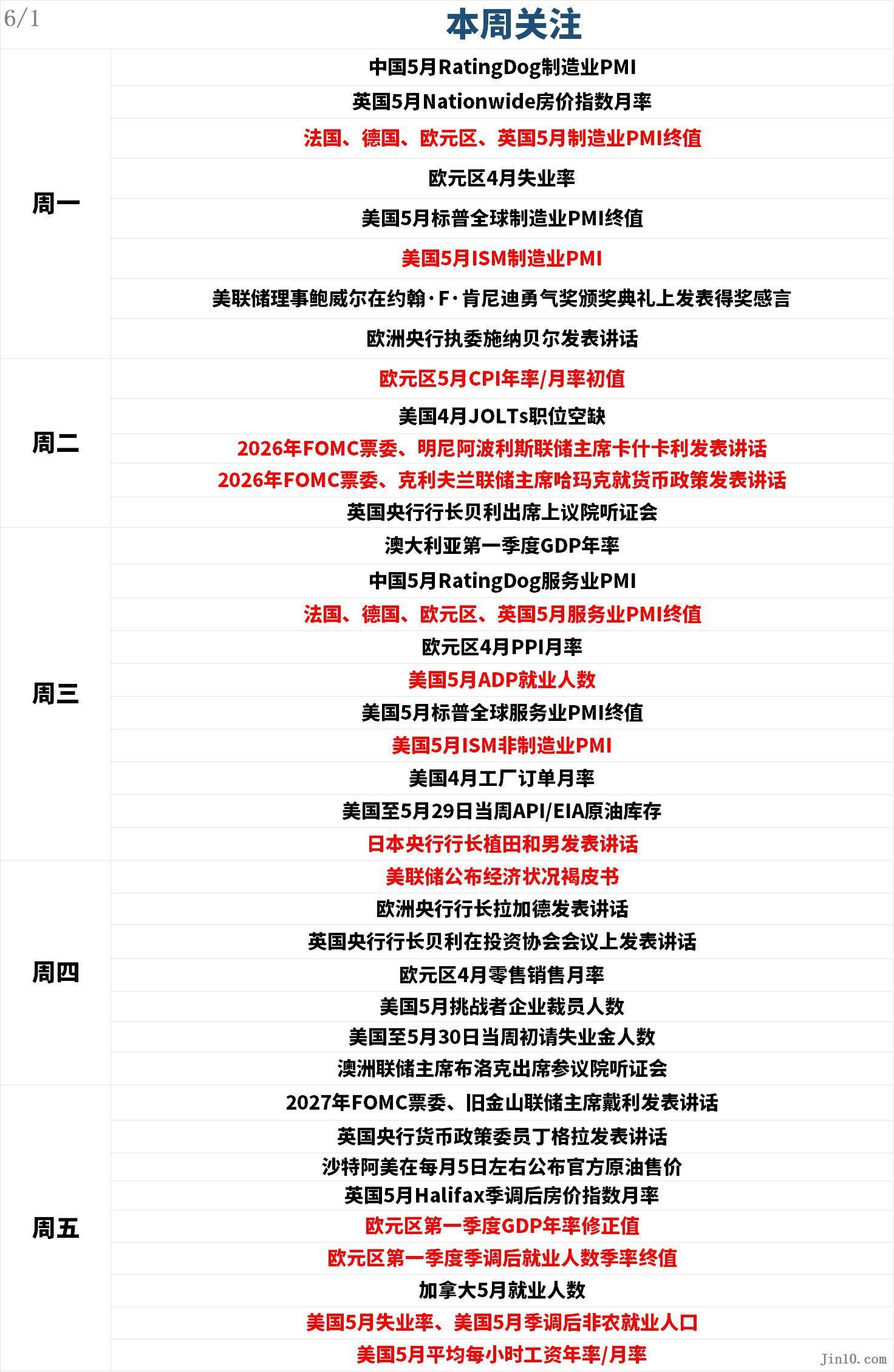
Here are the key points the market will focus on in the coming week (all times UTC+8):
Key Event: Trump Announces Imminent U.S.-Iran Deal, Market Signals Seriously Divided!
Over the weekend, a Kuwaiti airbase was hit by missiles, injuring several Americans and seriously damaging two MQ-9 Reaper drones, while U.S.-Iran ceasefire extension talks stalled without resolution.
Trump said Friday local time that he will soon decide whether to approve a proposed deal to extend the ceasefire with Iran, but Friday’s two-hour situation room meeting ended without any White House statement, marking the latest conflicting signals from Washington on the prospects of a deal with Tehran.
The proposal aims to extend the ceasefire agreement reached in early April by another 60 days, giving negotiators time to work toward a permanent end to the war. On Saturday, Iranian state television reported a new draft agreement that would give Iran “exclusive authority to determine the nature of strait transiting vessels”—a point the U.S. is unlikely to accept.
Trump said Iran must end its control of the Strait of Hormuz and dismantle its nuclear weapons capability—two conditions Tehran has yet to agree upon.
“Iran must agree that they will never have nuclear weapons or the atomic bomb. The Strait of Hormuz must be opened immediately with unrestricted, toll-free bidirectional shipping,” Trump said, adding that nuclear materials would be ‘excavated out’ by the U.S.
According to Iranian state TV, Iranian negotiator media committee member Saeed Ajorlou said Saturday that Tehran has not yet approved the final draft of the proposed deal with the U.S. and warned that Iran may withdraw if the U.S. fails to fulfill its commitments.
Ajorlou, in an interview, said to his knowledge, as of Friday night the final text has not been approved, but gaps between the sides are now small. “If the final text is approved, we enter a 60-day period of detailed negotiations,” he said, adding that every one of the 14 articles of the agreement contains appendices that require further talks. Ajorlou emphasized that the enforcement mechanism is more important than the text itself, especially with regard to Iran’s access to assets and the other party’s fulfillment of commitments.
He said the proposed agreement includes a clause allowing Iran to withdraw if the other party does not deliver. He indicated Iran could exit if there are violations, including a breach of the ceasefire, failure to provide access to funds, or failure to lift the naval blockade. He added that in the initial stage, if commitments are not implemented, Iran will reconsider participation in the proposed 60-day negotiations.
Semi-official Iranian news agency Fars quoted sources as saying Trump’s claims are “an attempt to fabricate a victory”. The Iranian senior official said the potential deal contains nothing related to nuclear issues. Meanwhile, Iran’s foreign ministry spokesman said on state TV that the management of the strait must be decided by Iran and Oman.
Fars reported that after the U.S. lifts its blockade of Iranian ships, the strait will reopen under Tehran’s conditions. U.S. Treasury Secretary Bessent said any lifting of the blockade would happen gradually, if at all.
Fars also reported the two sides have agreed to unfreeze $12 billion in Iranian assets. Trump insisted, “There will be no exchange of funds unless otherwise notified”—likely referring to Iranian demands for toll collection, war damages, or asset unfreezing.
Iran is also asking for the removal of sanctions, a U.S. military withdrawal from the region, and that any peace deal must end U.S. ally Israel’s attacks in Lebanon.
U.S. Defense Secretary Hegses said Saturday the U.S. is prepared to resume attacks on Iran if no deal is reached.
“We’re absolutely capable of doing it,” Hegses said in Singapore. “Our ammunition stockpiles are more than enough, whether locally or worldwide, so we’re in a very good position,” he added.
The Pentagon chief said Trump is “patient” and wants a “great deal” to ensure Iran cannot acquire nuclear weapons.
Iranian analysts said Iran is unlikely to be willing to hand over its 440 kilos of near-weapons-grade enriched uranium to the U.S., as that would be seen as tantamount to surrender.
Ultimately, Trump’s nuclear demands remain the main sticking point for any deal. The back-and-forth continues a pattern of both sides hinting a deal is imminent, then disagreeing over the same contentious issues.
Rhys Williams, Chief Investment Officer of Wayve Capital Management, said: “From a global economic perspective, the most important thing is opening the Strait of Hormuz. As for the nuclear issue, we can set it aside for now. I think that’s the deal that could be reached.”
Marc Chandler, Managing Director of Bannockburn Global Forex, said that extending the ceasefire is seen as positive for gold, and a break above the $4585 area would boost the technical backdrop.
Adam Button, Chief Currency Analyst at Forexlive.com, told Kitco News that the world’s most-watched commodities are sending conflicting signals. “Oil prices are reflecting expectations for the end of war—gold, not so much,” he said. “I think we just need to wait for the war to end. That simple.”
Button said gold has been under pressure lately because the market’s excitement over artificial intelligence is soaking up all liquidity. “When that boom stops, gold will start absorbing some liquidity again, and then the cycle repeats.”
Button said that since the outbreak of the Iran war, gold has repeatedly shown solid bottoms, with traders simply waiting for the arrival of peace for gold to resume its uptrend. Button believes it’s close at hand.
“At the risk of sounding foolish, I think the war is ending, and that’s a catalyst for gold,” he said. “Even if I’m duped ten times, I still think this time it’s here. Still, there’s no need to rush into gold until you’re sure there’s truly peace. Wait for peace; when it happens, buy gold.”
“I’m still very bullish on gold,” he said. “Previously there was some worry that central banks needed liquidity and would sell gold—Turkey was one example—then last week reports said Russia sold some gold. I think gold and silver may stay rangebound or even dip in the short-term. But the fact that they’re so well-supported is bullish; they dropped to certain levels but still held above them.”
Central Bank Dynamics: Hawkish Voices Emerge, Fed Hawks Take Flight!
Federal Reserve:
Monday 08:30 (UTC+8): Fed Governor Powell delivers acceptance speech at the John F. Kennedy Profile in Courage Award Ceremony
Tuesday 13:50 (UTC+8): 2026 FOMC Voter, Minneapolis Fed President Kashkari speaks
Tuesday 20:30 (UTC+8): 2026 FOMC Voter, Cleveland Fed President Harker speaks on monetary policy
Thursday 02:00 (UTC+8): Fed releases Beige Book on economic conditions
Friday 01:10 (UTC+8): 2027 FOMC Voter, San Francisco Fed President Daly speaks
Other Central Banks:
Monday 08:30 (UTC+8): ECB Executive Board Member Schnabel speaksTuesday 22:00 (UTC+8): Bank of England Governor Bailey attends House of Lords hearing; 23:00 (UTC+8): Monetary Policy Committee member Greene speaksWednesday 16:30 (UTC+8): Bank of Japan Governor Kazuo Ueda speaksWednesday 17:50 (UTC+8): ECB Executive Board Member Elderson speaks; 21:30 (UTC+8): Board Member Cipollone speaksThursday 16:00 (UTC+8): ECB President Lagarde speaksThursday 23:40 (UTC+8): Bank of England Governor Bailey speaks at Investment Association conferenceFriday 12:25 (UTC+8): Reserve Bank of Australia Deputy Governor Hauser speaksFriday 21:40 (UTC+8): Bank of England MPC member Dingra speaks
StoneX’s Haberkorn said, the key date to watch for gold and the whole market is June 17th.
“I want to see what messages are sent at the first Fed meeting under [Chair] Walsh’s leadership, and what tone he’ll take,” he said. “Will they be dovish or hawkish on interest rates? Historically, in our current environment, to fight inflation, rates should be going up. But we simply can’t do that now, because paying back debt is the largest line item in the budget. Rate hikes would put great pressure on everything, and while they might help in the short run against inflation, I think in the long term, they could do more harm.”
“I want to know if Walsh will sidestep the issue and hint at it,” he said. “I don’t think he’ll spell it out. He’s Trump’s pick, and last week, Trump in a speech said rates should be much lower than now. Walsh is a voting member, but given the debt situation, they’ll be reluctant to hike, so maybe they use some kind of quantitative easing to buy time.”
“By the 17th we’ll have more information to understand his stance and the new chairman’s direction for the Fed.”
Haberkorn said it’s extremely difficult to trade confidently in a market so driven by news headlines. “One headline after another contradicts the last. One minute it says a deal is done. Thirty minutes later, it says nothing has been signed. An hour later, you get the opposite news.”
Haberkorn hopes the Fed will clarify things for the market and also that the Iran situation will be resolved before the Fed meeting.
“It feels like we might be close to a deal. Hopefully, they can really get it done, so metals traders can put this behind them and focus on the Fed’s next move.”
“The Fed will set the tone for gold in the second half of the year. The most crucial thing in precious metals trading right now is patience,” Haberkorn added. “Stay patient until the Fed provides clearer guidance. I’m patiently optimistic that moving into the second half, we’ll see metals prices rise.”
Key Data: U.S. Economic Data “All Out”—But Gold’s Real Risk Lies Elsewhere
Monday 15:55-16:30 (UTC+8): U.K., France, Germany, Eurozone May Manufacturing PMI Final
Monday 22:00 (UTC+8): U.S. May ISM Manufacturing PMI
Tuesday 17:00 (UTC+8): Eurozone May CPI YoY/MoM prelim
Tuesday 22:00 (UTC+8): U.S. April JOLTs Job Openings
Wednesday 15:55-16:30 (UTC+8): U.K., France, Germany, Eurozone May Services PMI Final; 17:00 (UTC+8): Eurozone April PPI MoM
Wednesday 20:15 (UTC+8): U.S. May ADP Employment Change; 22:00 (UTC+8): U.S. May ISM Non-Manufacturing PMI
Thursday 17:00 (UTC+8): Eurozone April Retail Sales MoM
Thursday 19:30 (UTC+8): U.S. May Challenger Job Cuts; 20:30 (UTC+8): U.S. Initial Jobless Claims for week through May 30
Friday 17:00 (UTC+8): Eurozone Q1 GDP YoY Final, Q1 seasonally adjusted employment QoQ final
Friday 20:30 (UTC+8): U.S. May Unemployment Rate, May Nonfarm Payrolls SA, May Average Hourly Earnings YoY/MoM
Monday will see the release of the U.S. ISM Manufacturing PMI, where analysts are looking for signs of economic activity stabilizing or slipping further into contraction.
On Tuesday, attention will turn to the JOLTs Job Openings report, one of the Fed’s preferred indicators for labor market tightness.
Wednesday brings the “mini-NFP” ADP employment report, offering an early look at private sector hiring before the official nonfarm payrolls data Friday, followed by the ISM Services PMI.
Weekly initial jobless claims are out Thursday. The data remain near historic lows, so many economists continue to describe the labor market as resilient.
The highlight next week is Friday’s nonfarm payrolls report. This report provides the most comprehensive look at hiring, unemployment, and wage growth—all key Fed inputs. According to FactSet, economists project about 100,000 new U.S. jobs in May, down from 115,000 in April. The unemployment rate is expected to hold at 4.3%.
Unless there’s a major surprise in nonfarm payrolls, the market will likely absorb the data calmly, with investors adapting to an environment of “low hiring, low firing.” But EY-Parthenon Chief Economist Gregory Daco expects wage growth could come under pressure, dampening future consumer spending.
The trend in consumer spending will again largely depend on the duration of the Iran war and the movements in oil and gasoline prices. April’s Personal Consumption Expenditures Price Index showed Americans’ savings rates have dipped, suggesting less cushion to absorb future shocks.
FXTM Senior Market Analyst Lukman Otunuga said a soft nonfarm jobs report could add upside momentum to gold prices, especially if it further dulls the outlook for U.S. rate hikes in 2026.
On the technical front, Otunuga noted that gold’s daily chart is moving up after rebounding from $4450. “A break above the 21-day moving average could open the door to the 50-day MA at $4625,” he said. “A drop below $4450 could see gold test the 200-day MA at $4400.”
FxPro Senior Market Analyst Alex Kuptsikevich expects gold prices to fall next week.
“The key difference in the current rebound above $4400–$4500 compared to March is that gold is not as oversold and market conditions appear more balanced,” Kuptsikevich points out. “A break below here could clear the way to the $4000–$4100 range. If selling intensifies, losses could extend to $3400.”
“While it’s hard to believe this rebound is sustainable, we have to acknowledge that the market may consolidate around current levels, gathering strength after the downward momentum—that could take a few days to a week,” he added. “A more optimistic, though less likely, scenario is a bullish breakout above the 50-day MA at $4630, which would end the recent months’ downtrend and restore a long-term positive bias.”
CPM Group analysts issued a sell recommendation Thursday afternoon, initial target $4375 (timeframe May 29 to June 12), with a stop at $4610.
“Gold tested $4400 on Thursday, touched $4395.60, then bounced to $4545,” they wrote. “Gold and other major precious metals have been in a short-term downtrend, testing short-term support. A break below $4400 could trigger another round of selling, pushing gold to $4100, a level some technical analysts are discussing.”
“The June Comex contract has mostly rolled to August, with open interest for June at just about 6.1 million ounces. That too has released some upside pressure, opening the door to further declines.”
“Enthusiasm among some investors has cooled. The economic picture no longer seems as severe as a few months ago,” they added. “Even though U.S. and international political risks remain, it seems we’re in a temporary lull. These softer external trends have prompted some profit-taking and lower buying pressure, at least in the short term.”
“Any one of these factors could deteriorate quickly, rekindling investor demand for gold and sending prices higher,” CPM warns, “but for now, gold appears to be consolidating.”
Earnings: AI Rally Broadens, June “Jinx” Countdown
With Q1 earnings season wrapping up, Meituan (03690.HK), chip giant Broadcom (AVGO.O), and Tiger Brokers (TIGR.O) will report next week.

CNBC analysis suggests that if bond yields keep retreating from highs and oil prices pull back, aside from war-related issues, there’s little else to prompt stock investors to pause.
Artificial intelligence remains the market’s key driver. In Q1, earnings soared in nearly every sector, not just among the so-called “Magnificent Seven” tech names. According to FactSet, the S&P 500 is on track for over 28% aggregate earnings growth in Q1—the fastest pace since Q4 2021. The information technology sector alone is expected to post over 54% aggregate growth.
This week, Snowflake’s earnings reinforced investor faith that bets on AI remain worthwhile. The cloud-based data platform’s guidance for adjusted profit margin in the second quarter exceeded expectations, alleviating worries about AI supplanting traditional software companies and boosting other software stocks. This broadened this week’s AI rally beyond semiconductors.
Next week brings more software company reports, including CrowdStrike Holdings and Palo Alto Networks.
“There’s certainly optimism around the AI market,” said Ohsung Kwon, Chief Stock Strategist at Wells Fargo. “This rally is truly earnings-driven.”
From a seasonal perspective, the U.S. stock market faces another challenge: June is typically the worst month for equities in a midterm election year, and investors expect a period of short-term consolidation ahead.
“What you really have to bet on is that the Iran issue is slowly but surely heading toward resolution and that it’ll happen in the next two to three weeks,” said Williams of Wayve Capital. “I can’t imagine we’ll be talking about a closed Strait of Hormuz in October, and the market not reacting.”
Bank of America remains bullish for June on stocks like Apple (AAPL) and Nvidia (NVDA).
Market Holiday Reminder:
Monday (June 1): King’s Birthday in the U.K., New Zealand Stock Exchange closed for the day.
Disclaimer: The content of this article solely reflects the author's opinion and does not represent the platform in any capacity. This article is not intended to serve as a reference for making investment decisions.
You may also like
Shiba Inu Price Analysis: What Would It Take for SHIB to Reach $0.0001?

XDC rebounds from a key support – Will THIS help price reach $0.037?

The US debt machine is getting harder to stabilize – So where does Bitcoin fit in?

Hyperliquid briefly flips Dogecoin, joins the top 10 crypto list after $67.5 ATH

Trending news
MoreCrypto prices
More





